
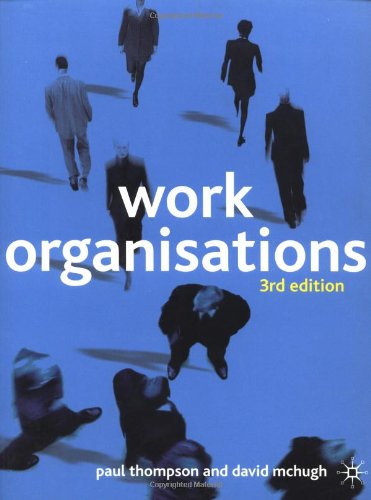
Work Organisations Critical introduction 3rd Edition by Paul TThompson, David McHugh ISBN 9780333980958 140390765X

Original price was: $50.00.$35.00Current price is: $35.00.
Work Organisations Critical introduction 3rd Edition by Paul B. TThompson, David McHugh- Ebook PDF Instant Download/Delivery: 9780333980958, 140390765X
Full download Work Organisations Critical introduction 3rd Edition after payment
Product details:
ISBN 10: 140390765X
ISBN 13: 9780333980958
Author: Paul B. TThompson, David McHugh
Carly often finds herself gazing through the gates of Paradise End. She fantasizes about dicovering that she was swapped at birth, and is in fact the rightful owner of the beautiful, empty mansion. But then she meets Tia, the daughter of the new tenant, whose life has some cruel secrets.
Table of contents:
Part 1
1 Studying organisations: an introduction
Organisations and organisation society
Defining the scope and purpose of organisations
Organisational analysis: problems and problematics
Goals, diversity and interests
Rationality, efficiency and choice
Hierarchy and the division of labour
Management and managerialism
A science of organisations?
A concluding comment
An alternative and critical agenda
Reflexivity
The embeddedness of organisations
Multi-dimensionality
Structure, contradiction and agency
Social transformation and change
Conclusion
2 The emergence of large-scale organisations
Organising the new work forms
The rise of the factory system
Modes of control in the transition to bureaucratic organisation
Decay and decline of traditional controls
Conclusion
3 Taylor, Weber and the bureaucratisation of the workplace
Taylorism and systematic management
Principles
Ideology and practice
Weber and administrative theories of management
The rise of bureaucratic control and its contradictions
Scientific management and bureaucratic work rules:modern legacies
Conclusion
4 Managing the human factor
Social science and industry: a courtship
Hawthorne and beyond Consolidating human relations
Legacies and continuities from human relations to human resource management
Conclusion
5 Organisations and environments
Closed systems?
Adaptation to the environment: open system approaches
Contingency theory
Selection theories: the population ecology approach
Critique and alternatives
Enacted environments?
Conclusion
6 Capital, labour and the state in a globalising era
Comparative analysis: beyond the American model
The rise of cultural explanations
Institutional theories
Globalisation
Understanding the comparative influences on work organisation The state still matters
Conclusion
7 Management
Classical management theory
The nature of management
Management practices: a new realism?
Bringing the threads together: management as a labour process Armstrong and inter-professional competition
Conclusion
8 Control:concepts and strategies
Mainstream mis/understandings
Radical perspectives: labour process theories of control
Management strategies
Questioning strategy
Questioning control over labour
New directions? Surveillance and shifting the locus of control
Conclusion
9 Power, conflict and resistance
Power in mainstream theory
Mainstream models
A critical evaluation: three-dimensional analyses
Foucault, post-structuralism and disciplinary power
Applications to organisations
Critique
Conclusion
10 Gender, sexuality and organisations
Policy parameters and intellectual frameworks
Gendering organisational analysis
Kanter and organisational context
Theorising difference
Culture, careers and networks: embedding gender
Enter sexuality
Contrasting perspectives on sex, power and organisations
Evaluation:under and overpowered explanations
From equal opportunity to managing diversity?
Conclusion
11 New Economy, new organisations?
Introduction: paradigm shift or shifting paradigms?
Firms, markets and hierarchies in the knowledge economy
Post-bureaucratic organisation: restructuring the corporation
Flexibility, work and employment
Japanese production regimes
The flexible firm model
Home and teleworking
Knowledge work and portfolio people
High performance and work systems:restructuring the division of labour
Conclusion
12 Continuity and change at work
Hierarchies, networks and knowledge revisited
Knowledge in the economy
Corporate structures: organised capitalism
A new flexible firm?
Changing employment relations and the new insecurity
Participation, control and commitment in the labour process
Autonomy, control and surveillance
Skills, tasks and rules
The effort bargain and work intensification
Conclusion
13 Corporations and culture: reinventing organisation man?
Product and perspective: the corporate culture merchants
HRM and the management of culture
Critics and questions
Questioning the novelty
Questioning the evidence
Questioning the concepts
Culture:commitment or control?
The limits to cultural influence
Conclusion
Part II
14 Understanding organisational behaviour: issues and agendas
Technologies of regulation?
Topics and texts: subjects and subjectivities
Defining the ‘subjective factor’
Conclusion
15 Masks for tasks: perception, attitudes and personality
Perception: learning what to see
Perceptual processing
Perceptual categorisation
Attribution theory
The attitude problem Defining attitudes
Attitudes and behaviour
Attitude change
Personality: masks for tasks
Types, traits and tests
Personality and selection
Conclusion
16 Learning, change and innovation
Learning and socialisation: seeing what to do
Socialisation
Roles
Skills and styles
Learning and development
Learning organisations
Organisational learning versus learning organisations
Changing the people?
Models and processes
Change and stability
Innovation: necessity or luxury?
Defining innovation
Diffusing innovation: change agents and agencies
Climate and culture
Sustaining innovation
Creativity
Social and organisational creativity
Conclusion: creativity, learning and sustaining innovation
17 Open to persuasion: communication and leadership
The power to communicate
Interpersonal influence
Leadership, might or myth?
Traits and characteristics
Styles and roles
Contingent leadership
Transforming leadership
Charisma?
Networking
Attributing leadership
Conclusion
18 Putting the pressure on: stress, work and emotion
Stress: the force to adapt
Role stress
Stress management
Stress counselling
Employee assistance programmes
Contesting stress
Emotional labour
Emotion management
Stress and control
Role socialisation and control
Stress in the labour process
Conclusion
19 Motivation: the drive for satisfaction
Motivation or motivating?
Enriching the content
Content theories
The drive for satisfaction
The ‘kick in the ass’ life cycle
Process theories
The goals of motivation
Goal-setting
Goals versus identity projects
Motivation as an artefact
Control theories
Self-concept theory
Control, self-concepts and identity
Mobilising commitment
Internalisation of commitment
Institutional commitment?
Conclusion
20 From groups to teams
The authority of the group
Group formation and composition
Group socialisation
Group cohesiveness and polarisation
Group responses to pressures on identity
Group resistance and conflict
Teamworking
Re-engaging the worker
Team dimensions
Groups versus teams
Conclusion
21 Identity work
Explanations of identity
Redefining the agenda
Gender and ethnic identities
Domination and security
Organisations and identities
Identity work and situational power
Responses to pressures on identity
Impression management and scripting
Identity work and ‘making out’
Identity working: strategies for organisational survival
Identity, ideology and technologies of regulation Managerial labour and identity work
Managerial misbehaviour
Conclusion
Part III
Theorising organisations
Introduction: the story so far
22 Resources for orthodoxy
Weber, bureaucracy and rationality Durkheim, human relations and social needs Systems theory
23 Critical alternatives
Social action theory
Radical structuralism
Marx and labour process theory
Radical Weberianism
The postmodern challenge to rationality
A masculine logic?
24 Critical social psychologies
Internal critique
Marxist psychology?
From critical theory to postmodernism
25 Theory, knowledge and practice
Paradigm diversity or closure?
Management and theory
Beyond criticism?
People also search for:
experience working with cross functional teams
z-critical
critical 0
2 working conditions
3 work-related strengths
Tags: Paul TThompson, David McHugh, Work Organisations, Critical introduction