
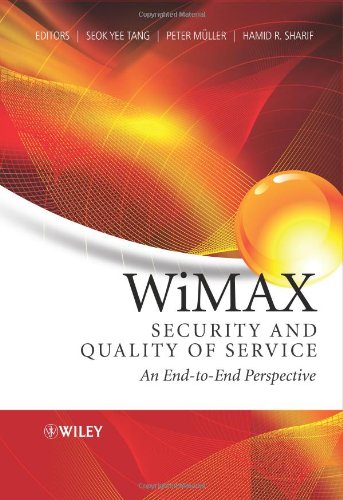
WiMAX Security and Quality of Service An End to End Perspective 1st Edition by Seok Yee Tang, Peter Muller, Hamid Sharif ISBN 978-0470721971 0470721979

Original price was: $50.00.$35.00Current price is: $35.00.
WiMAX Security and Quality of Service An End to End Perspective 1st Edition by Seok-Yee Tang, Peter Muller, Hamid Sharif – Ebook PDF Instant Download/Delivery: 978-0470721971, 0470721979
Full download WiMAX Security and Quality of Service An End to End Perspective 1st Edition after payment
Product details:
ISBN 10: 0470721979
ISBN 13: 978-0470721971
Author: Seok-Yee Tang, Peter Muller, Hamid Sharif
WiMAX is the first standard technology to deliver true broadband mobility at speeds that enable powerful multimedia applications such as Voice over Internet Protocol (VoIP), online gaming, mobile TV, and personalized infotainment. WiMAX Security and Quality of Service, focuses on the interdisciplinary subject of advanced Security and Quality of Service (QoS) in WiMAX wireless telecommunication systems including its models, standards, implementations, and applications. Split into 4 parts, Part A of the book is an end-to-end overview of the WiMAX architecture, protocol, and system requirements. Security is an essential element in the wireless world and Part B is fully dedicated to this topic. Part C provides an in depth analysis of QoS, including mobility management in WiMAX. Finally, Part D introduces the reader to advanced and future topics.
One of the first texts to cover security, QoS and deployments of WiMAX in the same book.
Introduces the primary concepts of the interdisciplinary nature of WiMAX security and QoS, and also includes discussion of hot topics in the field.
Written for engineers and researchers, answering practical questions from industry and the experimental field in academia.
Explains how WiMAX applications’ security and QoS are interconnected and interworked among the cross layers.
Table of contents:
Part A Introduction
1 Overview of End-to-End WiMAX Network Architecture
Dr Mohuya Chakraborty and Dr Debika Bhattacharyya
1.1 Introduction
1.2 Wireless Primer
1.2.1 Wireless Network Topologies
1.2.2 Wireless Technologies
1.2.3 Performance Parameters of Wireless Networks
1.2.4 WiFi and WiMAX
1.3 Introduction to WiMAX Technology
1.3.1 Operational Principles
1.3.2 WiMAX Speed and Range
1.3.3 Spectrum
1.3.4 Limitations
1.3.5 Need for WiMAX
1.4 Mobile WiMAX
1.4.1 Overview of Mobile WiMAX
1.4.2 Handover Process in Mobile WiMAX
1.4.3 LTE vs. Mobile WiMAX
1.5 Overview of End-to-End WiMAX Network Architecture
1.6 Radio Interface Specifications for WiMAX
1.6.1 Overview
1.6.2 802.16e-2005 Technology
1.6.3 Applications
1.6.4 WiMAX Simulation Tools
1.7 Interoperability Issues in WiMAX
1.8 Summary
References
Part B Security
2 WiMAX Security Defined in 802.16 Standards
Slim Rekhis and Noureddine Boudriga
2.1 Introduction
2.2 Overview of 802.16 WMAN Networks
2.2.1 IEEE 802.16 Standards and Connectivity Modes
2.2.2 Network Architecture
2.2.3 Protocol Architecture
2.2.4 Network Entry Procedure
2.3 Security Requirements for Broadband Access in WMAN Networks
2.4 Security Mechanisms in Initial 802.16 Networks
2.4.1 Security Associations
2.4.2 Use of Certificates
2.4.3 PKM Protocol
2.4.4 PKM Authorization
2.4.5 Privacy and Key Management
2.4.6 Data Encryption
2.5 Analysis of Security Weaknesses in Initial Versions of 802.16
2.5.1 Physical-Level Based Attacks
2.5.2 Attacks on Authentication
2.5.3 Attacks on Key Management
2.5.4 Attacks on Privacy
2.5.5 Attacks on Availability
2.6 Security Amendments in Recent Versions if IEEE 802.16
2.6.1 Authorization, Mutual Authentication and Access Control
2.6.2 TEK Three-Way Handshake
2.6.3 Encryption and Key Hierarchy
2.6.4 Multicast and Broadcast Service (MBS)
2.6.5 Security of Handover Schemes
2.7 Analysis of Security Weaknesses in 802.16e
2.7.1 Attacks on Authorization
2.7.2 Analysis of SA-TEK Three-Way Handshake
2.7.3 Vulnerability to Denial of Service Attacks
2.7.4 Broadcasting and Multicasting Related Weaknesses
2.7.5 Weaknesses in Handover Schemes
2.8 Further Reading
2.9 Summary
References
3 Key Management in 802.16e
Georgios Kambourakis and Stefanos Gritzalis
3.1 Introduction
3.2 Privacy Key Management Protocol
3.3 PKM Version 1
3.4 PKM Version 2
3.4.1 Security Negotiation
3.4.2 Authentication/Authorization
3.4.3 Key Derivation and Hierarchy
3.4.4 Three-Way Handshake
3.4.5 Key Delivery
3.5 Vulnerabilities and Countermeasures
3.5.1 Authorization
3.5.2 Key Derivation
3.5.3 Three-Way Handshake
3.5.4 Key Delivery
3.5.5 Attacks on Confidentiality
3.5.6 MBS Attacks
3.5.7 Mesh Mode Considerations
3.5.8 Handovers
3.6 Comparisons with 802.11/UMTS
3.7 Summary
References
4 WiMAX Network Security
Luca Adamo, Romano Fantacci and Leonardo Maccari
4.1 Introduction
4.2 WiMAX Network Reference Model
4.2.1 Functional Entities
4.2.2 Logical Domains
4.2.3 Reference Points
4.2.4 ASN Profiles
4.3 The RADIUS Server
4.3.1 Authentication in WiMAX Infrastructure
4.4 WiMAX Networking Procedures and Security
4.4.1 Handover Procedure
4.4.2 DHCP
4.4.3 Security Issues
4.4.4 Mobile IP Protocol
4.4.5 PMIP
4.4.6 PMIP Security Considerations
4.4.7 CMIP
4.4.8 CMIP Security Considerations
4.4.9 QoS
4.4.10 A Complete Authentication Procedure
4.5 Further Reading
4.6 Summary
References
Part C Quality of Service
5 Cross-Layer End-to-End QoS Architecture: The Milestone of WiMAX
Floriano De Rango, Andrea Malfitano and Salvatore Marano
5.1 Introduction
5.2 QoS Definitions
5.3 QoS Mechanisms Offered by IEEE 802.16
5.3.1 Cross-Layer QoS Architecture
5.3.2 MAC Layer Point of View
5.3.3 Offering QoS in PMP Mode
5.3.4 QoS Introduction in Mesh Mode
5.3.5 QoS Application on Packet by Packet Basis
5.3.6 PHY Layer Point of View
5.3.7 ACM: Adaptive Coding and Modulation
5.3.8 Mobility Support in IEEE 802.16
5.4 What is Missing in the WiMAX Features?
5.4.1 Absences in the MAC Layer
5.4.2 Scheduling Algorithm
5.4.3 Call Admission Control Algorithm
5.4.4 PHY Layer Improvements
5.4.5 QoS Based ACM Algorithm
5.5 Future Challenges
5.5.1 End-to-End QoS in the IP World
5.5.2 New Ways to Resolve the WiMAX QoS Problem: Two Interesting Examples
5.5.3 Game Theory in the WiMAX Scenario
5.5.4 Fuzzy Logic: What Idea to Guarantee QoS?
5.5.5 Designing Mobility – Mesh WiMAX
5.5.6 How to Extend QoS Mechanisms
5.6 Summary
References
6 QoS in Mobile WiMAX
Neila Krichene and Noureddine Boudriga
6.1 Introduction
6.2 Architectural QoS Requirements
6.2.1 QoS-Related Challenges
6.2.2 Architectural Requirements
6.3 Mobile WiMAX Service Flows
6.3.1 Service Flows
6.3.2 Scheduling Services Supporting Service Flows
6.3.3 QoS Parameters
6.4 Admission Control
6.4.1 MAC Layer Connections
6.4.2 Bandwidth Request Procedures
6.4.3 Bandwidth Allocation Procedures
6.5 Scheduling Service
6.5.1 Scheduling Architecture in Mobile WiMAX
6.5.2 Packet Schedulers Overview
6.6 Maintaining QoS During Handover
6.6.1 WiMAX Handover Schemes
6.6.2 Optimizing Handover to Maintain the Required QoS
6.7 Enhancing WiMAX QoS Issues: Research Work
6.7.1 New QoS Mechanisms
6.7.2 The WEIRD Project
6.7.3 WiFi and WiMAX QoS Integration
6.8 Further Reading
6.9 Summary
References
7 Mobility Management in WiMAX Networks
Ikbal Chammakhi Msadaa, Daniel Cˆamara and Fethi Filali
7.1 Mobile WiMAX Architecture
7.2 Horizontal Handover in 802.16e
7.2.1 Network Topology Acquisition
7.2.2 Handover Process
7.2.3 Fast BS Switching (FBSS) and Macro Diversity Handover (MDHO)
Discussion
7.3 Optimized 802.16e Handover Schemes
7.3.1 L2 Handover Schemes
7.3.2 L2-L3 Cross-Layer Handover Schemes
7.3.3 Mobile IPv6 Fast Handovers Over IEEE 802.16e Networks
Discussion
7.4 Vertical Handover
7.4.1 Vertical Handover Mechanisms Involving 802.16e Networks
7.4.2 IEEE 802.21, Media-Independent Handover Services
Discussion
7.5 Roaming
7.5.1 WiMAX Roaming Interface
7.5.2 The Roaming Process
7.6 Mobility Management in WiMESH Networks
7.7 Conclusion
7.8 Summary
References
Part D Advanced Topics
8 QoS Challenges in the Handover Process
Marina Aguado, Eduardo Jacob, Marion Berbineau and Ivan Lledo Samper
8.1 Introduction
8.2 Handover in WiMAX
8.3 The IEEE802.16 Handover Process
8.3.1 The Network Entry Procedure
8.3.2 Network Topology Advertising and Acquisition
8.3.3 The Association Procedure
8.3.4 Handover Stages in the IEEE 802.16 Standard
8.3.5 Handover Execution Methods
8.4 The Media Independent Handover Initiative – IEEE 802.21
8.4.1 MIH Interactions with Layer 2 and Layer 3 Protocols
8.4.2 MIH Scope and Limitations
8.5 Enhancing the Handover Process
8.5.1 Fast Ranging Mechanism
8.5.2 Seamless Handover Mechanism
8.5.3 Initiatives in the Cell Reselection Stage
8.5.4 Initiatives in the Execution Stage
8.6 Handover Scheduling
8.7 Handover Performance Analysis
8.8 Summary
References
9 Resource Allocation in Mobile WiMAX Networks
Tara Ali Yahiya
9.1 Introduction
9.2 Background on IEEE 802.16e
9.2.1 The Medium Access Control Layer – MAC
9.2.2 The Physical Layer – PHY
9.3 System Model
9.4 OFDMA Key Principles–Analysis and Performance Characterizations
9.4.1 Multiuser Diversity
9.4.2 Adaptive Modulation and Coding – Burst Profiles
9.4.3 Capacity Analysis – Time and Frequency Domain
9.4.4 Mapping Messages
9.5 Cross-Layer Resource Allocation in Mobile WiMAX
9.6 Channel Aware Class Based Queue (CACBQ) – The Proposed Solution
9.6.1 System Model
9.6.2 Channel Aware Class Based Queue (CACBQ) Framework
9.7 Summary and Conclusion
References
10 QoS Issues and Challenges in WiMAX and WiMAX MMR Networks
Kiran Kumari, Srinath Narasimha and Krishna M. Sivalingam
10.1 Introduction
10.1.1 Motivation
10.2 Multimedia Traffic
10.2.1 Voice Codecs
10.2.2 Video Codecs
10.2.3 QoS Specifications
10.2.4 QoS Effectiveness Measures
10.3 Multimedia: WiFi versus WiMAX
10.3.1 Limitations of Wireless LAN Technologies
10.3.2 WiMAX MAC Layer
10.3.3 QoS Architecture for WiMAX
10.4 QoS Scheduling in WiMAX Networks
10.4.1 Max-Min Weighted Fair Allocation
10.4.2 Deficit Fair Priority Queue
10.4.3 Weighted Fair Queuing
10.4.4 Weighted Fair Priority Queuing
10.5 Voice Traffic Scheduling in WiMAX
10.5.1 Lee’s Algorithm
10.5.2 UGS with Activity Detection Scheduling (UGS-AD)
10.5.3 Extended-rtPS Scheduling
10.5.4 Multi-Tap Scheduling
10.6 Video Traffic Scheduling in WiMAX
10.6.1 Opportunistic Scheduling
10.6.2 Opportunistic DRR
10.6.3 Summary
10.7 Introduction to WiMAX MMR Networks
10.7.1 How WiMAX MMR Networks Work
10.7.2 Performance Impact
10.7.3 Radio Resource Management Strategies
10.8 Scheduling in WiMAX MMR Networks
10.8.1 Objectives of Scheduling
10.8.2 Constraints on Scheduling
10.9 Basic Wireless Scheduling Algorithms
10.9.1 Round Robin Scheduling
10.9.2 Max-SINR Scheduling
10.9.3 Extension for Multi-Hop Case
10.9.4 Proportional Fair Scheduling
10.9.5 Extension for Multi-Hop Case
10.9.6 Performance Comparison
10.9.7 The PFMR Scheduling Algorithm
10.10 Scheduling Algorithms for WiMAX MMR Networks
10.10.1 The Scheduling Problem
10.10.2 The GenArgMax Scheduling Algorithm
10.10.3 The TreeTraversingScheduler Algorithm
10.10.4 The FastHeuristic16j Scheduling Algorithm
10.10.5 Improved Hop-Specific Scheduling Algorithms
10.10.6 Performance Evaluation
10.11 Further Reading
10.12 Summary
References
11 On the Integration of WiFi and WiMAX Networks
Tara Ali Yahiya and Hakima Chaouchi
11.1 Introduction
11.2 General Design Principles of the Interworking Architecture
11.2.1 Functional Decomposition
11.2.2 Deployment Modularity and Flexibility
11.2.3 Support for Variety of Usage Models
11.2.4 Extensive use of IETF Protocols
11.3 WiFi/Mobile WiMAX Interworking Architecture
11.4 Network Discovery and Selection
11.5 Authentication and Security Architecture
11.5.1 General Network Access Control Architecture
11.5.2 EAP and PANA
11.5.3 RADIUS and Diameter
11.6 Security in WiFi and WiMAX Networks
11.6.1 Security in WiFi
11.6.2 Security in WiMAX
11.6.3 Security Consideration in WiFi-WiMAX
11.6.4 WiFi-WiMAX Interworking Scenarios
11.7 Mobility Management
11.7.1 Handover Support
11.7.2 Cell Selection
11.7.3 IP for Mobility Management
11.7.4 Session Initiation Protocol for Mobility Management
11.7.5 Identity Based Mobility
11.8 Quality of Service Architecture
11.8.1 End-to-End QoS Interworking Framework
11.8.2 QoS Considerations
11.9 Summary
References
12 QoS Simulation and An Enhanced Solution of Cell Selection for WiMAX Network
Xinbing Wang, Shen Gu, Yuan Wu and Jiajing Wang
12.1 Introduction
12.2 WiMAX Simulation Tools – Overview
12.2.1 NS2
12.2.2 OPNet Modeler
12.2.3 QualNet
12.3 QoS Simulation of WiMAX Network
12.3.1 Performance Comparison Between Different Services
12.3.2 Mobility Support
12.4 Analysis of QoS Simulation Results
People also search for:
wimax definition
wimax examples
wimax signal
a wimax access point has a range
wimax bwa is another term for wimax 4g mobile wireless
Tags: Seok Yee Tang, Peter Muller, Hamid Sharif, WiMAX Security, Quality of Service, End Perspective