
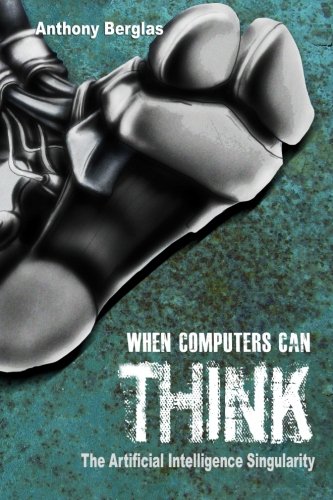
When Computers Can Think The Artificial Intelligence Singularity 1st Edition by Dr Anthony Berglas ISBN 978-1502384188 1502384183


Original price was: $50.00.$35.00Current price is: $35.00.
When Computers Can Think The Artificial Intelligence Singularity 1st Edition by Dr Anthony Berglas – Ebook PDF Instant Download/Delivery: 978-1502384188, 1502384183
Full download When Computers Can Think The Artificial Intelligence Singularity 1st Edition after payment
Product details:
ISBN 10: 1502384183
ISBN 13: 978-1502384188
Author: Dr Anthony Berglas
Could computers ever really think? They can now drive cars on suburban streets, control spaceships and have even won the Jeopardy! game show. But could they ever be self aware, create original ideas, develop their own goals, and write complex computer programs?.
Why can’t computers already think? Why has 60 years of research failed to produce a single intelligent robot? What has been learnt, what are the technically difficult problems, and when are they likely to be solved?
What would computers think about? What would be their challenges, goals and aspirations? They certainly would not need children. Would they need us?
This book addresses the unseen elephant in the room. Computers are becoming ever more intelligent. The future will not be anything like it used to be.
The book differs from other recent works by providing a strong focus on what caused people to ultimately be the way we are, namely upon natural selection. It then attempts to predict how natural selection would condition an intelligent machine’s behaviour by considering the very different world that it would experience.
Several technical and rhetorical arguments are presented both for and against the hypothesis that computers will, eventually, be able to think. There is also some discussion about what it actually means to be intelligent and the limitations of terms such as “creative” and “self aware”.
The second and largest part of the book then describes existing AI technologies in some detail. These include symbolic and logic based approaches, Bayesian expert systems, vision, speech, robotics, and an overview of computational neuroscience. This provides a more realistic basis for predictions of the future as well as simply gaining a better understanding of what intelligence actually is. It helps ground abstract philosophical discussions in terms of real, practical technologies. The text is moderately technical while being aimed at the general reader.
The book also posits that intelligent machines will be developed as succession of ever more intelligent software tools that are released and used in the real world. The book then analyzes the medium term effects of those semi-intelligent tools upon society. This includes some surprising results from an historical review of existing technologies.
There is a growing awareness of these issues, with concerns recently raised by physicist Stephen Hawking, Microsoft founder Bill Gates, and billionaire Elon Musk. 2
Table of contents:
-
Preliminary Material
Editor: Stella Borg Barthet -
Exchanging – Sharing Our Places
Hoda Barakat -
Exclusion and the Intellectuals — Some Thoughts on Unequal Academic Exchange Between Africa and the West
Brian Crow -
What Lies Ahead: Consolidation and Diversity in Postcolonial Studies
Jesús Varela Zapata -
Beyond Revolution: Re-Writing Violence and the Future of Postcolonial Studies
Daphne Grace -
Territorial Terrors: Colonial Spaces and Postcolonial Revisions – Some Basic Concepts
Gerhard Stilz -
In the Enemy’s Camp: Women Representing Male Violence in Zimbabwe’s Wars
Pauline Dodgson–Katiyo -
Shared Place and Maimed Bodies: Flesh of the Past, Soul of the Future (or Vice-Versa) in Once Were Warriors
Chantal Kwast–Greff -
Historical Trauma, lieu de mémoire, Source of Collective Renewal: Parihaka in the Poetic Imagination of Aotearoa New Zealand
Bärbel Czennia -
Becoming a Writer in Morocco
Leila Abouzeid -
Middle Eastern Women’s Roles Transformed: The Gendered Spaces of Ghādah al-Sammān and Sahar Khalīfah
Kifah Hanna -
Going Through Twentieth-Century Malta in the Company of Francis Ebejer’s Heroines
Bernadette Falzon -
Aesthetic (Dis)Continuities in the African Gendered Space: The Example of Younger Nigerian Women’s Writing
Taiwo Oloruntoba–Oju -
Smells, Skins, and Spices: Indian Spice Shops as Gendered Diasporic Spaces in the Novels of Indian Women Writers of the Diaspora
Christine Vogt–William -
Generational Change: Women and Writing in the Novels of Thea Astley
Maureen Lynch Pèrcopo -
Poems From Malta
Daniel Massa -
Currents and Swells in Maltese Identity: Representations of Community in Maltese Poetry in English Since Independence
Stella Borg Barthet -
Finding Nemo: Puzzling Maltese Identity in Edgar Allan Poe’s “The Murders in the Rue Morgue”
Kevin Stephen Magri -
The Sea and the Erosion of Cultural Identity in Romesh Gunesekera’s Reef
Melanie A. Murray -
The Otherless Other, or The Anonymity of Water: Unmapping Ondaatje’s ‘Sand Sea’ Self in Minghella’s The English Patient
Saviour Catania and Ivan Callus -
The Sea and the Changing Nature of Cultural Identity
Isabel Moutinho -
Diaspora in Cary Phillips’s Crossing the River (1993)
Thomas Bonnici -
“They Are Us” – Interview with Caryl Phillips
Adrian Grima -
Sharing Media Spaces: The Kumars at No. 42
Hilary P. Dannenberg -
Writing Second-Generation Migrant Identity in Meera Syal’s Fiction
Devon Campbell–Hall -
Is ‘Sharing Places’ Viable in a Postmodern World Order? Salman Rushdie’s Novel The Ground Beneath Her Feet
Amrit Biswas -
Sharing Nation Space: Representations of India
T. Vijay Kumar -
Exploring Boundaries: The North in Western Canadian Writing
Janne Korkka -
Sharing Quebec: Lorena Gale’s Je me souviens and George Elliott Clarke’s Québécité
Pilar Cuder–Domínguez -
Towards a Pedagogy of African-Canadian Literature
George Elliott Clarke -
Notes on Contributors
Editor: Stella Borg Barthet -
Index
Editor: Stella Borg Barthet
People also search for:
when computers can think
when computers were human
do computers think on their own
when computers came out
can computers think for themselves