
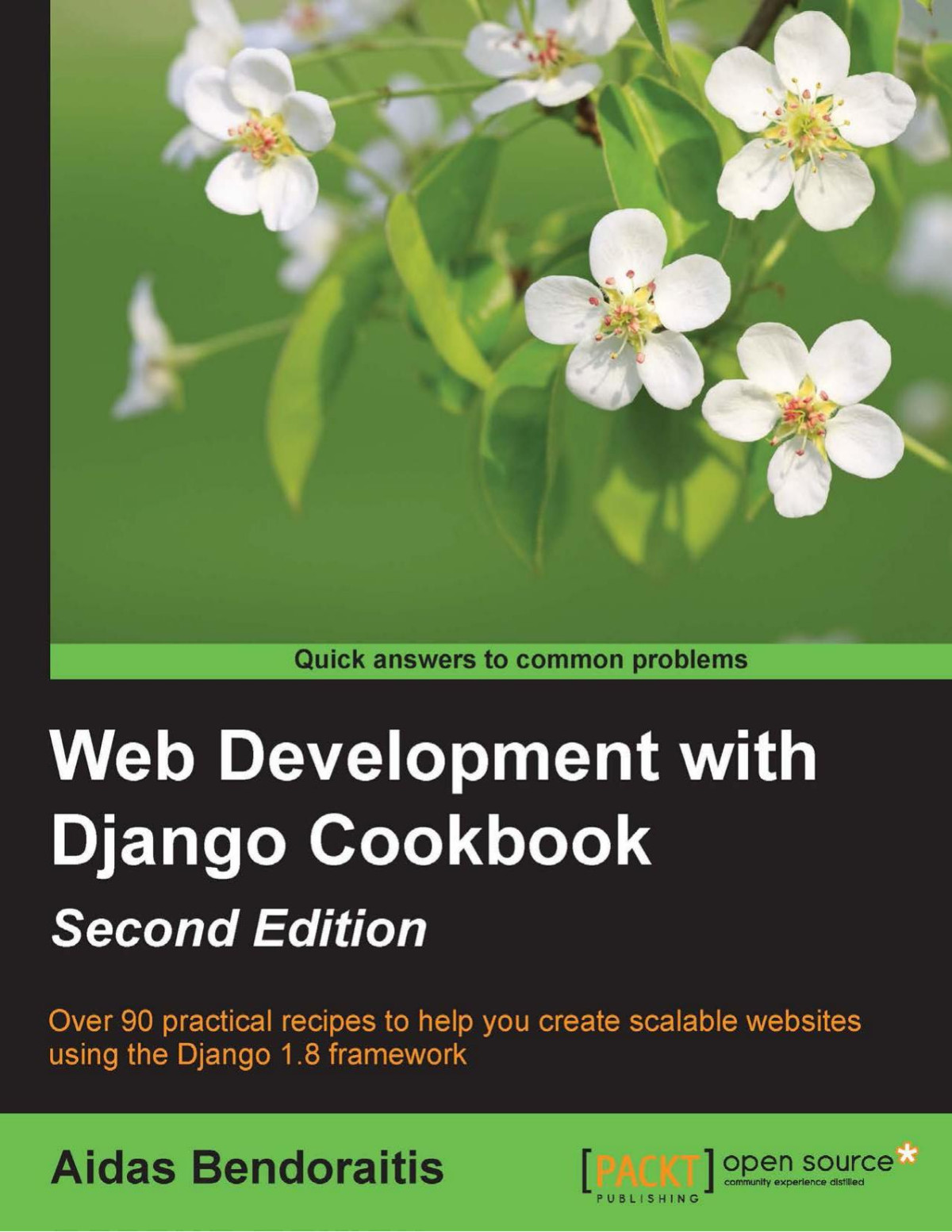
Web Development With Django Cookbook 2nd Edition by Aidas Bendoraitis ISBN 1785886770 978-1785886775


Original price was: $50.00.$35.00Current price is: $35.00.
Web Development With Django Cookbook 2nd Edition by Aidas Bendoraitis- Ebook PDF Instant Download/Delivery: 1785886770, 978-1785886775
Full download Web Development With Django Cookbook 2nd Edition after payment
Product details:
ISBN 10: 1785886770
ISBN 13: 978-1785886775
Author: Aidas Bendoraitis
Over 70 practical recipes to help you create scalable websites using the Django 1.8 framework
About This Book
This is the latest book on the market that will help you take advantage of the new features added to Django 1.8
This book consists of recipes of varying complexities to help you create multilingual, responsive, and scalable websites with Django
This updated edition teaches you major Django functions and will help you improve your skills by developing models, forms, views, and templates
Who This Book Is For
This book is for intermediate-level and professional Django users who need to build projects that are multilingual, functional on devices of different screen sizes, and that scale over a period of time. If you have created websites with Django but you want to sharpen your knowledge and learn some good approaches to different aspects of web development, you should definitely read this book.
What You Will Learn
Get started with the basic configuration necessary to start any Django project
Build a database structure out of reusable model mixins
Manage forms and views and get to know some useful patterns that are used to create them
Create handy template filters and tags that you can reuse in every project
Integrate your own functionality into the Django CMS
Manage hierarchical structures with MPTT
Import data from local sources and external web services as well as exporting your data to third parties
Implement a multilingual search with Haystack
Test and deploy your project efficiently
In Detail
Django is a web framework that was designed to strike a balance between rapid web development and high performance. It has the capacity to handle applications with high levels of user traffic and interaction, and can integrate with massive databases on the backend, constantly collecting and processing data in real time.
Through this book, you’ll discover that collecting data from different sources and providing it to others in different formats isn’t as difficult as you thought. It follows a task-based approach to guide you through all the web development processes using the Django framework. We’ll start by setting up the virtual environment for a Django project and configuring it. Then you’ll learn to write reusable pieces of code for your models and find out how to manage database schema changes using South migrations. After that, we’ll take you through working with forms and views to enter and list data. With practical examples on using templates and JavaScript together, you will discover how to create the best user experience. In the final chapters, you’ll be introduced to some programming and debugging tricks and finally, you will be shown how to test and deploy the project to a remote dedicated server.
By the end of this book, you will have a good understanding of the new features added to Django 1.8 and be an expert at web development processes.
Style and approach
Every chapter consists of practical examples and a mix of basic and advanced recipes that will guide you through the entire web development process, starting from project configuration and taking you right through to deployment.
Table of contents:
1. Getting Started with Django 1.8
Working with a virtual environment
Creating a project file structure
Handling project dependencies with pip
Making your code compatible with both Python 2.7 and Python 3
Including external dependencies in your project
Configuring settings for development, testing, staging, and production environments
Defining relative paths in the settings
Creating and including local settings
Setting up STATIC_URL dynamically for Subversion users
Setting up STATIC_URL dynamically for Git users
Setting UTF-8 as the default encoding for MySQL configuration
Setting the Subversion ignore property
Creating the Git ignore file
Deleting Python-compiled files
Respecting the import order in Python files
Creating app configuration
Defining overwritable app settings
2. Database Structure
Using model mixins
Creating a model mixin with URL-related methods
Creating a model mixin to handle creation and modification dates
Creating a model mixin to take care of meta tags
Creating a model mixin to handle generic relations
Handling multilingual fields
Using migrations
Switching from South migrations to Django migrations
Changing a foreign key to the many-to-many field
3. Forms and Views
Passing HttpRequest to the form
Utilizing the save method of the form
Uploading images
Creating a form layout with django-crispy-forms
Downloading authorized files
Filtering object lists
Managing paginated lists
Composing class-based views
Generating PDF documents
Implementing a multilingual search with Haystack
4. Templates and JavaScript
Arranging the base.html template
Including JavaScript settings
Using HTML5 data attributes
Opening object details in a modal dialog
Implementing a continuous scroll
Implementing the Like widget
Uploading images by Ajax
5. Custom Template Filters and Tags
Following conventions for your own template filters and tags
Creating a template filter to show how many days have passed since a post was publis
Creating a template filter to extract the first media object
Creating a template filter to humanize URLs
Creating a template tag to include a template if it exists
Creating a template tag to load a QuerySet in a template
Creating a template tag to parse content as a template
Creating a template tag to modify request query parameters
6. Model Administration
Customizing columns on the change list page
Creating admin actions
Developing change list filters
Customizing default admin settings
Inserting a map into a change form
7. Django CMS
Creating templates for Django CMS
Structuring the page menu
Converting an app to a CMS app
Attaching your own navigation
Writing your own CMS plugin
Adding new fields to the CMS page
8. Hierarchical Structures
Creating hierarchical categories
Creating a category administration interface with django-mptt-admin
Creating a category administration interface with django-mptt-tree-editor
Rendering categories in a template
Using a single selection field to choose a category in forms
Using a checkbox list to choose multiple categories in forms
9. Data Import and Export
Importing data from a local CSV file
Importing data from a local Excel file
Importing data from an external JSON file
Importing data from an external XML file
Creating filterable RSS feeds
Using Tastypie to create API
Using Django REST framework to create API
10. Bells and Whistles
Using the Django shell
Using database query expressions
Monkey-patching the slugify() function for better internationalization support
Toggling the Debug Toolbar
Using ThreadLocalMiddleware
Caching the method return value
Using Memcached to cache Django views
Using signals to notify administrators about new entries
Checking for missing settings
11. Testing and Deployment
Testing pages with Selenium
Testing views with mock
Testing API created using Django REST framework
Releasing a reusable Django app
Getting detailed error reporting via e-mail
Deploying on Apache with mod_wsgi
Setting up cron jobs for regular tasks
Creating and using the Fabric deployment script
Index
People also search for:
web development with django github
django 3 web development cookbook
web django python
web framework django
django web development for beginners
Tags: Aidas Bendoraitis, Web Development, With Django Cookbook