
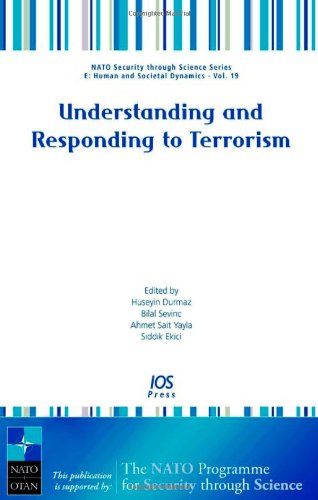
Understanding and Responding to Terrorism Volume 19 NATO Security through Science Series Human and Societal Dynamics Nato Security Through Science 1st Edition by Huseyin Durmaz, Bilal Sevinc, Ahmet Sait Yayla, Siddik Ekici ISBN 1586037404 9781586037406


Original price was: $50.00.$35.00Current price is: $35.00.
Understanding and Responding to Terrorism Volume 19 NATO Security through Science Series Human and Societal Dynamics Nato Security Through Science 1st Edition by Huseyin Durmaz, Bilal Sevinc, Ahmet Sait Yayla, Siddik Ekici – Ebook PDF Instant Download/Delivery: 1586037404, 9781586037406
Full download Understanding and Responding to Terrorism Volume 19 NATO Security through Science Series Human and Societal Dynamics Nato Security Through Science 1st Edition after payment
Product details:
ISBN 10: 1586037404
ISBN 13: 9781586037406
Author: Huseyin Durmaz, Bilal Sevinc, Ahmet Sait Yayla, Siddik Ekici
This publication concerns three main topics: – Dynamics of effective international cooperation against terrorism: Facilitators and barriers; – Law enforcement response to terrorism in different countries and regions; – Emergency management lessons for Homeland Security. On the first topic on the role of international organizations, the barriers for cooperation and their solutions are explored. With respect to the second topic, several country’s legislative efforts against terrorism, the level of terrorism, experienced threat, and how law enforcement agencies fight terrorism in their respective states are handled. The third topic includes evaluations of the response and recovery operations that are implemented after terrorist attacks in order to enhance emergency management and homeland security policies and procedures as well as the integration of crisis and consequence management activities. The articles in this publication have been categorized in five parts: – International Police Cooperation – National Approaches to Terrorism – Responding to Terrorism – Terrorism Emergency Management – Closing Remarks This book can be a useful source to better understand and respond to the terrorism threat.IOS Press is an international science, technical and medical publisher of high-quality books for academics, scientists, and professionals in all fields.Some of the areas we publish in:-Biomedicine
-Oncology
-Artificial intelligence
-Databases and information systems
-Maritime engineering
-Nanotechnology
-Geoengineering
-All aspects of physics
-E-governance
-E-commerce
-The knowledge economy
-Urban studies
-Arms control
-Understanding and responding to terrorism
-Medical informatics
-Computer Sciences
“synopsis” may belong to another edition of this title.
Table of contents:
Part 1. International Police Cooperation
Chapter 1. Interpol – Providing Support and Assistance to Combat International Terrorism
Jennifer Hurst
Chapter 2. Europol in the Combat of International Terrorism Max-Peter Ratzel
Chapter 3. International Police Cooperation Against Terrorism: Interpol and Europol in Comparison
Mathieu Deflem
Chapter 4. International Organizations and Non-Traditional Conflicts Cuneyt Gurer and Serhat Demir
Chapter 5. Barriers to International Police Cooperation in the Age of Terrorism Mitchel P. Roth and Murat Sever
Chapter 6. Employing Global Need-Based Information and Technology Sharing to Enhance Cooperation Among Law Enforcement Organizations
Selcuk Zengin and M. Murat Yasar
Chapter 7. Extradition of Terror Suspects and Developments in Extradition Process
Huseyin Durmaz
Chapter 8. Global Developments in Transnational Police Training: TADOC (Turkish International Academy Against Drugs and Organized Crime) Arif Akgul and Otwin Marenin
Chapter 9. Establishing the International Institute for Police Research and Training in Turkey Recep Gultekin, Samih Teymur, Selcuk Zengin, Huseyin Cinoglu and Kubra Gultekin
Part 2. Country Approaches to Terrorism
Chapter 10. Socio-Juridical Characteristics of Terrorism in the Laws of Azerbaijan
Elnur Kazimli
Chapter 11. The Last Amendments to the Prevention of Terror Act of Turkey
Ali Safak
Chapter 12. Terrorist Activities in Kyrgyzstan and Precautionary Measures
Kambarali T. Kongantiev
Chapter 13. International Cooperation as a Strategy of Fighting and Prevention Terrorism in Georgia
Alasania returned
Chapter 14. Macedonia as a Leader in the South-East Europe’s Cooperation in the Fight Against Organised Crime
Stojanovski is suffering
Chapter 15. Collaboration in the Field of Prevention to the Organized Crime and Terrorism
Mykola Khaschevoi and Olena Ivaschenko
Chapter 16. Initiatives Taken by the Republic of Armenia in the Fight Against Terror: Legislative Regulations and Intergovernmental Cooperation with the CIS States
Armen Healthy
Part 3. Responding to Terrorism
Chapter 17. Terrorism as a Social and Criminal Phenomenon: A Complete Model to Deal with Terrorism
Ahmet Sait Yayla
Chapter 18. Legal Policing Responses to Terrorist Operations
Farhad Mehdiyev
Chapter 19. Organizing to Combat Future Terrorist Threats: Policy and Operational Implications
Stephen Sloan
Chapter 20. Intelligence Led Policing as a Framework for Law Enforcement in the 21st Century
Edmund F. McGarrell
Chapter 21. Supply Chains, Illicit Markets, and Terrorism: Understanding Organizations and Strategies
Robyn R. Mace
Chapter 22. Money Laundering and Financing of Terrorism
Suleyman Aydin
Chapter 23. Local Policing: Using Community Policing Principles as a Tactic in the Time of Terror
Mehmet Afacan
Chapter 24. Local Values and Police
Iskender Ormon Uulu
Chapter 25. Family Case Approach in Understanding and Combating Crime in General and Specifically Terror
Ersin Oguz
Chapter 26. Youth and Terrorism Necati Alkan and M. Cemil Citak
Part 4. Terrorism Emergency Management
Chapter 27. An Emerging Concept: ‘Terrorism Emergency Management’ Alican Kapti and Zeki Pamuk
Chapter 28. The Impacts of Catastrophic Events in Large Cities: Considerations for Coping with the Aftermath of Terrorism in Urban Settings
Jack L. Rozdilsky
Chapter 29. Terrorism, Vulnerability and Assessment
Huseyin Akdogan
Chapter 30. Improvisation, Creativity, and the Art of Emergency Management James Kendra and Tricia Wachtendorf
Chapter 31. Coordinated Response to Man-Made and Natural Disasters Naim Kapucu
Chapter 32. Reassessing FEMA and Its Role in Preparing the Nation: Recommendations to Respond Effectively to Disasters
Siddik Ekici and David A. McEntire
Chapter 33. Responding to Terrorist Attacks Within the Labyrinth of Independent Governments: Collaborating and Quarrelling
Abraham Benavides and Sebahattin Gultekin
Chapter 34. Public Archetypes in U.S. Counter-Bioterrorist Policy Monica Schoch-Spana
Chapter 35. The Disaster Management Perspective of the November 20, 2003 Events in Istanbul, Turkey
Derin N. Ural
Chapter 36. Building Trust Among Community Stakeholders Sudha Arlikatti, Michael K. Lindell and Carla S. Prater
Part 5. Closing Remarks
Closing Remarks Mathieu Deflem
Author Index
People also search for:
understanding and responding to terrorism
how does the united states respond to terrorism
what is terrorism and what is the war on terrorism
what is terrorism and what is not
which response to the threat of terrorism has most
Tags: Huseyin Durmaz, Bilal Sevinc, Ahmet Sait Yayla, Siddik Ekici, Understanding and Responding, Security through Science, Series Human