
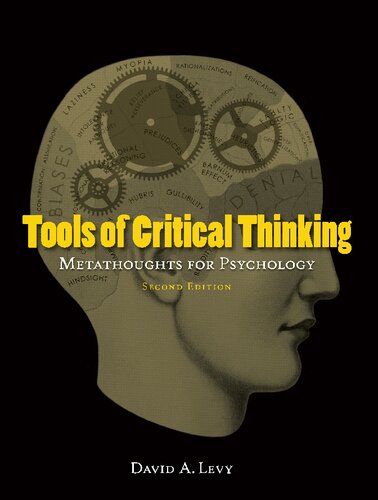
Tools of Critical Thinking Metathoughts for Psychology 2nd Edition by David Levy ISBN 1577666291 978-1577666295


Original price was: $50.00.$35.00Current price is: $35.00.
Tools of Critical Thinking Metathoughts for Psychology 2nd Edition by David A. Levy- Ebook PDF Instant Download/Delivery: 1577666291, 978-1577666295
Full download Tools of Critical Thinking Metathoughts for Psychology 2nd Edition after payment
Product details:
ISBN 10: 1577666291
ISBN 13: 978-1577666295
Author: David A. Levy
This innovative text is designed to improve thinking skills through the application of 30 critical thinking principles—Metathoughts. These specialized tools and techniques are useful for approaching all forms of study, inquiry, and problem solving. Levy applies Metathoughts to a diverse array of issues in contemporary clinical, social, and cross-cultural psychology: identifying strengths and weaknesses in various schools of thought, defining and explaining psychological phenomena, evaluating the accuracy and usefulness of research studies, reducing logical flaws and personal biases, and improving the search for creative solutions. The Metathoughts are brought to life with practical examples, clinical vignettes, illustrations, anecdotes, thought-provoking exercises, useful antidotes, and contemporary social problems and issues.
Tools of Critical Thinking, 2/E is primarily suited as a core textbook for courses in critical thinking/problem solving, or makes an ideal supplement in a wide variety of undergraduate and graduate psychology courses, including introductory psychology, abnormal psychology (psychopathology), cross-cultural psychology, theories and methods of psychotherapy, research methods and design, theories of personality, clinical practicum, and contemporary problems and issues in psychology.
Table of contents:
Part One: CONCEPTUALIZING PHENOMENA
1. The Evaluative Bias of Language: To Describe Is to Prescribe
2. The Reification Error: Comparing Apples and Existentialism
3. Multiple Levels of Description: The Simultaneity of Physical and Psychological Events
4. The Nominal Fallacy and Tautologous Reasoning: To Name Something Isn’t to Explain It
5. Differentiating Dichotomous Variables and Continuous Variables: Black and White, or Shades of Grey?
6. Consider the Opposite: To Contrast Is to Define
7. The Similarity-Uniqueness Paradox: All Phenomena Are Both Similar and Different
8. The Naturalistic Fallacy: Blurring the Line between “Is” and “Should”
9. The Barnum Effect: “One-Size-Fits-All” Personality Interpretations
Part Two: EXPLAINING PHENOMENA
10. Correlation Does Not Prove Causation: Confusing “What” with “Why”
11. Bidirectional Causation: Causal Loops, Healthy Spirals, and Vicious Cycles
12. Multiple Causation: Not “Either/Or,” but “Both/And”
13. Degrees of Causation: Not All Causes Are Created Equal
14. Multiple Pathways of Causation: Different Causes, Same Effect
Part Three: COMMON MISATTRIBUTIONS
15. The Fundamental Attribution Error: Underestimating the Impact of External Influences
16. The Intervention-Causation Fallacy: When the Cure Doesn’t Prove the Cause
17. The Consequence-Intentionality Fallacy: The Effect Doesn’t Prove the Intent
18. The “If I Feel It, It Must Be True” Fallacy: The Truth Hurts; But So Do Lies
19. The Spectacular Explanation Fallacy: Extraordinary Events Do Not Require Extraordinary Causes
Part Four: INVESTIGATING PHENOMENA
20. Deductive and Inductive Reasoning: Two Methods of Inference
21. Reactivity: To Observe Is to Disturb
22. The Self-Fulfilling Prophecy: When Expectations Create Reality
23. The Assimilation Bias: Viewing the World through Schema-Colored Glasses
24. The Confirmation Bias: Ye Shall Find Only What Ye Shall Seek
25. The Belief Perseverance Effect: The Rat Is Always Right
26. The Hindsight Bias: Predicting a Winner after the Race Is Finished
Part Five: OTHER BIASES AND FALLACIES IN THINKING
27. The Representativeness Bias: Fits and Misfits of Categorization
28. The Availability Bias: The Persuasive Power of Vivid Events
29. The Insight Fallacy: To Understand It Isn’t Necessarily to Change It
Part Six: CONCLUSIONS
30. Every Decision Is a Trade-Off: Take Stock of Pluses and Minuses
People also search for:
tools to improve critical thinking
critical thinking learn the tools the best thinkers use
tools of critical thinking levy pdf
metathoughts psychology
tools for critical thinking
Tags:
David Levy, Critical Thinking,Metathoughts for Psychology