
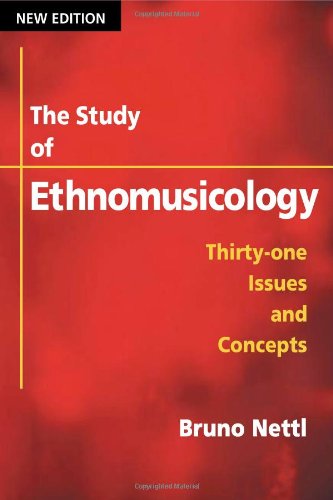
The Study of Ethnomusicology Thirty one Issues and Concepts 2nd Edition by Bruno Nettl ISBN 0252072789 978-0252072789
Original price was: $50.00.$35.00Current price is: $35.00.
The Study of Ethnomusicology Thirty one Issues and Concepts 2nd Edition by Bruno Nettl – Ebook PDF Instant Download/Delivery: 0252072789, 978-0252072789
Full download The Study of Ethnomusicology Thirty one Issues and Concepts 2nd Edition after payment
Product details:
ISBN 10: 0252072789
ISBN 13: 978-0252072789
Author: Bruno Nettl
The first edition of this book, The Study of Ethnomusicology: Twenty-Nine Issues and Concepts, has become a classic in the field. This revised edition, written twenty-two years after the original, continues the tradition of providing engagingly written analysis that offers the most comprehensive discussion of the field available anywhere.
This book looks at the field of ethnomusicology–defined as the study of the world’s musics from a comparative perspective, and the study of all music from an anthropological perspective–as a field of research. Nettl selects thirty-one concepts and issues that have been the subjects of continuing debate by ethnomusicologists, and he adds four entirely new chapters and thoroughly updates the text to reflect new developments and concerns in the field.
Each chapter looks at its subject historically and goes on to make its points with case studies, many taken from Nettl’s own field experience. Drawing extensively on his field research in the Middle East, Western urban settings, and North American Indian societies, as well as on a critical survey of the available literature, Nettl advances our understanding of both the diversity and universality of the world’s music. This revised edition’s four new chapters deal with the doing and writing of musical ethnography, the scholarly study of instruments, aspects of women’s music and women in music, and the ethnomusicologist’s study of his or her own culture.
Table of contents:
PART I: Contemplating the Musics of the World
1 A Harmless Drudge: Reaching for the Dictionary: Discusses the definition and evolution of ethnomusicology.
2 Combining Tones: On the Concept of Music: Explores the various definitions of music.
3 Is Music the Universal Language of Mankind? Commonalities and the Origins of Music: Examines the debate on whether music is a universal language and delves into its origins.
PART II: As Sounds and Structures
4 Inspiration and Perspiration: Creative Processes: Investigates how music is created.
5 A Nonuniversal Language: On the Musics of the World: Focuses on the diversity of music across cultures.
6 The Fundamental Skill: Notation and Transcription: Highlights the importance of transcription in ethnomusicology.
7 Contemplating Musical Repertories: A Sampling of Descriptive and Analytical Approaches: Discusses methods for describing and analyzing musical repertories.
8 The Most Indefatigable Tourists of the World: Units of Musical Thought: Explores the study of individual musical works.
9 Apples, Oranges, and a Model T: Comparison and Comparative Study: Examines the role and ethics of comparative studies in ethnomusicology.
PART III: In the Field
10 Come Back and See Me Next Tuesday: Essentials of the Fieldwork Tradition: Details the essentials of fieldwork.
11 You Will Never Understand This Music: Insiders and Outsiders: Discusses the perspectives of insiders and outsiders in understanding music.
12 Citadels of the Profession: Archives, Preservation, and the Study of Recordings: Focuses on the role of archives and preservation.
13 No One Plays It Like Me: Ordinary and Exceptional Musicians: Explores the role of musicians.
14 You Call That Fieldwork? Redefining the “Field”: Discusses the evolving definition of “field” in fieldwork.
15 Who Owns This Music? The Host’s Perspective: Examines the issue of ownership and cultural sensitivity.
PART IV: In Human Culture
16 Music and “That Complex Whole”: Studying Music in or as Culture: Discusses the relationship between music and culture.
17 Writing the Meat-and-Potatoes Book: Musical Ethnography: Focuses on writing musical ethnographies.
18 “If Music Be the Food of Love …”: Uses and Functions: Explores the uses and functions of music.
19 The River of Heraclitus: On People Changing Their Music: Discusses how people change their music.
20 Traditions: Recorded, Printed, Written, Oral, Virtual: Examines different forms of musical traditions.
21 The Basic Unit of All Culture and Civilization: Signs, Symbols, and Meaning: Discusses the role of symbols and meaning.
22 The Whys of World Music: Determinants of Musical Style: Explores the determinants of musical styles.
PART V: In All of Its Varieties
23 The “Where” of World Music: Interpreting Geographic Distribution: Focuses on the geographic distribution of music.
24 Never Heard a Horse Sing: Taxonomies and Boundaries: Discusses classifications and boundaries in music.
25 The Creatures of Jubal: Instruments: Examines the study of musical instruments.
26 How Do You Get to Carnegie Hall? Teaching and Learning: Discusses the teaching and learning of music.
27 I’m a Stranger Here Myself: Women’s Music, Women in Music: Focuses on women’s roles in music.
28 Diversity and Difference: A Variety of Minorities: Explores the music of minority groups.
PART VI: From a Broad Perspective
29 Are You Doing Anyone Any Good? Thoughts on Applied Ethnomusicology: Discusses the practical applications of ethnomusicology.
30 Musing about an Interdiscipline: Musicology, Anthropology, and the Study of Dance: Examines the interdisciplinary nature of ethnomusicology.
31 Second Thoughts: Some Personal Disclosures: Offers personal reflections on the field.
32 On the Shape of the Story: Perspectives on the History of Ideas and Practices: Discusses the history of ethnomusicology.
33 A Snapshot of the New Century: Notes on Ethnomusicology Today: Provides an overview of contemporary ethnomusicology.
People also search for:
the study of ethnomusicology thirty one issues and concepts
the study of ethnomusicology twenty nine issues and concepts
ethnomusicology is the study of music as
ethnomusicology is the anthropological study of music
what is applied ethnomusicology
Tags:
Bruno Nettl,The Study,Ethnomusicology Thirty,Issues and Concepts