
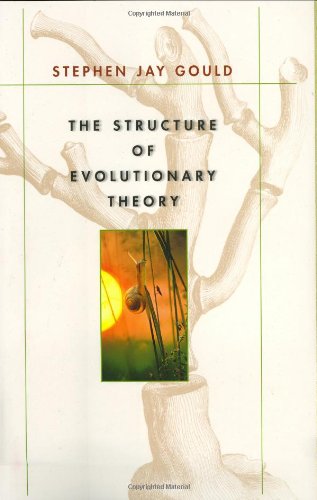
The Structure of Evolutionary Theory 5th Edition by Stephen Jay Gould ISBN 9780674006133 0674006135


Original price was: $50.00.$35.00Current price is: $35.00.
The Structure of Evolutionary Theory 5th Edition by Stephen Jay Gould – Ebook PDF Instant Download/Delivery: 9780674006133, 0674006135
Full download The Structure of Evolutionary Theory 5th Edition after payment
Product details:
ISBN 10: 0674006135
ISBN 13: 9780674006133
Author: Stephen Jay Gould
The theory of evolution is regarded as one of the greatest glimmerings of understanding humans have ever had. It is an idea of science, not of belief, and therefore undergoes constant scrutiny and testing by argumentative evolutionary biologists. But while Darwinists may disagree on a great many things, they all operate within a (thus far) successful framework of thought first set down in The Origin of Species in 1859. In The Structure of Evolutionary Theory, a monumental labor of academic love, Stephen Jay Gould attempts to define and revise that framework. Using the clear metaphors and personable style he is so well known for, Gould outlines the foundation of the theory and attempts to use it to show that modern evolutionary biology has lost its way. He then offers his own system for reconciling Darwin’s “basic logical commitments” with the critiques of modern scientists.Gould’s massive opus begs a new look at natural selection with the full weight of history behind it. His opponents will find much to criticize, and orthodox, reductionist Darwinists might feel that Gould has given them short shrift. But as an opening monologue for the new century’s biological debates, The Structure of Evolutionary Theory sets a mountainous precedent in exhaustive scholarship, careful logic, and sheer reading pleasure. –Therese Littleton
Table of contents:
Chapter 1: Defining and Revising the Structure of Evolutionary Theory
Theories Need Both Essences and Histories
The Structure of Evolutionary Theory: Revising the Three Central Features of Darwinian Logic
Apologia Pro Vita Sua
A Time to Keep
A Personal Odyssey
Epitomes for a Long Development
Levels of Potential Originality
An Abstract of One Long Argument
Part I: The History of Darwinian Logic and Debate
Chapter 2: The Essence of Darwinism and the Basis of Modern Orthodoxy: An Exegesis of the Origin of Species
A Revolution in the Small
Darwin as a Historical Methodologist
One Long Argument
The Problem of History
A Fourfold Continuum of Methods for the Inference of History
Darwin as a Philosophical Revolutionary
The Causes of Nature’s Harmony
Darwin and William Paley
Darwin and Adam Smith
The Organism as the Agent of Selection
Natural Selection as a Creative Force
The Requirements for Variation
The Adaptationist Program
The Uniformitarian Need to Extrapolate
Environment as Enabler of Change
Judgments of Importance
Chapter 3: Seeds of Hierarchy
Lamarck and the Birth of Modern Evolutionism in Two-Factor Theories
The Myths of Lamarck
Lamarck’s Two-Factor Theory
The Hierarchy of Progress and Deviation
Antinomies of the Two-Factor Theory
Darwin’s Reaction
Weismann on Germinal Selection
Germinal Selection as a Full Theory of Hierarchy
Hints of Hierarchy in Supraorganismal Selection
Darwin on the Principle of Divergence
The Failure of Darwin’s Argument and the Need for Species Selection
Species Selection Based on Propensity for Extinction
Solution to the Problem of the “Delicate Arrangement”
Coda
Chapter 4: Internalism and Laws of Form: Pre-Darwinian Alternatives to Functionalism
Darwin’s Fateful Decision
Two Ways to Glorify God in Nature
William Paley and British Functionalism
Louis Agassiz and Continental Formalism
Unity of Plan and the Pre-Darwinian Debate
Geoffroy and Cuvier
The Debate of 1830
Richard Owen and English Formalism
The Vertebrate Archetype
Darwin’s Limited Interest in Structural Constraint
Correlation of Parts
Chapter 5: The Fruitful Facets of Gabon’s Polyhedron: Channels and Saltations in Post-Darwinian Formalism
Orthogenesis and the Marginalization of Darwinism
Theodor Eimer and the Power of Selection
Alpheus Hyatt and Mollusk Evolution
C. O. Whitman and Pigeon Evolution
Saltation and Internal Impetus
William Bateson and Inherent Discontinuity
Hugo de Vries and the Mutation Theory
Richard Goldschmidt as a Formalist Opponent of Darwinism
Chapter 6: Pattern and Progress on the Geological Stage
Darwin and Biotic Competition
Uniformity in Geology
Lyell’s Victory and Catastrophism
Kelvin’s Time Constraints
Too Little Geology
Too Much Directionality
Chapter 7: The Modern Synthesis as a Limited Consensus
Why Synthesis?
Synthesis as Restriction
Rejecting Old Alternatives
R. A. Fisher and the Darwinian Core
J. B. S. Haldane and Pluralism
J. S. Huxley’s Pluralism
Synthesis as Hardening
Selection’s Power and the Shift in Dobzhansky and Simpson
Mayr’s Paradigm Shift
Levels of Selection
Extrapolation into Geological Time
From Overstressed Doubt to Overextended Certainty
Two Centennials
Macroevolution in Textbooks
Adaptation and Natural Selection
Reduction and Trivialization of Macroevolution
People also search for:
the structure of evolutionary theory pdf
the structure of evolutionary theory 2002
the structure of evolutionary theory harvard university press
summarize the structure of an evolutionary tree
the structure and confirmation of evolutionary theory