
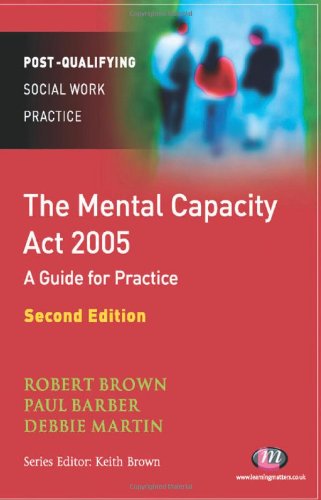
The Mental Capacity Act 2005 A Guide for Practice Post Qualifying Social Work Practice 2nd Edition by Robert Brown, Paul Barber, Debbie Martin ISBN 1844452941 978-1844452941


Original price was: $50.00.$35.00Current price is: $35.00.
The Mental Capacity Act 2005 A Guide for Practice Post Qualifying Social Work Practice 2nd Edition by Robert Brown, Paul Barber, Debbie Martin – Ebook PDF Instant Download/Delivery: 1844452941, 978-1844452941
Full download The Mental Capacity Act 2005 A Guide for Practice Post Qualifying Social Work Practice 2nd Edtion 2nd Edition after payment
Product details:
ISBN 10: 1844452941
ISBN 13: 978-1844452941
Author: Robert Brown, Paul Barber, Debbie Martin
In 2007 The Mental Capacity Act came into effect providing a new statutory framework for decision making. This book is a practical guide to working within the requirements of the Act, identifying situations where staff will need to be familiar with the Act and Code of Practice and providing checklists and exercises to help people to ensure compliance with the new requirements. This edition also includes the complete text of the Deprivation of Liberty Safeguards and will be of immense value to Best Interest Assessors.
Table of contents:
1 Background to the Mental Capacity Act 2005
Introduction
Key issues to be resolved
The concept of mental capacity
The work of the Law Commission
Who decides?
Making decisions
The Mental Incapacity Bill
2 The key features of the Mental Capacity Act 2005
Introduction
The five principles
Mental incapacity defined
Best interests
Protection for those making decisions
Lasting Powers of Attorney
Deputies and declarations
Advance decisions
Independent Mental Capacity Advocates (IMCAs)
The Court of Protection and the Public Guardian
Other issues
3 The Code of Practice (sections 42–43)
Introduction
What does the Code of Practice cover?
To whom does the Code of Practice apply?
What is the status and effect of the Code?
4 Principles (section 1)
Introduction
The five principles
A person must be assumed to have capacity
Practicable steps to help the person make
a decision
Unwise decisions
Best interests
Less restrictive approach
5 What is lack of capacity? (sections 2–3)
Introduction
A functional approach
Non-discrimination
The section 3 test
Situations requiring the capacity test
What is a reasonable belief that someone lacks capacity?
A checklist for assessing capacity
Recording by professionals
6 Best interests (section 4)
Introduction
The checklist approach
The principle of equal consideration
All relevant circumstances
Regaining capacity
Participation of the individual
Life-sustaining treatment
Wishes, feelings, beliefs and values
The views of other people
Best interests checklist
7 Protection for those making decisions (sections 5–8)
Introduction
Section 5 acts
Restraint
Deprivation of liberty
What amounts to deprivation of liberty?
Financial implications of section 5 decisions
Key checks for decision-makers
8 Lasting Powers of Attorney (sections 9–14 and 22–23)
General
What is a Lasting Power of Attorney?
What can an LPA cover?
The formal requirements
To what controls are attorneys and LPAs subject?
How might an LPA be limited in scope?
Who may be an attorney?
The role and duties of an attorney
Advance decisions and Lasting Powers of Attorney
Does the law limit the powers of an attorney?
The role and powers of the Court of Protection
Transitional arrangements for Enduring Powers of Attorney (EPAs)
Key points and questions relating to Lasting Powers of Attorney
9 Deputies and declarations (sections 15–21)
General
The power to make declarations
The power to make decisions
The approach of the court
Personal welfare decisions
Property and affairs decisions
The power to appoint a deputy
When might a deputy be appointed?
What restrictions affect a deputy’s powers?
The responsibilities and duties of a deputy
Key points and questions relating to the Court of Protection and deputies
10 Advance decisions to refuse treatment (sections 24–26)
General
The statutory provisions
An advance decision must be valid
An advance decision must be applicable
What are the formal requirements?
The effect of a valid and applicable advance decision
Protection for healthcare professionals
Problems in practice
Advance decisions refusing treatment for mental disorder
Advance decisions and Lasting Powers of Attorney
Conscientious objections by healthcare professionals
Key points and questions relating to advance decisions
11 Independent Mental Capacity Advocates (IMCAs) (sections 35–41)
Introduction
Purpose of the service
Powers of the advocate
The need for an IMCA
Exceptions: when an IMCA will not be needed
Other circumstances when an IMCA could be involved
The role of the IMCA
Training and procedures for staff on the role of the IMCA
12 The Court of Protection and the Public Guardian (sections 45–61)
General
The court structure
When might an application be made?
Who can apply to the Court of Protection?
Court of Protection Visitors
The Public Guardian
How will the Public Guardian operate in practice?
13 Other issues
Ill-treatment and neglect (section 44)
Exclusions
Specific exclusions
14 Research
Introduction
What research is affected by the Act?
The requirements for approval
The requirement of consultation
Other safeguards
15 Links with other areas of law
Links with the Human Rights Act 1998
Relevance of the Human Rights Act 1998 in the passage of the Bill
Articles 2, 3, and 8 of the European Convention on Human Rights
Links with the Mental Health Act 1983
Mental incapacity compared with mental disorder
Consent to treatment under the Mental Health Act 1983
Other links with the Mental Health Act 1983
Links with the children’s law
Links with the common law
16 Deprivation of liberty safeguards
Introduction
Lawful ways to deprive someone of their liberty
The deprivation of liberty safeguards (DOLS) procedure
Managing authority
Supervisory body
Request for a standard authorisation
Standard authorisation application information
Assessment to establish if an unauthorised deprivation of liberty is occurring
The six assessments
Age
Mental health
Mental capacity
Best interests
Eligibility
No refusals
Authorisation of deprivation of liberty
Giving information
Selection of assessors
Equivalent assessments
Expiry of an authorisation
Urgent authorisation
Independent mental capacity advocates (IMCA)
Reviews
Suspension of an authorisation
Protection from liability
Key points
17 The interface between the Mental Capacity Act and the Mental Health Act
Introduction
Treatment (amounting to a restriction of movement)
Treatment (amounting to a deprivation of liberty)
Accommodation (amounting to a restriction of movement)
Accommodation (amounting to a deprivation of liberty)
Examples of provisions that can be used together
Examples of provisions that cannot be used together
Choice of Act
Examples of when the MCA may not be relied upon
Key points
18 The distinction between restriction of movement and deprivation of liberty
Introduction
Article 5 of the ECHR and related case law
HL v United Kingdom (2004)
JE v DE and Surrey CC (2006)
Why is the distinction relevant to practice?
Mental Capacity Act 2005
Mental Health Act 1983
Common law doctrine of necessity
Decision-making
Case law
Government guidance
Other views
Conclusion
Key points
People also search for:
who does the mental capacity act 2005 protect
who does the mental capacity act 2005 apply to
which countries does the mental capacity act 2005 apply to
what goes beyond the mental capacity act 2005
how many principles underpin the mental capacity act 2005
Tags:
Robert Brown,Paul Barber,Debbie Martin,The Mental Capacity,A Guide,Post Qualifying