
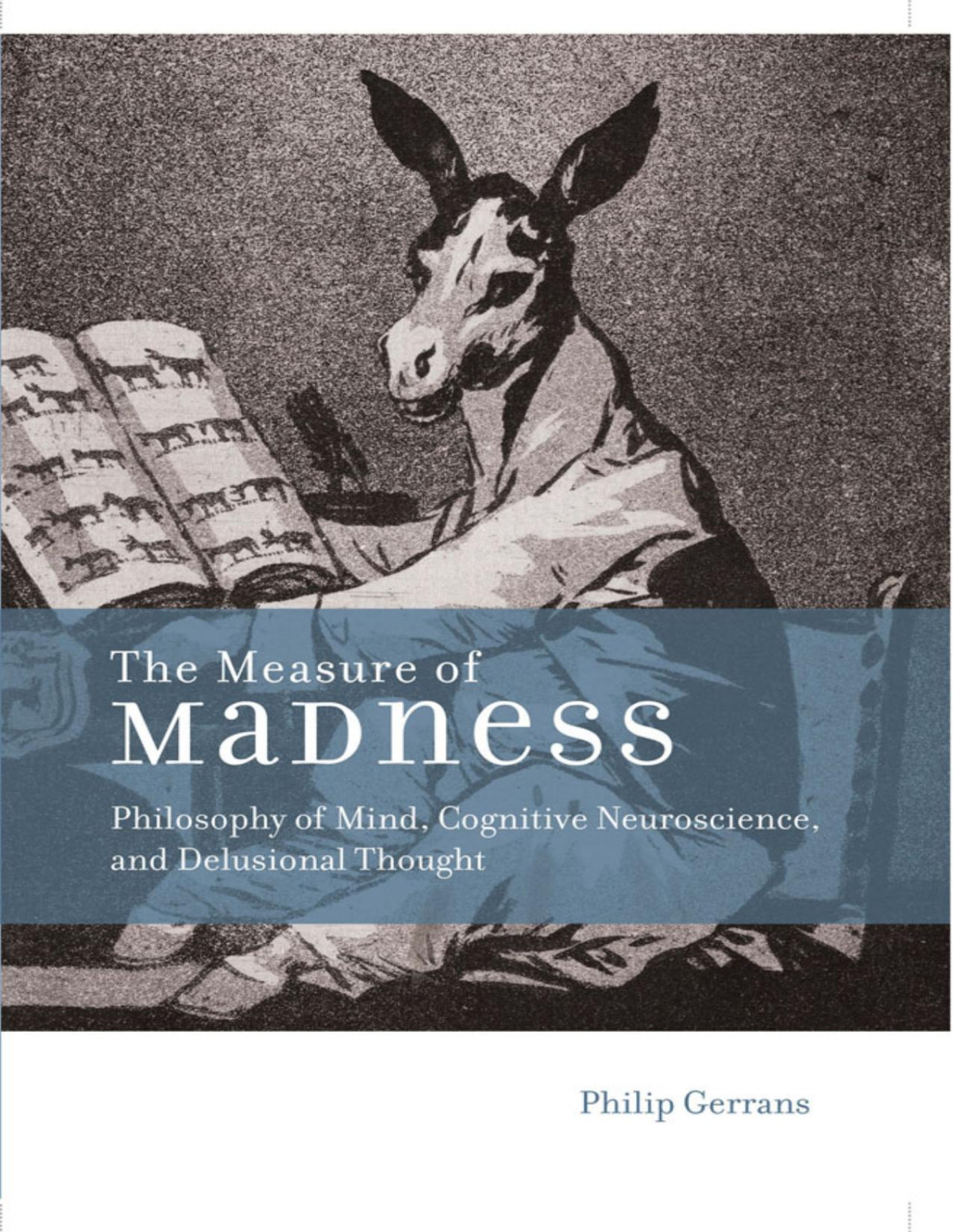
The Measure of Madness Philosophy of Mind Cognitive Neuroscience and Delusional Thought 2nd Edition by Philip Gerrans 0262027550 9780262027557


Original price was: $50.00.$35.00Current price is: $35.00.
The Measure of Madness Philosophy of Mind Cognitive Neuroscience and Delusional Thought 2nd Edition by Philip Gerrans – Ebook PDF Instant Download/Delivery: 0262027550, 978-0262027557
Full dowload The Measure of Madness Philosophy of Mind Cognitive Neuroscience and Delusional Thought 2nd Edition after payment
Product details:
ISBN 10: 0262027550
ISBN 13: 978-0262027557
Author: Philip Gerrans
Drawing on the latest work in cognitive neuroscience, a philosopher proposes that delusions are narrative models that accommodate anomalous experiences.
In The Measure of Madness, Philip Gerrans offers a novel explanation of delusion. Over the last two decades, philosophers and cognitive scientists have investigated explanations of delusion that interweave philosophical questions about the nature of belief and rationality with findings from cognitive science and neurobiology. Gerrans argues that once we fully describe the computational and neural mechanisms that produce delusion and the way in which conscious experience and thought depend on them, the concept of delusional belief retains only a heuristic role in the explanation of delusion.
Gerrans proposes that delusions are narrative models that accommodate anomalous experiences. He argues that delusions represent the operation of the Default Mode Network (DMN)—the cognitive system that provides the raw material for humans’ inbuilt tendency to provide a subjectively compelling narrative context for anomalous or highly salient experiences—without the “supervision” of higher cognitive processes present in the nondelusional mind. This explanation illuminates the relationship among delusions, dreams, imaginative states, and irrational beliefs that have perplexed philosophers and psychologists for over a century.
Going beyond the purely conceptual and the phenomenological, Gerrans brings together findings from different disciplines to trace the flow of information through the cognitive system, and applies these to case studies of typical schizophrenic delusions: misidentification, alien control, and thought insertion. Drawing on the interventionist model of causal explanation in philosophy of science and the predictive coding approach to the mind influential in computational neuroscience, Gerrans provides a model for integrative theorizing about the mind.
The Measure of Madness Philosophy of Mind Cognitive Neuroscience and Delusional Thought 2nd Table of contents:
1. The Measure of Madness
1.1 Integrative versus Autonomous Theoretical Explanation
1.2 The Basis of Theoretical Autonomy
1.3 Jaspers and the Inscrutability of Delusion
1.4 Meaning Rationalism and Framework Propositions
1.5 Neurobiological Eliminativism
1.6 Cognitive Phenomenology
2. Models, Mechanisms, and Cognitive Theories
2.1 Cognitive Autonomy: Models and Multiple Realizability
2.2 Causal Relevance and the Personal Level
2.3 Cognitive Neuropsychiatry and Neurocognitive Psychiatry
2.4 Autonomy Revisited
2.5 The Cognitive Economy
2.6 Theoretical Definition
3. The Processing Hierarchy and the Salience System
3.1 The Processing Hierarchy
3.2 A Computational Framework
3.3 The Salience System and Reward Prediction
3.4 Salience and the Adaptive Critic
3.5 Dopamine and Delusion
3.6 Applications
4. The Default Mode Network
4.1 Simulations as Narrative Elements
4.2 Mental Time Travel and the Default Network
4.3 Delusions as a “Mixed Mode” of the Default Network
4.4 The First-Person Perspective and Decontextualization
4.5 The Default Network and the “Essential Indexical”
4.6 Subjectivity, Affective Processing, and the Hub of the Default Network
4.7 Default and Decontextualized Processes
4.8 A Mundane Example
5. Dreaming, Default Thinking, and Delusion
5.1 Dreaming and the Default Mode Network
5.2 The AIM Model
5.3 Feature Binding and the Fregoli Delusion
5.4 Context Binding in Dreams and Delusions
5.5 Dorsolateral Deactivation in Dreams and Delusions
5.6 Are Delusions Dreams?
6. The Second Factor: Default or Doxastic Incorporation
6.1 Doxastic Theories and the Second Factor
6.2 Performance Accounts: Endorsement, Explanation, and Incorporation
6.3 Interactionism, Explanationism, and Attributional Style
6.4 Attributional Style and the Cotard Delusion
6.5 Bias and Default Thinking
6.6 Competence Accounts: Deficits of Belief Fixation
7. Imagination Incorporated
7.1 Incorporating Imagination
7.2 Belief and Imagination; Congruence and Incongruence
7.3 Joint Incorporation
7.4 The Metacognitive Account
7.5 Delusions and Default Processing
7.6 The Dual Nature of Default Thoughts
7.7 Imaginative Resistance and the Essential Indexical
7.8 Cognitive Therapy for Doxastic Theorists
7.9 Imagination and Psychological Structure
8. The Sense of Agency, Lost and Found: Experience and Thought in Schizophrenic Delusion
8.1 The Sense of Agency, Lost and Found
8.2 The Priority of Visual Experience
8.3 Predictive Mechanisms and Cognitive Architecture
8.4 Experimental Evidence
8.5 Awareness of Predictions in Schizophrenia
8.6 Passivity and Externality
8.7 Mirror Neurons and Other Bodies
8.8 Passivity of Thought
8.9 External Attribution of Thoughts
8.10 External Attribution and Psychological Coherence
8.11 Passivity of Experience, Externality of Thought
9. Louis Sass and the Schizophrenic Lifeworld
9.1 Schreber’s Lifeworld
9.2 Cognitive Phenomenology
10. Conclusion
People also search for The Measure of Madness Philosophy of Mind Cognitive Neuroscience and Delusional Thought 2nd:
a philosophy of madness pdf
the madness of materialism
what is the madness of crowds about
man is the measure of all things humanism
5 fundamentals of marksmanship
Tags:
Philip Gerrans,Measure,Madness Philosophy,Mind,Cognitive,Neuroscience,Delusional,Thought 2nd