
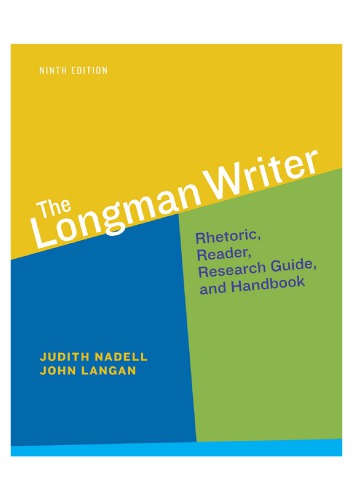
The Longman Writer 4th Edition by Eliza A Comodromos, John Langan, Deborah Coxwell-Teague ISBN 978-0321914132 0321914139
Original price was: $50.00.$35.00Current price is: $35.00.
The Longman Writer 4th Edition by Eliza A Comodromos, John Langan, Deborah Coxwell-Teague – Ebook PDF Instant Download/Delivery: 978-0321914132, 0321914139
Full download The Longman Writer 4th Edition after payment
Product details:
ISBN 10: 0321914139
ISBN 13: 978-0321914132
Author: Eliza A Comodromos, John Langan, Deborah Coxwell-Teague
The best of the “product” and “process” approaches to writing.
The Longman Writer with MyWritingLab draws on decades of teaching experience to integrate the best of the “product” and “process” approaches to writing. Emphasis on the reading-writing connection, focus on invention and revision, and attention to the fact that patterns blend in actual writing are delivered with clear, step-by-step writing instruction and extensive practice activities and assignments—more than 500 in all.
Table of contents:
Part I: The Reading Process
Becoming a Critical Reader
Stage 1: Get an Overview of the Selection
Stage 2: Deepen Your Sense of the Selection
Stage 3: Evaluate the Selection
Assessing Visuals in a Reading
Assessing an Image: An Example
Assessing a Graph: An Example
A Model Annotated Reading
Ellen Goodman, “Family Counterculture”
Part II: The Writing Process
1 Getting Started Through Prewriting
Use Prewriting to Get Started
Keep a Journal
The Pre-Reading Journal Entry
Understand the Boundaries of the Assignment
Determine Your Purpose, Audience, Tone, and Point of View
Discover Your Essay’s Limited Subject
Generate Raw Material About Your Limited Subject
Conduct Research
Organize the Raw Material
Activities: Getting Started Through Prewriting
2 Identifying a Thesis
What Is a Thesis?
Finding a Thesis
Writing an Effective Thesis
Tone and Point of View
Implied Pattern of Development
Including a Plan of Development
Don’t Write a Highly Opinionated Statement
Don’t Make an Announcement
Don’t Make a Factual Statement
Don’t Make a Broad Statement
Arriving at an Effective Thesis
Placing the Thesis in an Essay
Activities: Identifying a Thesis
3 Supporting the Thesis with Evidence
What Is Evidence?
How Do You Find Evidence?
How the Patterns of Development Help Generate Evidence
Characteristics of Evidence
The Evidence Is Relevant and Unified
The Evidence Is Specific
The Evidence Is Adequate
The Evidence Is Dramatic
The Evidence Is Accurate
The Evidence Is Representative
Borrowed Evidence Is Documented
Activities: Supporting the Thesis with Evidence
4 Organizing the Evidence
Use the Patterns of Development
Select an Organizational Approach
Chronological Approach
Spatial Approach
Emphatic Approach
Simple-to-Complex Approach
Prepare an Outline
Activities: Organizing the Evidence
5 Writing the Paragraphs in the First Draft
How to Move from Outline to First Draft
General Suggestions on How to Proceed If You Get Bogged Down
A Suggested Sequence for Writing the First Draft
Write the Supporting Paragraphs
Write Other Paragraphs in the Essay’s Body
Write the Introduction
Write the Conclusion
Write the Title
Pulling It All Together
Sample First Draft: Harriet Davids, “Challenges for Today’s Parents”
Commentary
Activities: Writing the Paragraphs in the First Draft
6 Revising Overall Meaning, Structure, and Paragraph Development
Five Strategies to Make Revision Easier
Set Your First Draft Aside for a While
Work from Printed Text
Read the Draft Aloud
View Revision as a Series of Steps
Evaluate and Respond to Instructor Feedback
Peer Review: An Additional Revision Strategy
Evaluate and Respond to Peer Review
Revising Overall Meaning and Structure
Revising Paragraph Development
Sample Student Revision of Overall Meaning, Structure, and Paragraph Development
Activities: Revising Overall Meaning, Structure, and Paragraph Development
People also search for:
longman academic writing 3 answer key
longman academic writing series 5 answer key
longman academic writing 5 answer key
the longman writer 9th edition pdf
longman and eagle happy hour
Tags: Eliza A Comodromos, John Langan, Deborah Coxwell-Teague, The Longman Writer