
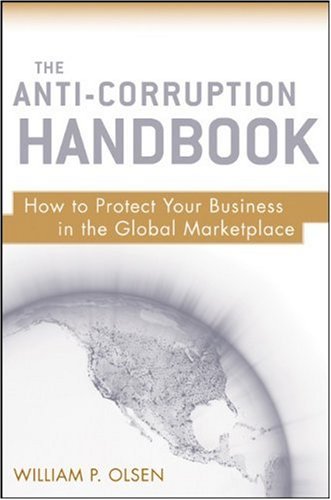
The Anti Corruption Handbook How to Protect Your Business in the Global Marketplace 1st Edition by William Olsen ISBN 0470484500 978-0470484500

Original price was: $50.00.$35.00Current price is: $35.00.
The Anti Corruption Handbook How to Protect Your Business in the Global Marketplace 1st Edition by William P. Olsen – Ebook PDF Instant Download/Delivery: 0470484500, 978-0470484500
Full download The Anti Corruption Handbook How to Protect Your Business in the Global Marketplace 1st Edition after payment
Product details:
ISBN 10: 0470484500
ISBN 13: 978-0470484500
Author: William P. Olsen
THE ANTI-CORRUPTION HANDBOOK
Today’s demanding marketplace expects CFOs, auditors, compliance officers, and forensic accountants to take responsibility for fraud detection. These expectations are buoyed by such legislation as the Foreign Corruption Practices Act (FCPA), which makes it a crime for any U.S. entity or individual to obtain or retain business by paying bribes to foreign government officials.
Written by William P. Olsen, the National Practice Leader of Investigations at Grant Thornton, The Anti-Corruption Handbook: How to Protect Your Business in the Global Marketplace provides guidelines addressing the challenges of maintaining business integrity in the global marketplace. Timely and thought provoking, this book reveals the risks of doing business around the world and the precautions organizations can take to deter such activity.
Authoritative, comprehensive, and insightful, The Anti-Corruption Handbook provides clear guidance on:
Managing corruption risk in the global marketplace
U.S. laws governing corruption
Internal controls and accounting provisions of FCPA
The human factor of corruption
Corporate governance: the key to unmasking corrupt activity
Navigating the perils of global business
Anti-money laundering
Procurement and construction fraud
Information security
Whistle blower programs
Doing business internationally does not need to increase your exposure to fraud and corruption. Filled with case studies, tables, charts, and practical examples, The Anti-Corruption Handbook: How to Protect Your Business in the Global Marketplace equips fraud-fighting professionalswhatever their role or responsibilitywith the knowledge and tools needed to obtain a competitive advantage in the global markets of the twenty-first century.
Table of contents:
1 Managing Corruption Risk
2 You are Not Alone
3 Bribery and Kickbacks
4 Economic Espionage
5 Money Laundering
6 Developing Effective Compliance Programs
7 Performing Due Diligence
8 What is Anti-Corruption?
9 Anti-Corruption Detection and Prevention
10 Critical Elements of an Effective Compliance Program
11 Governance and Oversight
12 U.S. Efforts to Combat Global Corruption
13 The Emergence of Nongovernment Organizations
14 World Trade Organization
15 Global Forum on Fighting Corruption
16 International Financial Institutions
17 International Chamber of Commerce
18 Transparency International
19 Global Corporate Governance Forum
20 The Role of Civil Society
21 The Emerging Markets
22 U.S. Laws Governing Corruption
23 Racketeer Influenced and Corrupt Organizations Act
24 RICO Offenses
25 Sherman Antitrust Act
26 Anti-Kickback Act of 1986
27 Economic Espionage Act of 1996
28 The Evolution of the Foreign Corrupt Practices Act
29 Background
30 Anti-Bribery Provisions
31 Third-Party Payments
32 Facilitating Payments
33 Sanctions against Bribery
34 Internal Controls and Accounting Provisions of the FCPA
35 FCPA Accounting Provisions
36 Failed Controls
37 Controls Assessment
38 Conclusion
39 Case Study: Rolling on a River
40 Do Not Crimp: The Need for Oversight of Foreign Operations
41 Pitfalls of Emerging Markets
42 Monitoring Behavior
43 Education and Communication
44 Extending the Tone from the Top beyond the Borders
45 Case Study: Bribes in the USSR
46 The Human Factor
47 Why Focus on Fraud and Corruption Risk?
48 Behavioral Root Causes of Fraud and Corruption
49 Psychology of Fraud Perpetrators
50 Understanding Management Fraud
51 Approaches to Deterring and Mitigating Financial Fraud Risk
52 Corporate Governance: The Key to Unmasking Corrupt Activity
53 Enterprise Risk Management: Create Stronger Governance and Corporate Compliance
54 Mitigating Risk
55 Ascertain Risk Areas
56 Establishing Procedures to Mitigate Risk
57 Perform a Periodic Assessment
58 Blowing the Whistle on Corporate Fraud
59 Whistle-Blower Programs
60 Pulling Out the Earplugs
61 Understanding Stakeholders and Their Needs
62 Steps of the MACH Process
63 Monitoring the MACH Process
64 Conclusion
65 Appendix
66 Document Retention
67 Create, Communicate, Monitor
68 Reduce Risk through Technology
69 Computer Crime
70 The Most Common Computer-Related Crimes
71 The Value of Stored Data
72 Information Security: Intellectual Property Theft is Often the Result of Government Corruption
73 Information Security Audit
74 Classification of Information
75 Division of Responsibilities and Duties is an Effective Strategy in Protecting Trade Secrets
76 Information Security Control Officers or Custodians
77 Use of Confidential or Proprietary Markings
78 Document Destruction
79 Education and Training
80 Background Checks
81 Confidentiality Agreements
82 Employee Orientation
83 Separation Plans
84 Physical Security
85 Systems Security
86 E-Mail Policy
87 Internet Policy
88 Solicitations for Information
89 Seminar/Tradeshow/Off-Site Meetings Policy
90 Joint Venture/Vendor/Subcontractor Procedures
91 Contractual Provisions with End Users
92 Action Plans
93 International Protection Issues
94 Information Security Policy
95 Anti–Money Laundering: The USA PATRIOT Act
96 Current State of AML in the Global Marketplace
97 Case Study: The Boys from Brazil
98 Procurement Fraud: Detecting and Preventing Procurement and Related Fraud
99 Kickbacks
100 Vendor Fraud
101 Bid Rigging
102 Defective Pricing and Price Fixing
103 Contract Fraud
104 Cost/Labor Mischarging
105 Case Study 1: Employee Fraud
106 Case Study 2: Vendor Kickbacks and Collusion
107 Conclusion
108 Construction Fraud: Monitoring, Mitigating, and Investigating Construction Fraud
109 Common Construction Company Fraud Schemes
110 Combating Fraud and Corruption
111 Strengthen Your Internal Controls
112 Special Investigations: How to Investigate Allegations of Corruption
113 An Interested Party: The Auditor
114 The Special Investigation
115 Navigating the Perils of the Global Marketplace
116 FCPA Enforcement
117 Record Keeping
118 Data Collection and Processing
119 Transborder Data-Flow Issues
120 Case for Collective Action: The World Bank Initiative
121 Why Collective Action against Corruption?
122 Different Views of Corruption
123 Business Costs of Corruption
124 Costs of Corruption for Industries, Economies, and Countries
125 Different Views of the Private Sector
126 Corruption Dilemma
127 Leveling the Playing Field
128 Book Research Summary
People also search for:
the anti handbook handbook
handbook corruption
anti-handbook handbook
anti corruption manual pdf
anti corruption handbook
Tags: William Olsen, The Anti Corruption, Protect Your Business, Global Marketplace