
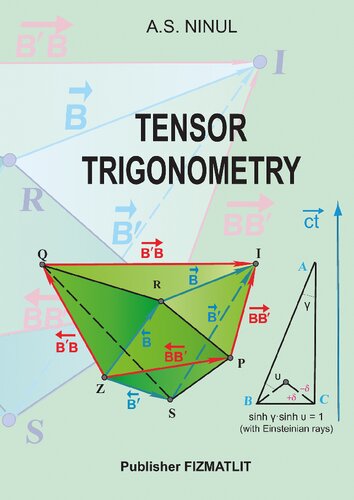
Tensor trigonometry 1st Edition by Nin Ul ISBN 9785030037172 5940522785


Original price was: $50.00.$35.00Current price is: $35.00.
Tensor trigonometry 1st Edition by Nin´Ul A. S. – Ebook PDF Instant Download/Delivery: 9785030037172, 5940522785
Full download Tensor trigonometry 1st Edition after payment
Product details:
ISBN 10: 5940522785
ISBN 13: 9785030037172
Author: Nin´Ul A. S.
The main goals of this monograph are (as 1st step) to develop a number of algebraic and geometric notions in Theory of Exact Matrices (Part I, Chapters 1-4), and then (as 2nd step) to work out on this platform the basic contents of Tensor Trigonometry with bivalent tensor angles of two kinds. They are formed either by two linear subspaces (planars) in the given superspace or formed by rotation of a linear subspace (planar) in the same superspace (Part II, Chapters 5-12). Since Tensor Trigonometry may have a lot of applications in mathematical and physical domains, some large examples of them are exposed in main Part II and in the book’s big Appendix. Described in the book are fundamentals of this new math subject with many various examples of its applications.
Planimetry includes metric part and trigonometry. In geometries of metric spaces, from the end of XIX age, their tensor forms are widely used. However the flat trigonometry is remained only in scalar forms in a plane or in a pseudoplane. Tensor trigonometry is development of the flat Scalar Trigonometry from Leonard Euler classic forms into multi-dimensional tensor forms (at n ≥ 2) with their vector and scalar orthoprojections in an admissible coordinate base, and with step by step increasing a complexity and opportunities. So, for n = 2, we developed preliminary simplest plane and pseudoplane tensor trigonometry, and developed further pseudoplane Scalar Trigonometry with all its trigonometric relations and complete solution of a pseudo-Euclidean right triangle. One of the latter’s important formula is illustrated with two complementary hyperbolic angles onto the book’s front cover.
In theoretic plan, Tensor Trigonometry with its binary tensor angles complements naturally Analytic Geometry and Linear Algebra. In practical plan, it gives the clear instrument for solutions of many various geometric and physical problems in homogeneous isotropic spaces, such as Euclidean, quasi-Euclidean and pseudo-Euclidean ones (i.e., as spaces with quadratic metrics); and also in non-Euclidean spherical or hyperbolic (hyper)subspaces of constant radius-parameter R embedded into them. For these spaces and subspaces, the various elementary kinds of Tensor Trigonometry give non-commutative Pythagorean Theorems, and very clearly general laws of angular summing two-step, multistep and integral rotations (motions) in complete forms with their polar decompositions into principal (spherical or hyperbolic) and secondary (orthospherical) ones. So, for non-collinear pseudo-Euclidean motions, a new interpretation of the orthospherical Thomas precession is given as manifestation of an induced Coriolis acceleration in the Minkowski space-time.
In general, for Theory of Relativity, these applications were considered till a complete tensor trigonometric 4D pseudoanalog for world lines of the classic 3D theory by Frenet–Serret for Euclidean curves with all absolute and relative differentially–geometric, kinematic and dynamic characteristics in current world points of a world line. Along the way, the strict and clear implementation of the classical Laws of conservation of momentum and energy in a closed system of particles or bodies for Minkowski space-time, as well as the very simple sequential genesis of physical tensors of relativistic motion from a dimensionless trigonometric motion tensor, have been demonstrated.
The book is intended for researchers in the fields of multi-dimensional spaces, analytic geometry, linear algebra with theory of exact matrices, non-Euclidean geometries, theory of relativity, and also to all those who is interested in new knowledges and applications, given by exact sciences. It may be useful for educational purposes on this new math subject in the university departments of algebra, geometry, and physics.
In a paper form, without having this book, one may read it, for example, in the largest Russian State Library and Scientific Library of MSU. In a digital form one may read or upload it, for instance, here or in the Google Books, in E-Books Directory (section Tensor Calculus), also in E-library.ru, e-library of MSU’s Mech-Math Faculty (section Geometry and Topology), etc.
Table of contents:
Part I. Theory of Exact Matrices: some of general questions
Chapter 1. Coefficients of characteristic polynomials
1.1. Simultaneous definition of scalar and matrix coefficients
1.2. The general inequality of means
1.3. The serial method for solving an algebraic equation with real roots
1.4. Structures of scalar and matrix characteristic coefficients
1.5. The minimal annulling polynomial of a matrix in its explicit form
1.6. Null-prime and null-defective singular matrices
1.7. The reduced form of characteristic coefficients
Chapter 2. Affine (oblique) and orthogonal eigenprojectors
2.1. Affine (oblique) eigenprojectors and quasi-inverse matrix
2.2. Spectral representation of anan-matrix and its basic canonical form
2.3. Transforming a null-prime matrix in the null-cell canonical form
2.4. Null-normal singular matrices
2.5. Spherically orthogonal eigenprojectors and quasi-inverse matrices
Chapter 3. Main scalar invariants of singular matrices
3.1. The minorant of a matrix and its applications
3.2. Sine characteristics of matrices.
3.3. Cosine characteristics of matrices
3.4. Limit methods for evaluating projectors and quasi-inverse matrices
Chapter 4. Two alternative complexity variants
4.1. Comparing two variants
4.2. Examples of adequate complexification
4.3. Examples of Hermitian and symbiotic complexification
Part II. Tensor trigonometry: fundamental contents
Chapter 5. Euclidean and quasi-Euclidean tensor trigonometry
5.1. Objects of tensor trigonometry and their space relations
5.2. Projective tensor sine, cosine, and spherically orthogonal reflectors
5.3. Projective tensor secant, tangent, and affine (oblique) reflectors
5.4. Comparison of two ways for defining projective tensor angles
5.5. Canonical cell-forms of trigonometric functions and reflectors
5.6. The trigonometric theory of prime roots VI
5.7. Rotational trigonometric functions and motive-type spherical angles
5.8. The tensor sine, cosine, socant, and tangent of a motive type angle
5.9. Relations between projective and motive angles and functions
5.10. Deformational trigonometric functions and cross projecting
5.11. Special transformations of orthogonal and oblique eigenprojectors
5.12. Elementary tensor spherical trigonometric functions with frame axes
Chapter 6. Pseudo-Euclidean tensor and scalar trigonometry as a basis
6.1. Hyperbolic tensor angles, trigonometric functions, and reflectors
6.2. Covariant concrete (or specific) spherical-hyperbolic analogy
6.3. The reflector tensor in quasi-Euclidean and pseudo-Euclidean interpretation.
6.4. Scalar trigonometry in a pseudoplane
6.5. Elementary tensor hyperbolic trigonometric functions with frame axes
Chapter 7. Trigonometric interpretation of matrices commutativity and anticommutativity
7.1. Commutativity of prime matrices
7.2. Anticommutativity of prime matrices pairs
Chapter 8. Trigonometric spectra and trigonometric inequalities
8.1. Trigonometric spectra of a null-prime matrix
8.2. The general cosine inequality
8.3. Spectral-cell representations of tensor trigonometric functions
8.4. The general sine inequality
Chapter 9. Geometric norms of matrix objects
9.1. Quadratic norms of matrix objects in Euclidean and quasi-Euclidean spaces
9.2. Absolute and relative norms
9.3. Geometric interpretation of particular quadratic norms
9.4. Lineors of special kinds and simplest figures formed by lineors
Chapter 10. Complexification of tensor trigonometry
10.1. Adequate complexification
10.2. Hermitian complexification
10.3. Pseudoization in binary complex spaces
Chapter 11. Tensor trigonometry of general pseudo-Euclidean spaces
11.1. Realification of complex quasi-Euclidean spaces
11.2. The general Lorentzian group of pseudo-Euclidean rotations
11.3. Polar representation of general pseudo-Euclidean rotations
11.4. Multistep hyperbolic rotations
Chapter 12. Tensor trigonometry of Minkowski pseudo-Euclidean space
12.1. Trigonometric models for two concomitant hyperbolic geometries
12.2. Rotations and deformations in elementary tensor forms
12.3. The special mathematical principle of relativity
Appendix. Trigonometric models of motions in STR and non-Euclidean Geometra
Preface with additional notations
Chapter 1A. Space-time of Lagrange and space-time of Minkowski as mathematical abstractions and physical reality
Chapter 2A. The tensor trigonometric model of Lorentzian homogeneous principal transformations
Chapter 3A. Einsteinian dilation of time as a consequence of the time-arrow hyperbolic rotation
Chapter 4A. Lorentzian seeming contraction of moving object extent as a consequence of the moving Euclidean subspace hyperbolic deformation
Chapter 5A. Trigonometric models of two-step, multistep and integral collinear motions in STR and in hyperbolic geometries
Chapter 6A. Isomorphic mapping of a pseudo-Euclidean space into time-like and space-like quasi-Euclidean ones, Beltrami pseudosphere
Chapter 7A. Trigonometric models of two-step, multistep and integral non-collinear motions in STR and in hyperbolic geometrices
Chapter 8A. Trigonometric models of two-step and multistep non-collinear motions in quasi-Euclidean space and in spherical geometry..
Chapter 9A. Real and observable space-time in the general relativity
Chapter 10A. Motions along world lines in (P+1) and their geometry
People also search for:
tensor trigonometry
tensor trigonometry pdf
tensor simple explanation
tensor formula
tensor explained
Tags: Nin Ul, Tensor trigonometry