
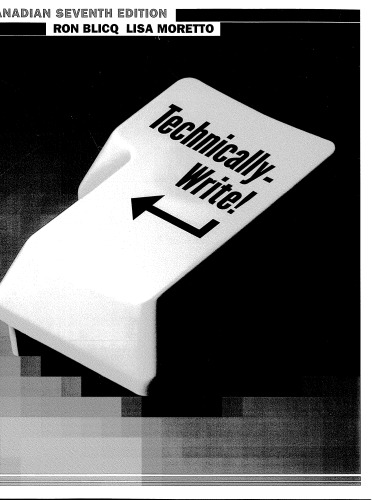
Technically Write Canadian Seventh Edition by Ronald Blicq, Lisa Moretto ISBN 9780131737235 0131737236

Original price was: $50.00.$35.00Current price is: $35.00.
Technically Write Canadian Seventh Edition by Ronald S. Blicq, Lisa A. Moretto – Ebook PDF Instant Download/Delivery: 9780131737235, 0131737236
Full download Technically Write Canadian Seventh Edition after payment
Product details:
ISBN 10: 0131737236
ISBN 13: 9780131737235
Author: Ronald S. Blicq, Lisa A. Moretto
Technically-Write! explores the most effective techniques for written and oral communication in today’s business world , and covers all aspects of technical correspondence, report writing, oral communication, and the job-seeking process. This comprehensive, mid-level text has been Canada’s best-selling technical writing text for more than 30 years. Featuring Blicq’s patented “pyramid” approach to the writing process, this unique method helps students structure their documents to grab and maintain a reader’s attention. The updated seventh edition of this well established book has been streamlined to utilize a more brief and direct “on-the-job” approach. With an additional emphasis on email, Technically-Write! continues to reflect today’s evolving professional world, and will continue to aid today’s evolving professional writers.
Table of contents:
Chapter 1
Why Technical People Need to Write Well
The First Fifty Years
A Change in Style
Chapter 2
A Technical Person’s Approach to Writing
Simplifying the Approach
Planning the Writing Task
Writing the First Draft
Taking a Break
Reading with a Plan
Checking for Clarity
Checking for Correct Tone and Style
Checking for Accuracy
Revising Your Own Words
Assignments
Chapter 3
Letters, Memos, and Emails
Using the Pyramid
Identifying the Main Message
Getting Started
Avoiding False Starts
Planning the Letter
Opening Up the Pyramid
Writing to Inform
Writing to Persuade
Creating a Confident Image
Be Clear
Be Concise
Be Complete
Be Definite
Adopting a Pleasant Tone
Know Your Reader
Be Sincere
Be Human
Avoid Words That Antagonize
Close on a Strong Note
Using Business Formats
Letter Style
Interoffice Memo
Fax Cover Sheet
Writing Electronic Mail
Email Etiquette
Assignments
Chapter 4
Short Informal Reports
Writing Style
Incident Report
Trip Report
Short Trip Reports
Long Trip Reports
Progress or Status Reports
Occasional Progress Report
Periodic Progress Report
Personal Progress Report
Project Completion Report
Inspection Report
Laboratory Report
Assignments
Chapter 5
Longer Informal and Semiformal Reports
Investigation Report
Conducting a Comparative Analysis
Evaluation Report/Feasibility Study
Assignments
Chapter 6
Formal Reports
Major Parts
Summary
Introduction
Discussion
Conclusions
Recommendations
Appendices
Subsidiary Parts
Cover
Title Page
Table of Contents
References (Endnotes), Bibliography, and Footnotes
Cover Letter
Executive Summary
The Complete Formal Report
The Main Parts
Traditional Arrangement of Report Parts
Pyramidal Arrangement of Report Parts
Assignments
Chapter 7
Technical Proposals
Overall Writing Plan
Short Informal Proposal
Longer Informal or Short Semiformal Proposal
Student Project Proposal
The Language of Proposal Writing
-
Present Only Essential Information
-
Use the Active Voice
-
Avoid Wishy-Washy Words
-
Avoid Giving Opinions
Assignments
Chapter 8
Instructions and Procedures
User’s Manual
Identifying the Audience
Writing Plan
Describing the Product
Using the Product
Technical Instruction
Start with a Plan
Give Your Reader Confidence
Avoid Ambiguity
Write Short Steps
Insert Precautions
Insist on an Operational Check
Assignments
Chapter 9
Illustrating Technical Documents
Primary Guidelines
Computer-Designed Graphs and Charts
Graphs
Single Curve
Multiple Curves
Graph Scales
Simplicity
Charts
Bar Charts
Histograms
Pie Charts
Diagrams
Photos
Digital Clip Art
Tables
Positioning the Illustrations
Assignments
Chapter 10
Technically-Speak!
The Technical Briefing
Establish the Circumstances
Determine Your Audience’s Needs
Prepare to Speak
Make Your Presentation
Taking Part in Meetings
The Chairperson’s Role
The Participants’ Role
The Secretary’s Role
Assignments
Chapter 11
Communicating with Prospective Employers
The Employment-Seeking Process
Using the Internet in Your Job Search
Developing a Personal Data Record
Education
Work Experience
Extracurricular Activities
References
Preparing a Resume
Resume Formats
The Traditional Resume
The Focused Resume
The Functional Resume
Electronic Resume Formats
Plain Text Resumes
Key Word Summary Resumes
Scanned Resumes
Web Portfolios or Resumes
Writing a Letter of Application
The Solicited Application Letter
The Unsolicited Application Letter
Completing a Company Application Form
Attending an Interview
Prepare for the Interview
Create a Good Initial Impression
Participate Throughout the Interview
Accepting a Job Offer
Assignments
Chapter 12
The Technique of Technical Writing
The Whole Document
Tone
Style
Appearance
Use Good Language
Paragraphs
Unity Within the Paragraph
Coherence in the Paragraph
Paragraph Development
Correct Length
Sentences
Unity Within the Sentence
Coherence Within the Sentence
Emphasis Within the Sentence
Completeness
Words
Words That Tell a Story
Combining Words into Compound Terms
Spelling “Canadian Style”
Long Versus Short Words
Low-Information-Content Expressions
Some Fine Points
Using Parallelism to Good Effect
Abbreviating Technical and Nontechnical Terms
Writing Numbers in Narrative
Writing Metric Units and Symbols (SI)
Writing Non-Gender-Specific Language
Writing for an International Audience
Assignments
People also search for:
technically write canadian
technically write
technical writing careers
technical writing capitalization rules
an example of technical writing