
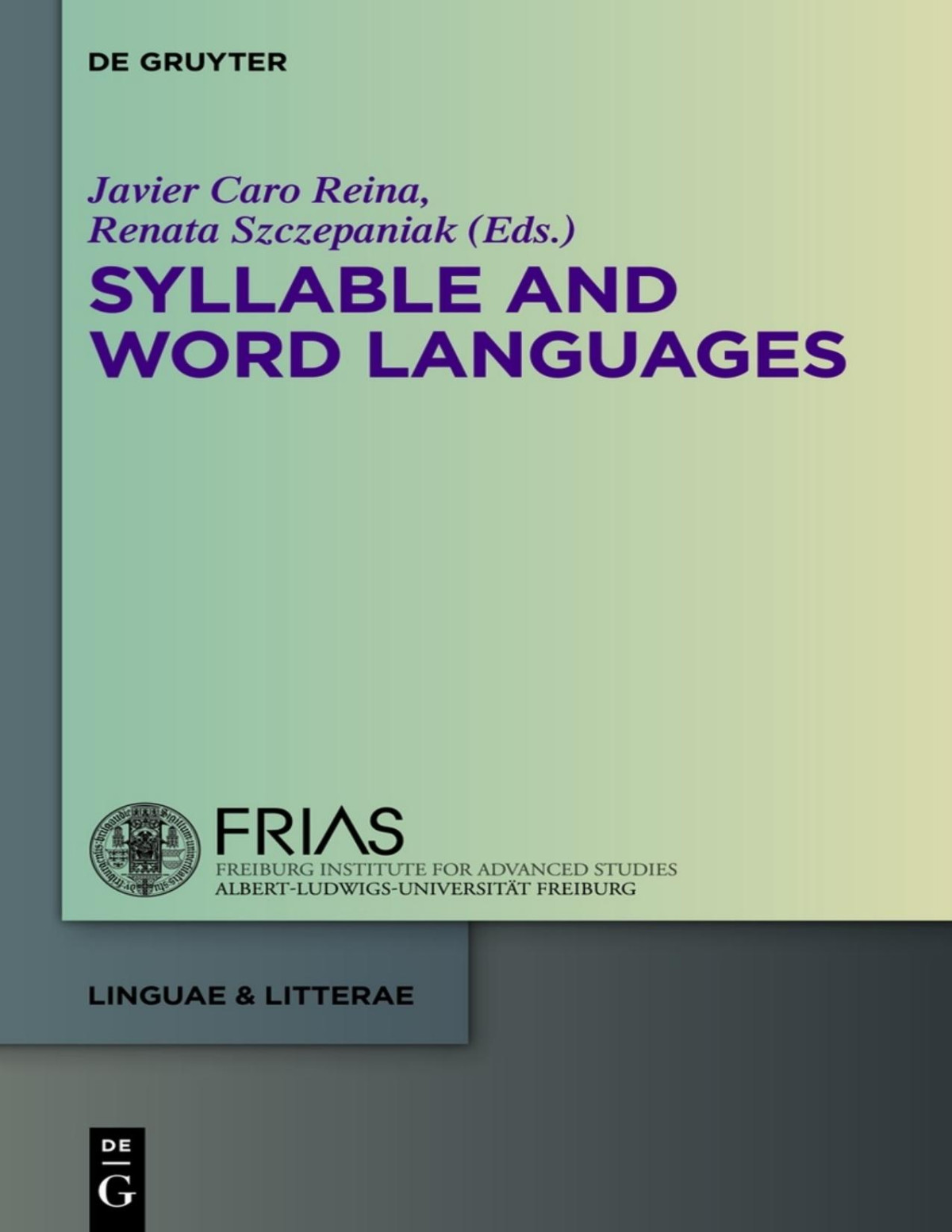
Syllable and Word Languages 1st Edition by Javier Caro Reina, Renata Szczepaniak ISBN 978-3110343458 3110343452
Original price was: $50.00.$35.00Current price is: $35.00.
Syllable and Word Languages 1st Edition by Javier Caro Reina, Renata Szczepaniak – Ebook PDF Instant Download/Delivery: 978-3110343458, 3110343452
Full download Syllable and Word Languages 1st Edition after payment
Product details:
ISBN 10: 3110343452
ISBN 13: 978-3110343458
Author: Javier Caro Reina, Renata Szczepaniak
This is the first volume concerned with the phonological typology of syllable and word languages, based on the model of a complex, multi-layered and hierarchically structured phonological system. The main typological claim is that the phonetic and phonological make-up of a language depends on the relevance of the prosodic categories. In previous research, the syllable and the phonological word have already proved to be typologically important. The contributions in this volume discuss theoretical questions and address issues such as the variable structure of the phonological word, the interplay between phonetics and phonology as well as the effect of a language’s phonological make-up on its morphology or lexicon. The volume provides detailed synchronic and diachronic analyses of (Non-)Indo-European languages which will serve as a basis for further typological research.
Table of contents:
Preface
References
Introduction: Syllable and word languages
1 Rhythm-based classifications
1.1 Syllable-timed vs. stress-timed languages (“Isochrony Hypothesis”)
1.2 Rhythm class hypothesis
2 The phonological typology of syllable and word languages
3 Typological parameters
4 Research areas
5 Summaries of the contributions in this volume
Part 1: Theoretical issues
Part 2: Diachronic approaches
Part 3: Synchronic approaches (Germanic languages)
Part 4: Synchronic approaches (Romance languages)
References
Part 1: Theoretical issues
The typology of syllable and word languages and Swedish phonological structure
1 Introduction
2 Theoretical preliminaries
2.1 Prosodic Phonology
2.2 The phonological word
2.3 Language-particular and cross-linguistic comparability of phonological words
2.4 One or several SL/WL continua
2.5 Indirect reference to morphosyntax
2.6 Domain of phonotactic constraints
2.7 Direction of processing in the phonological component and configurative function
2.8 Syllabification
2.9 Diagnostics for syllable and word languages
3 Canonical forms of native Swedish morphemes
4 The SL/WL criteria applied to Swedish
4.1 Word stress, tonal accent
4.2 Syllable structure in different positions in the word
4.3 Geminate vs. ambisyllabic consonants
4.4 Word-external vs. word-internal sandhi
4.5 Vowel inventories in accented vs. unaccented position
4.6 Vowel elision and consonant insertions
4.7 Word-related phonological processes
5 Syllabification
6 Recovery of grammatical boundaries by phonological means
6.1 Clues from morpheme structure
6.2 Clues from the outputs of rule applications
7 Swedish and SL/WL typology: Summary and final remarks
7.1 Descriptive/typological considerations
7.2 A concluding theoretical note
References
Syllable complexity in the diachrony of Romance languages: A center vs. periphery view and the syllable vs. word rhythm paradigm
1 Introductory remarks
2 Tendencies in Latin and Romance languages: Syllabic reduction vs. persistence of shell complexity
2.1 Syllabic reduction
2.2 Persistence of complex syllable types
3 A center vs. periphery view on syllable type complexity in Romance languages
3.1 Syllable shell complexity as a typological parameter in
Romance languages
3.2 Complexity: central vs. peripheral
4 Different ways of coping with syllable shell complexity
References
Pervasive syllables and phonological unity in words
1 Introduction
2 A syllable or a word language?
2.1 Korean
2.2 Turkish
2.2.1 Vowel harmony and the phonological word in Turkish
2.2.2 Minimal word size and category-specific phonology
3 Pertinacity of syllables: Emergent segments via syllable repair
3.1 Vowel hiatus
3.1.1 Vowel assimilation: A syllabically conditioned (but word-sensitive) process
3.2 (In)Tolerance for consonant clusters and word edge asymmetries
3.2.1 Syllabically conditioned perceptual epenthesis
4 Syllables and beyond: Phonology for word-segmentation
5 Pervasive syllables in morphological and prosodic change
6 Discussion and conclusion
References
Monosyllabic Lengthening in German and its relation to the syllable vs. word language typology
1 Introduction
2 Monosyllabic Lengthening in Zurich German
2.1 Moraic theory (Hayes 1989)
2.2 MSL in Zurich German: Quantity contrasts and word minimality
3 More on Monosyllabic Lengthening in High German varieties
3.1 Monosyllabic Lengthening or paradigm levelling?
3.2 A brief synopsis of High German quantity
developments
4 Doing typology: In search of correlations and implications
5 Conclusion and outlook
References
Vowel and consonant epentheses in the history of German from the typological perspective of syllable and word languages
1 Syllable and word as typologically relevant phonological
domains
2 Syllable and word language as opposite typological prototypes
3 Vowel epentheses in Old and Early New High German
3.1 The Old High German cluster breakers
3.2 The Early New High German trochee makers
4 Consonant epentheses in Old and Early New High German
4.1 The Old High German hiatus breakers
4.2 The Early New High German word edge strengtheners
4.3 The glottal stop and has word edge markers in contemporary German
5 Summary
References
Part 2: Diachronic approaches
Scandinavian word phonology: Evidence for a typological cycle
1 The Germanic languages: Some general structural
patterns and drift phenomena
2 Intervening factors
3 Splitting up Proto-Germanic: Mainly a case of vowel change?
4 On the phonotactics and word structure of Proto-Germanic and Ancient Nordic
5 West Scandinavian: A typological change from a predominantlysyllable language to a word language
6 East Scandinavian: Evidence of a typological cycle and counter-drift
6.1 The consequences of retroflex consonants in unstressed syllables
6.2 The rise of new enclitic inflections: A starting point for
a new typological cycle
6.3 Language contact: A typological counter-drift towards
a more syllable-relatedlanguage
6.4 Language cultivation:
Introducing spelling
pronunciation in modern Swedish
7 Conclusion
References
Syllable- and word-related developments in earlier Indo-Iranian
1 Introduction
1.1 The typological parameters
1.2 The older Indo-Iranian languages and their attestation
1.3 Overview of the phonological systems
1.4 Accent and stress
2 Phonological inventories and their relation to words and syllables
3 Syllable structure
3.1 Clusters and shell complexity
3.1.1 Onset clusters
3.1.2 Coda clusters
3.1.3 Conclusion
3.2 Sonority Hierarchy
3.3 Vowel epenthesis and loss
3.4 Consonantal processes
4 Sandhi and resyllabification
5 General conclusions
References
From Christel to Christina, from Klaus to Nico: A diachronic study of German first names (1945-2010) and their shift towards the syllable language type
1 German proper names and their changing structures
2 German first names and their historical development
3 Linguistic comparison of first names and common nouns since 1945
3.1 Number of syllables
3.2 Accent positions
3.3 Consonant clusters
3.4 In hiatus
3.5 Final black
3.6 Full vowels in unstressed positions
4 Conclusion
References
Part 3: Synchronic approaches (Germanic languages)
Reduction and deletion of glottal stops and geminates at phonological word boundaries in German compounds: Effects of word frequency and accentuation
1 Introduction
2 Materials and methods
2.1 Speech material
2.2 Acoustic analysis and segmentation
2.3 Statistic analysis
2.4 Frequency counts
3 Results
3.1 Glottal stop and glottalization
3.1.1 Combined realization categories
3.1.1.1 Frequency
3.1.1.2 Accentuation
3.1.2 Deletion of the glottal stop
3.1.3 Summary
3.2 Degemination
3.2.1 Cluster durations
3.2.2 Categorical evaluation
4 Summary and discussion
References
Phonological domains in Luxembourgish and their relevance for the phonological system
1 Introduction
2 Luxembourgish
3 (Potential) Syllable language traits
3.2 Schwa epenthesis
4 Word language traits
5 Phenomena related to the syllable and the phonological word at the same time
5.1 n-rule
5.2 Resyllabification and voicing assimilation
6 Discussion
References
Low German: A profile of a word language
1 Introduction
2 Low German as a word language
2.1 Criteria
2.2 Phoneme system
2.3 Stress sensitivity in segmental phonotactics
2.3.1 Syllable structure, word structure, and stress
2.3.2 Word-medial consonants
2.4 Phonological processes
2.4.1 Word-medial obstructive voicing
2.4.2 Stem-final consonants and postverbal /1k/
2.4.3 Expanding phonological words: Function words
2.5 Word-level suprasegmental: The Knick phoneme
3 Areal perspective: North German, Scandinavian, and beyond
4 Conclusion
References
Phonological and phonetic considerations for a classification of Swiss German dialects as a word language or a syllable
language
1 Introduction
2 Phonetic correlates of phonological differences
3 Swiss German dialect – A syllable language?
3.1 Word-related features in Swiss German dialects
3.2 Syllable-related features in Swiss German dialects
4 Prosodic evidence on the phonetic level
4.1 Resyllabification and the duration of fricatives
4.2 Duration of schwa
4.3 Intonation contour
5 Conclusion
References
Part 4: Synchronic approaches (Romance languages)
Central Catalan in the framework of the typology of syllable and word languages
1 Introduction
2 Determining the phonological domains
3 Syllable structure
4 Phonotactic restrictions
4.1 Stress-related restrictions
4.2 Position-related restrictions
5 Word-related processes
5.1 Word-final obstruent devoicing
5.2 Affrication of word-final/3/
5.3 Obstruent voicing across words
5.4 Deletion of unstressed vowels
5.5 Deletion of word-final n and.r
5.6 Simplification of word-final homorganic consonants
5.7 Word-final consonant epenthesis
6 Summary and discussion
References
Batidas latinas: On rhythm and meter in Spanish and Portuguese and other forms of music
1 Introduction: Language is music distorted by semantics
2 Facts of prosodic structure in Spanish and Portuguese
2.1 Vowel reduction
2.2 Lexical and morphological functions
2.3 Accents by lexical marks
2.4 Metrical alignment
2.5 Importance of meter in perception
3 Rhythm and meter in music
3.1 The grid and metrical well-formedness
3.2 The establishment of metrical structure
3.3 Attentional focus within metrical structure
4 Beats, prominence and cognitive networks
4.1 Differential Phonology
4.2 Moras as points in time
4.3 The rhythmic difference between Spanish and Portuguese
5 Conclusion
References
Syllable typology and the rhythm class hypothesis: Evidence from Italo-Romance dialects
1 Rhythm-oriented typology in the new millenium
2 Italian and Italo-Romance dialects
2.1 Italian
2.2 Italo-Romance dialects
3 A sketch of syllabic typology of Italo-Romance
3.1 Syllable types: Data collection and analysis
3.2 Syllable types: The numerical complexity of syllable structure
3.3 Sonority relations in syllable heads and codas
3.4 Some remarks on vowel reduction
4 Applying rhythm metrics to Italo-Romance dialects: A pilot study
4.1 Data and method
4.2 Italo-Romance dialects according to the metrics of Ramus, Nespor, and Mehler (1999)
4.3 Rhythm and speech rate in Italo-Romance dialects: Varco C
4.4 Italo-Romance dialects in the light of the Pairwise Variability Index (PVI)
5 Conclusion References
People also search for:
v/v syllable word list
2 syllable z words
z words in other languages
z syllables
y syllable
Tags: Javier Caro Reina, Renata Szczepaniak, Syllable and Word