
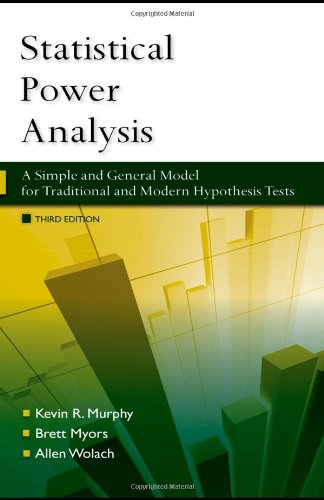
Statistical Power Analysis A Simple and General Model for Traditional and Modern Hypothesis Tests 3rd Edition by Kevin Murphy, Brett Myors, Allen Wolach 0415965551 9780415965552


Original price was: $50.00.$35.00Current price is: $35.00.
Statistical Power Analysis A Simple and General Model for Traditional and Modern Hypothesis Tests 3rd Edition by Kevin R. Murphy, Brett Myors, Allen Wolach – Ebook PDF Instant Download/Delivery: 0415965551, 978-0415965552
Full dowload Statistical Power Analysis A Simple and General Model for Traditional and Modern Hypothesis Tests 3rd Edition after payment
Product details:
ISBN 10: 0415965551
ISBN 13: 978-0415965552
Author: Kevin R. Murphy, Brett Myors, Allen Wolach
Noted for its accessible approach, this bestseller applies power analysis to both null hypothesis and minimum-effect testing using the same basic model. Through the use of a few relatively simple procedures and examples from the behavioral and social sciences, the authors show readers with little expertise in statistical analysis how to quickly obtain the values needed to carry out the power analysis for their research. Illustrations of how these analyses work and how they can be used to understand problems of study design, to evaluate research, and to choose the appropriate criterion for defining “statistically significant” outcomes are sprinkled throughout. The book presents a simple and general model for statistical power analysis that is based on the F statistic.
Statistical Power Analysis reviews how to determine:
- The sample size needed to achieve desired levels of power
- The level of power needed in a study
- The size of effect that can be reliably detected by a study
- Sensible criteria for statistical significance.
The third edition features:
- Re-designed, user-friendly software at www.psypress.com/statistical-power-analysis that allows users to perform all of the book’s analyses on a wider range of tests and conduct significance tests, power analyses, and assessments of N and alpha
- A new chapter on Complex ANOVA Designs that demonstrates the use of power analysis in split-plot and randomized block factorial designs
- New boxed sections that provide examples of power analysis in action and unique issues that arise when applying power analyses
- Expanded coverage of minimum-effect tests, the fundamentals of power analysis and the application of these concepts to correlational studies.
Ideal for students and researchers in the social, behavioral, and health sciences, business, and education, this valuable resource helps readers apply methods of power analysis to their research. PV and F tables serve as a quick reference.
More details – plus a link to download the One Stop F Calculator – can be found at http://www.psypress.com/statistical-power-analysis/ .
Statistical Power Analysis A Simple and General Model for Traditional and Modern Hypothesis Tests 3rd Table of contents:
Chapter 1: A First Encounter with Graphs
1.1. A few definitions
- 1.1.1. Directed graphs
- 1.1.2. Unoriented graphs
1.2. Paths and connected components - 1.2.1. Connected components
- 1.2.2. Stronger notions of connectivity
1.3. Eulerian graphs
1.4. Defining Hamiltonian graphs
1.5. Distance and shortest path
1.6. A few applications
1.7. Comments
1.8. Exercises
Chapter 2: A Glimpse at Complexity Theory
2.1. Some complexity classes
2.2. Polynomial reductions
2.3. More hard problems in graph theory
Chapter 3: Hamiltonian Graphs
3.1. A necessary condition
3.2. A theorem of Dirac
3.3. A theorem of Ore and the closure of a graph
3.4. Chvátal’s condition on degrees
3.5. Partition of Kn into Hamiltonian circuits
3.6. De Bruijn graphs and magic tricks
3.7. Exercises
Chapter 4: Topological Sort and Graph Traversals
4.1. Trees
4.2. Acyclic graphs
4.3. Exercises
Chapter 5: Building New Graphs from Old Ones
5.1. Some natural transformations
5.2. Products
5.3. Quotients
5.4. Counting spanning trees
5.5. Unraveling
5.6. Exercises
Chapter 6: Planar Graphs
6.1. Formal definitions
6.2. Euler’s formula
6.3. Steinitz’ theorem
6.4. About the four-color theorem
6.5. The five-color theorem
6.6. From Kuratowski’s theorem to minors
6.7. Exercises
Chapter 7: Colorings
7.1. Homomorphisms of graphs
7.2. A digression: isomorphisms and labeled vertices
7.3. Link with colorings
7.4. Chromatic number and chromatic polynomial
7.5. Ramsey numbers
7.6. Exercises
Chapter 8: Algebraic Graph Theory
8.1. Prerequisites
8.2. Adjacency matrix
8.3. Playing with linear recurrences
8.4. Interpretation of the coefficients
8.5. A theorem of Hoffman
8.6. Counting directed spanning trees
8.7. Comments
8.8. Exercises
Chapter 9: Perron–Frobenius Theory
9.1. Primitive graphs and Perron’s theorem
9.2. Irreducible graphs
9.3. Applications
9.4. Asymptotic properties
- 9.4.1. Canonical form
- 9.4.2. Graphs with primitive components
- 9.4.3. Structure of connected graphs
- 9.4.4. Period and the Perron–Frobenius theorem
- 9.4.5. Concluding examples
9.5. The case of polynomial growth
9.6. Exercises
Chapter 10: Google’s Page Rank
10.1. Defining the Google matrix
10.2. Harvesting the primitivity of the Google matrix
10.3. Computation
10.4. Probabilistic interpretation
10.5. Dependence on the parameter α
10.6. Comments
People also search for Statistical Power Analysis A Simple and General Model for Traditional and Modern Hypothesis Tests 3rd:
statistical power and significance level
simple power analysis calculator
how to do a statistical power analysis
power statistical significance
determining statistical power
Tags:
Kevin Murphy,Brett Myors,Allen Wolach,Statistical Power Analysis,Simple,General Model,Traditional,Modern,Hypothesis,Tests 3rd