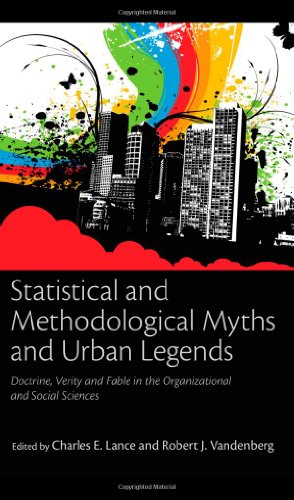
Statistical and Methodological Myths and Urban Legends Doctrine Verity and Fable in the Organizational and Social Sciences 1st Edition by Charles E. Lance, Robert J Vandenberg- Ebook PDF Instant Download/Delivery: 978-0805862386, 0805862382
Full download Statistical and Methodological Myths and Urban Legends Doctrine Verity and Fable in the Organizational and Social Sciences 1st Edition after payment

Product details:
ISBN 10: 0805862382
ISBN 13: 978-0805862386
Author: Charles E. Lance, Robert J Vandenberg
This book provides an up-to-date review of commonly undertaken methodological and statistical practices that are sustained, in part, upon sound rationale and justification and, in part, upon unfounded lore. Some examples of these “methodological urban legends”, as we refer to them in this book, are characterized by manuscript critiques such as: (a) “your self-report measures suffer from common method bias”; (b) “your item-to-subject ratios are too low”; (c) “you can’t generalize these findings to the real world”; or (d) “your effect sizes are too low”.
Historically, there is a kernel of truth to most of these legends, but in many cases that truth has been long forgotten, ignored or embellished beyond recognition. This book examines several such legends. Each chapter is organized to address: (a) what the legend is that “we (almost) all know to be true”; (b) what the “kernel of truth” is to each legend; (c) what the myths are that have developed around this kernel of truth; and (d) what the state of the practice should be. This book meets an important need for the accumulation and integration of these methodological and statistical practices.
Table of contents:
Part 1. Statistical Issues
Daniel A. Newman
Missing Data Techniques and Low Response Rates: The Role of Systematic Nonresponse Parameters
Michael J. Zickar, Alison A. Broadfoot
The Partial Revival of a Dead Horse? Comparing Classical Test Theory and Item Response Theory
Deborah L. Bandalos, Meggen R. Boehm
Four Common Misconceptions in Exploratory Factor Analysis
Adam W. Meade, Tara S. Behrend, Charles E. Lance
Dr. StrangeLOVE, or: How I Learned to Stop Worrying and Love Omitted Variables
James M. LeBreton, Jane Wu, Mark N. Bing
The Truth(s) on Testing for Mediation in the Social and Organizational Sciences
Jeffrey R. Edwards
Seven Deadly Myths of Testing Moderation in Organizational Research
Robert J. Vandenberg, Darrin M. Grelle
Alternative Model Specifications in Structural Equation Modeling: Facts, Fictions, and Truth
Ronald S. Landis, Bryan D. Edwards, Jose M. Cortina
On the Practice of Allowing Correlated Residuals Among Indicators in Structural Equation Models
Part 2. Methodological Issues
Lillian T. Eby, Carrie S. Hurst, Marcus M. Butts
Qualitative Research: The Red-Headed Stepchild in Organizational and Social Science Research?
Scott Highhouse, Jennifer Z. Gillespie
Do Samples Really Matter That Much?
Herman Aguinis, Erika E. Harden
Sample Size Rules of Thumb: Evaluating Three Common Practices
Jose M. Cortina, Ronald S. Landis
When Small Effect Sizes Tell a Big Story, and When Large Effect Sizes Don’t
David Chan
Why Ask Me? Are Self-report Data Really that Bad?
Charles E. Lance, Lisa E. Baranik, Abby R. Lau, Elizabeth A. Scharlau
If It Ain’t Trait It Must Be Method: (Mis)application of the Multitrait Multimethod Design in Organizational Research
Marcus M. Butts, Thomas W. H. Ng
Chopped Liver? OK. Chopped Data? Not OK
People also search for:
Vstatistical and methodological
statistical methodology examples
what are statistical methodologies
statistical analysis methodologies
statistical methodology meaning
Tags: Charles Lance, Robert J Vandenberg, Statistical and Methodological, Urban Legends