
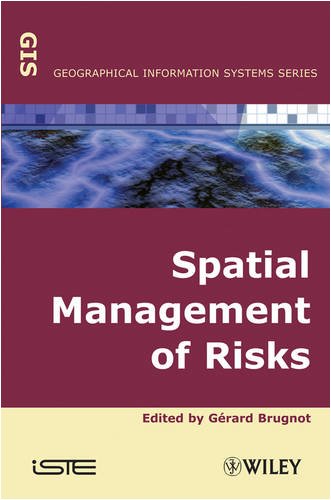
Spatial Management of Risks Geographical Information Systems 1st Edition by Gerard Brugnot ISBN 978-1118623541 1118623541

Original price was: $50.00.$35.00Current price is: $35.00.
Spatial Management of Risks Geographical Information Systems 1st Edition by Gerard Brugnot – Ebook PDF Instant Download/Delivery: 978-1118623541, 1118623541
Full download Spatial Management of Risks Geographical Information Systems 1st Edition after payment
Product details:
ISBN 10: 1118623541
ISBN 13: 978-1118623541
Author: Gerard Brugnot
Spatial analysis is an increasingly important tool for detecting and preventing numerous risk and crisis phenomena such as floods in a geographical area. This book concentrates on examples of prevention but also gives crisis control advice and practical case studies. Some chapters address urban applications in which vulnerabilities are concentrated in area; others address more rural areas with more scattered phenomena.
Table of contents:
Chapter 1. From Prevention to Risk Management: Use of GIS.
Sophie SAUVAGNARGUES-LESAGE
1.1. Introduction.
1.2. GIS and public security.
1.3. Examples of applications for public security
1.3.1. SIGASC application
1.3.2. Application
1.3.3. SIG CODIS application
1.4. Prospects for development.
1.5. Conclusion
1.6. Bibliography
Chapter 2. Coupled Use of Spatial Analysis and Fuzzy Arithmetic:
Assessing the Vulnerability of a Watershed to Phytosanitary Products
Bertrand DE BRUYN, Catherine FREISSINET and Michel VAUCLIN
2.1. Introduction.
2.2. Construction of the index.
2.3. Implementation of fuzzy calculations
2.4. Application to the watershed of Vannetin: vulnerability to atrazine
2.4.1. The research site
2.4.2. Parameters of the watershed
2.4.2.1. Pluviometry
2.4.2.2. Anthropogenic sub-index
2.4.2.3. Pedology
2.4.2.4. Summary of data common to the entire watershed
2.4.3. Cell parameters
2.4.3.1. Geographic characteristics of the area.
2.4.3.2. Vegetation cover
2.4.4. Fuzzy parameters
2.4.5. Representation of the indicator and of its related inaccuracy
2.5. Conclusion
2.6. Bibliography
Chapter 3. Agricultural Non-Point Source Pollution
Philippe BOLO and Christophe BRACHET
3.1. Introduction.
3.2. Mapping non-point source pollution phenomenon.
3.2.1. Mapping principles.
3.2.2. Description of the research phenomenon.
3.2.3. Mapping steps.
3.3. Territorial database building rules
3.3.1. Choosing software programs
3.3.2. Design of the implemented GIS
3.3.3. Organizing and creating geographic information layers
3.3.3.1. Implementation of a conceptual data model
3.3.3.2. Digitization of paper-based document.
3.3.3.3. Digital data import
3.3.3.4. Controlling the geographic data integrity.
3.3.4. Organizing and creating attribute tables
3.3.4.1. Implementing a conceptual data model.
3.3.4.2. Creating a data dictionary.
3.3.4.3. Thematic data processing or import
3.3.4.4. Controlling the attribute data integrity
3.4. The data sources used.
3.4.1. Identifying the available information
3.4.2. Soil-related data.
3.4.2.1. Surface texture of the soils
3.4.2.2. Soil hydromorphy.
3.4.2.3. Soil textural differentiation
3.4.3. Topography-related data.
3.4.3.1. The slope.
3.4.3.2. Slope orientation
3.4.4. Land use-related data.
3.4.5. Land planning-related data
3.4.5.1. Hedges
3.4.5.2. Ditches
3.4.5.3. Agricultural land drainage.
3.5. Pollution risk zoning
3.5.1. Treatments to be performed.
3.5.1.1. Zoning of the potential for pollution.
3.5.1.2. Vulnerability zoning.
3.5.1.3. Risk zoning
3.5.2. An example of risk zoning
3.5.2.1 General presentation of the research area
3.5.2.2. Knowing the risks
3.5.2.3. Transfer diagnosis
3.5.2.4. Risk management.
3.6. Risk zoning applications
3.6.1. Risk knowledge applications
3.6.2. Spatial planning applications
3.6.3. Applications related to monitoring water quality
3.7. Conclusion
3.8. Bibliography
Chapter 4. Cartographic Index and History of Road Sites that Face Natural Hazards in the Province of Turin
Paola ALLEGRA, Laura TURCONI and Domenico TROPEANO
4.1. Introduction.
4.2. Principal risks
4.3. Research area.
4.3.1. Geological insight
4.3.2. Morphology of the research areas
4.4. Working method.
4.5. Computer-based synthetic analysis and transcription of historical data and information collected on the research area.
4.6. First results
4.7. Structure of computer thematic mapping
4.8. Application and use of the method
4.9. Bibliography
Chapter 5. Forest and Mountain Natural Risks: From Hazard
Representation to Risk Zoning – The Example of Avalanches
Frédéric BERGER and Jérôme LIÉVOIS
5.1. Introduction.
5.1.1. General information on forests.
5.1.2. The protective role of mountain forests.
5.2. Identification of protective forest zones
5.2.1. General principle.
5.2.2. Methodology
5.2.3. Building up a synthesis map of natural hazards
5.2.3.1. General information on the process of mapping avalanches.
5.2.3.2. General principles to build a synthesis map of natural hazards upon existing cartographic documents
5.2.3.3. A method to characterize potential avalanche terrain.
5.2.4. Building up the forest map
5.2.5. Building up the natural forest-hazard synthesis map
5.2.6. Building up the map of socio-economic issues and vulnerability.
5.2.7. Building up the priority areas for forestry action map
5.3. Perspectives
5.4. The creation of green zones in risk prevention plans
5.4.1. Natural hazard prevention plans
5.4.1.1. Objectives
5.4.1.2. Tools
5.4.1.3. A necessity.
5.4.2. Transfer from researchers to users.
5.4.3. The method used
5.4.4. Consequences of these works.
5.4.5. Reflections and perspectives
5.5. Conclusion: general recommendations
.5.6. Bibliography
Chapter 6. GIS and Modeling in Forest Fire Prevention.
Marielle JAPPIOT, Raphaële BLANCHI and Franck GUARNIERI
6.1. Understanding forest fire risks
6.1.1. Risk.
6.1.2. Description of the phenomenon
6.1.3. Particularities of fire risk
6.1.3.1. Forest fire hazard.
6.1.3.2. Human response to the phenomenon
6.1.3.3. Specific issues.
6.1.4. A spatio-temporal variation of forest fire risk
6.2. Forest fire management: risk mapping and the use of spatial analysis.
6.2.1. Requirements with respect to forest fire risk assessment.
6.2.1.1. Chronological evolution in the field of forest fire risk mapping
6.2.1.2. Town planning requirements
6.2.1.3. Forest management requirements
6.2.1.4. Other requirements.
6.2.2. Forest fire risk assessment and mapping: the use of geographic information systems
6.2.2.1. Towards a risk analysis approach
6.2.2.2. Implementing traditional spatial analysis tools to assess forest fire risks.
6.2.2.3. Coupling to models.
6.3. Using GIS to map forest fire risks
6.3.1. Forest fire risk assessment and mapping in the Massif des Maures
(Department of Var): raster GIS
6.3.1.1. Analytical approach: the example of fire propagation hazard..
6.3.1.2. Towards a global approach: characterization of interfaces with the use of remote sensing
6.3.2. WILFRIED – fire fighting support (coupling GIS and model)
6.3.2.1. Model systems and knowledge-based systems for the processing of knowledge
6.3.2.2. WILFRIED, a PSE dedicated to forest fire prevention.
6.3.2.3. Partial conclusion.
6.4. Conclusion
6.5. Bibliography
Chapter 7. Spatial Decision Support and Multi-Agent Systems:
Application to Forest Fire Prevention and Control
Franck GUARNIERI, Alain JABER and Jean-Luc WYBO
7.1. Introduction.
7.2. Natural risk prevention support and the need for cooperation between the software programs
7.2.1. The cooperation issue between the information systems.
7.2.2. The various approaches aiming at facilitating this type of cooperation.
7.3. Towards an intelligent software agent model to satisfy
the cooperation between the decision-support systems dedicated to natural risk prevention
7.3.1. The multi-agent paradigm.
7.3.2. Intelligent software agents
7.3.3. A proposed intelligent software agent model
7.4. Experiment in the field of forest fire prevention and control.
7.4.1. Context of the experiment
7.4.2. The experiment scenario.
7.4.3. First part of the scenario.
7.4.4. Second part of the scenario
7.4.5. An example of problem solving
7.4.6. Conclusion of the scenario
7.5. Conclusions and perspectives
7.6. Bibliography
People also search for:
7 types of risk management
6 steps of risk management process
5 risk management strategies
4 risk management techniques
4 risk management strategies
Tags: Gerard Brugnot, Spatial Management, Risks Geographical