
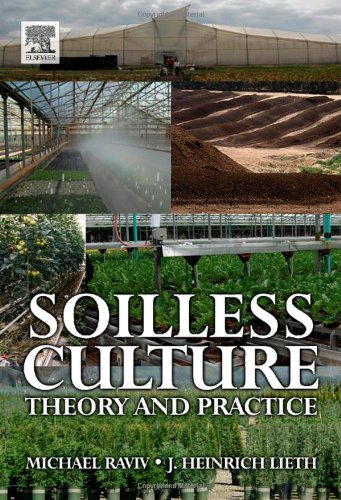
Soilless Culture Theory and Practice 1st Edition by Michael Raviv, Heinrich Lieth ISBN 978-0444529756 0444529756


Original price was: $50.00.$35.00Current price is: $35.00.
Soilless Culture Theory and Practice 1st Edition by Michael Raviv, J. Heinrich Lieth- Ebook PDF Instant Download/Delivery: 978-0444529756, 0444529756
Full download Soilless Culture Theory and Practice 1st Edition after payment
Product details:
ISBN 10: 0444529756
ISBN 13: 978-0444529756
Author: Michael Raviv, J. Heinrich Lieth
Plant production in hydroponics and soilless culture is rapidly expanding throughout the world, raising a great interest in the scientific community. For the first time in an authoritative reference book, authors cover both theoretical and practical aspects of hydroponics (growing plants without the use of soil). This reference book covers the state-of-the-art in this area, while offering a clear view of supplying plants with nutrients other than soil. Soilless Culture provides the reader with an understanding of the properties of the various soiless media and how these properties affect plant performance in relation to basic horticultural operations, such as irrigation and fertilization. This book is ideal for agronomists, horticulturalists, greenhouse and nursery managers, extension specialists, and people involved with the production of plants.
* Comprehensive discussion of hydroponic systems, irrigation, and control measures allows readers to achieve optimal performance* State-of-the-art book on all theoretical aspects of hydroponics and soilless culture including a thorough description of the root system, its functions and limitation posed by restricted root volume* Critical and updated reviews of current analytical methods and how to translate their results to irrigation and fertilization practices * Definitive chapters on recycled, no-discharge systems including salinity and nutrition management and pathogen eradication * Up-to-date description of all important types of growing media
Table of contents:
1. Significance of Soilless Culture in Agriculture
1.1 Historical Facets of Soilless Production
1.2 Hydroponics
1.3 Soilless Production Agriculture
References
2. Functions of the Root System
2.1 The Functions of the Root System
2.2 Depth of Root Penetration
2.3 Water Uptake
2.4 Response of Root Growth to Local Nutrient Concentrations
-
2.4.1 Nutrient Uptake
-
2.4.2 Root Elongation and P Uptake
-
2.4.3 Influence of N Form and Concentration
2.5 Interactions Between Environmental Conditions and Form of N Nutrition -
2.5.1 Temperature and Root Growth
-
2.5.2 Role of Ca in Root Elongation
-
2.5.3 Light Intensity
-
2.5.4 pH
-
2.5.5 Urea
-
2.5.6 Mycorrhiza–Root Association
2.6 Roots as Source and Sink for Organic Compounds and Plant Hormones -
2.6.1 Hormone Activity
References
Further Readings
3. Physical Characteristics of Soilless Media
3.1 Physical Properties of Soilless Media
-
3.1.1 Bulk Density
-
3.1.2 Particle Size Distribution
-
3.1.3 Porosity
-
3.1.4 Pore Distribution
3.2 Water Content and Water Potential in Soilless Media -
3.2.1 Water Content
-
3.2.2 Capillarity, Water Potential and its Components
-
3.2.3 Water Retention Curve and Hysteresis
3.3 Water Movement in Soilless Media -
3.3.1 Flow in Saturated Media
-
3.3.2 Flow in an Unsaturated Media
-
3.3.3 Richards Equation, Boundary and Initial Conditions
-
3.3.4 Wetting and Redistribution of Water in Soilless Media – Container Capacity
3.4 Uptake of Water by Plants in Soilless Media and Water Availability -
3.4.1 Root Water Uptake
-
3.4.2 Modeling Root Water Uptake
-
3.4.3 Determining Momentary and Daily Water Uptake Rate
-
3.4.4 Roots Uptake Distribution Within Growing Containers
-
3.4.5 Water Availability vs. Atmospheric Demand
3.5 Solute Transport in Soilless Media -
3.5.1 Transport Mechanisms – Diffusion, Dispersion, Convection
-
3.5.2 Convection–Dispersion Equation
-
3.5.3 Adsorption – Linear and Non-linear
-
3.5.4 Non-equilibrium Transport – Physical and Chemical Non-equilibria
-
3.5.5 Modeling Root Nutrient Uptake – Single-root and Root-system
3.6 Gas Transport in Soilless Media -
3.6.1 General Concepts
-
3.6.2 Mechanisms of Gas Transport
-
3.6.3 Modeling Gas Transport in Soilless Media
References
4. Irrigation in Soilless Production
4.1 Introduction
-
4.1.1 Water Movement in Plants
-
4.1.2 Water Potential
-
4.1.3 The Root Zone
-
4.1.4 Water Quality
4.2 Root Zone Moisture Dynamics -
4.2.1 During an Irrigation Event
-
4.2.2 Between Irrigation Events
-
4.2.3 Prior to an Irrigation Event
4.3 Irrigation Objectives and Design Characteristics -
4.3.1 Capacity
-
4.3.2 Uniformity
4.4 Irrigation Delivery Systems -
4.4.1 Overhead Systems
-
4.4.2 Surface Systems
-
4.4.3 Subsurface
4.5 Irrigation System Control Methods -
4.5.1 Occasional Irrigation
-
4.5.2 Pulse Irrigation
-
4.5.3 High Frequency Irrigation
-
4.5.4 Continuous Irrigation
4.6 Irrigation Decisions -
4.6.1 Irrigation Frequency
-
4.6.2 Duration of Irrigation Event
4.7 Approaches to Making Irrigation Decisions -
4.7.1 ‘Look and Feel’ Method
-
4.7.2 Gravimetric Method
-
4.7.3 Time-based Method
-
4.7.4 Sensor-based Methods
-
4.7.5 Model-based Irrigation
4.8 Future Research Directions
References
5. Technical Equipment in Soilless Production Systems
5.1 Introduction
5.2 Water and Irrigation
-
5.2.1 Water Supply
-
5.2.2 Irrigation Approaches
-
5.2.3 Fertigation Hardware
5.3 Production Systems -
5.3.1 Systems on the Ground
-
5.3.2 Above-ground Production Systems
5.4 Examples of Specific Soilless Crop Production Systems -
5.4.1 Fruiting Vegetables
-
5.4.2 Single-harvest Leaf Vegetables
-
5.4.3 Single-harvest Sown Vegetables
-
5.4.4 Other Speciality Crops
-
5.4.5 Cut Flowers
-
5.4.6 Potted Plants
5.5 Discussion and Conclusion
References
6. Chemical Characteristics of Soilless Media
6.1 Charge Characteristics
-
6.1.1 Adsorption of Nutritional Elements to Exchange Sites
6.2 Specific Adsorption and Interactions Between Cations/Anions and Substrate Solids -
6.2.1 Phosphorus
-
6.2.2 Zinc
-
6.2.3 Effects of P and Zn Addition on Solution Si Concentration
6.3 Plant-induced Changes in the Rhizosphere -
6.3.1 Effects on Chemical Properties of Surfaces of Substrate Solids
-
6.3.2 Effects on Nutrients Availability
-
6.3.3 Assessing the Impact of Plants: The Effect of Citric Acid Addition on P Availability
6.4 Nutrient Release from Inorganic and Organic Substrates
References
7. Analytical Methods Used in Soilless Cultivation
7.1 Introduction
-
7.1.1 Why to Analyze Growing Media?
-
7.1.2 Variation
-
7.1.3 Interrelationships
7.2 Physical Analysis -
7.2.1 Sample Preparation (Bulk Sampling and Sub-sampling)
-
7.2.2 Bulk Sampling Preformed Materials
-
7.2.3 Bulk Sampling Loose Material
-
7.2.4 Sub-sampling Pre-formed materials
-
7.2.5 Sub-sampling Loose Materials
7.3 Methods -
7.3.1 Bulk Density
-
7.3.2 Porosity
-
7.3.3 Particle Size
-
7.3.4 Water Retention and Air Content
-
7.3.5 Rewetting
-
7.3.6 Rehydration Rate
-
7.3.7 Hydrophobicity (or Water Repellency)
-
7.3.8 Shrinkage
-
7.3.9 Saturated Hydraulic Conductivity
-
7.3.10 Unsaturated Hydraulic Conductivity
-
7.3.11 Oxygen Diffusion
-
7.3.12 Penetrability
-
7.3.13 Hardness, Stickiness
7.4 Chemical Analysis -
7.4.1 Water-soluble Elements
-
7.4.2 Exchangeable, Semi- and Non-water Soluble Elements
-
7.4.3 The pH in Loose Media
-
7.4.4 Nitrogen Immobilization
-
7.4.5 Calcium Carbonate Content
7.5 Biological Analysis -
7.5.1 Stability (and Rate of Biodegradation)
-
7.5.2 Potential Biodegradability
-
7.5.3 Heat Evolution (Dewar Test)
-
7.5.4 Solvita Test™
-
7.5.5 Respiration Rate by CO₂ Production
-
7.5.6 Respiration Rate by O₂ Consumption (The Potential Standard Method)
-
7.5.7 Weed Test
-
7.5.8 Growth Test
References
8. Nutrition of Substrate-grown Plants
8.1 General
8.2 Nutrient Requirements of Substrate-grown Plants
-
8.2.1 General
-
8.2.2 Consumption Curves of Crops
8.3 Impact of N Source -
8.3.1 Modification of the Rhizosphere pH and Improvement of Nutrient Availability
-
8.3.2 Cation-anion Balance in Plant and Growth Disorders Induced by NH₄⁺ Toxicity
8.4 Integrated Effect of Irrigation Frequency and Nutrients Level -
8.4.1 Nutrient Availability and Uptake by Plants
-
8.4.2 Direct and Indirect Outcomes of Irrigation Frequency on Plant Growth
8.5 Salinity Effect on Crop Production -
8.5.1 General
-
8.5.2 Salinity-nutrients Relationships
-
8.5.3 Yield Quality Induced by Salinity-nutrients
8.6 Composition of Nutrient Solution -
8.6.1 pH Manipulation
-
8.6.2 Salinity Control
References
9. Fertigation Management and Crops Response to Solution Recycling in Semi-closed Greenhouses
9.1 System Description
-
9.1.1 Essential Components
-
9.1.2 Processes and System Variables and Parameters
-
9.1.3 Substrate Considerations
-
9.1.4 Monitoring
-
9.1.5 Control
9.2 Management -
9.2.1 Inorganic Ion Accumulation
-
9.2.2 Organic Carbon Accumulation
-
9.2.3 Microflora Accumulation
-
9.2.4 Discharge Strategies
-
9.2.5 Substrate and Solution Volume Per Plant
-
9.2.6 Effect of Substrate Type
-
9.2.7 Water and Nutrients Replenishment
-
9.2.8 Water Quality Aspects
-
9.2.9 Fertigation Frequency
-
9.2.10 pH Control: Nitrification and Protons and Carboxylates Excretion by Roots
-
9.2.11 Root Zone Temperature
-
9.2.12 Interrelationship Between Climate and Solution Recycling
-
9.2.13 Effect of N Sources and Concentration on Root Disease Incidence
9.3 Specific Crops Response to Recirculation -
9.3.1 Vegetable Crops
-
9.3.2 Ornamental Crops
9.4 Modeling the Crop-Recirculation System -
9.4.1 Review of Existing Models
-
9.4.2 Examples of Closed-loop Irrigation System Simulations
9.5 Outlook: Model-based Decision-support Tools for Semi-Closed Systems
Acknowledgment
Appendix
References
10. Pathogen Detection and Management Strategies in Soilless Plant Growing Systems
10.1 Introduction
-
10.1.1 Interaction Between Growing Systems and Plant Pathogens
-
10.1.2 Disease-Management Strategies
-
10.1.3 Overview of the Chapter
10.2 Detection of Pathogens -
10.2.1 Disease Potential in Closed Systems
-
10.2.2 Biological and Detection Thresholds
-
10.2.3 Method Requirements for Detection and Monitoring
-
10.2.4 Detection Techniques
-
10.2.5 Possibilities and Drawbacks of Molecular Detection Methods for Practical Application
-
10.2.6 Future Developments
10.3 Microbial Balance -
10.3.1 Microbiological Vacuum
-
10.3.2 Microbial Populations in Closed Soilless Systems
-
10.3.3 Plant as Driving Factor of the Microflora
-
10.3.4 Biological Control Agents
-
10.3.5 Disease-suppressive Substrate
-
10.3.6 Conclusions
10.4 Disinfestation of the Nutrient Solution -
10.4.1 Recirculation of Drainage Water
-
10.4.2 Volume to be Disinfected
-
10.4.3 Filtration
-
10.4.4 Heat Treatment
-
10.4.5 Oxidation
-
10.4.6 Electromagnetic Radiation
-
10.4.7 Active Carbon Adsorption
-
10.4.8 Copper Ionization
-
10.4.9 Conclusions
10.5 Synthesis: Combined Strategies -
10.5.1 Combining Strategies
-
10.5.2 Combining Biological Control Agents and Disinfestation
-
10.5.3 Non-pathogenic Microflora After Disinfestation
-
10.5.4 Addition of Beneficial Microbes to Sand Filters
-
10.5.5 Detection of Pathogenic and Beneficial Micro-organisms
-
10.5.6 Future
Acknowledgments
References
11. Organic Soilless Media Components
11.1 Introduction
11.2 Peat
-
11.2.1 Chemical Properties
-
11.2.2 Physical Properties
-
11.2.3 Nutrition in Peat
11.3 Coir -
11.3.1 Production of Coir
-
11.3.2 Chemical Properties
-
11.3.3 Physical Properties
-
11.3.4 Plant Growth in Coir
11.4 Wood Fiber -
11.4.1 Production of Wood Fiber
-
11.4.2 Chemical Properties
-
11.4.3 Physical Properties
-
11.4.4 Nitrogen Immobilization
-
11.4.5 Crop Production in Wood Fiber
-
11.4.6 The Composting Process
11.5 Bark -
11.5.1 Chemical Properties
-
11.5.2 Nitrogen Immobilization
-
11.5.3 Physical Properties
-
11.5.4 Plant Growth
11.6 Sawdust
11.7 Composted Plant Waste
11.8 Other Materials
11.9 Stability of Growing Media -
11.9.1 Physical and Biological Stability
-
11.9.2 Pathogen Survival in Compost
11.10 Disease Suppression by Organic Growing Media -
11.10.1 The Phenomenon and its Description
-
11.10.2 Suggested Mechanisms for Suppressiveness of Compost Against Root Diseases
-
11.10.3 Horticultural Considerations of Use of Compost as Soilless Substrate
References
12. Inorganic and Synthetic Organic Components of Soilless Culture and Potting Mixes
12.1 Introduction
12.2 Most Commonly Used Inorganic Substrates in Soilless Culture
-
12.2.1 Natural Unmodified Materials
-
12.2.2 Processed Materials
-
12.2.3 Mineral Wool
12.3 Most Commonly Used Synthetic Organic Media in Soilless Culture -
12.3.1 Polyurethane
-
12.3.2 Polystyrene
-
12.3.3 Polyester Fleece
12.4 Substrates Mixtures — Theory and Practice -
12.4.1 Substrate Mixtures — Physical Properties
-
12.4.2 Substrate Mixtures — Chemical Properties
-
12.4.3 Substrate Mixtures — Practice
12.5 Concluding Remarks
Acknowledgments
References
13. Growing Plants in Soilless Culture: Operational Conclusions
13.1 Evolution of Soilless Production Systems
-
13.1.1 Major Limitation of Soilless vs. Soil-growing Plants
-
13.1.2 The Effects of Restricted Root Volume on Crop Performance and Management
-
13.1.3 The Effects of Restricted Root Volume on Plant Nutrition
-
13.1.4 Root Confinement by Rigid Barriers and Other Contributing Factors
-
13.1.5 Root Exposure to Ambient Conditions
-
13.1.6 Root Zone Uniformity
13.2 Development and Change of Soilless Production Systems -
13.2.1 How New Substrates and Growing Systems Emerge (and Disappear)
-
13.2.2 Environmental Restrictions and the Use of Closed Systems
-
13.2.3 Soilless ‘Organic’ Production Systems
-
13.2.4 Tailoring Plants for Soilless Culture: A Challenge for Plant Breeders
-
13.2.5 Choosing the Appropriate Medium, Root Volume and Growing System
13.3 Management of Soilless Production Systems -
13.3.1 Interrelationships Among Various Operational Parameters
-
13.3.2 Dynamic Nature of the Soilless Root Zone
-
13.3.3 Sensing and Controlling Root-zone Major Parameters: Present and Future
People also search for:
soilless culture theory and practice pdf
soilless culture theory and practice 2nd edition pdf
soilless culture theory and practice elsevier
what is soilless culture
types of soilless culture
Tags: Michael Raviv, Heinrich Lieth, Soilless Culture Theory