
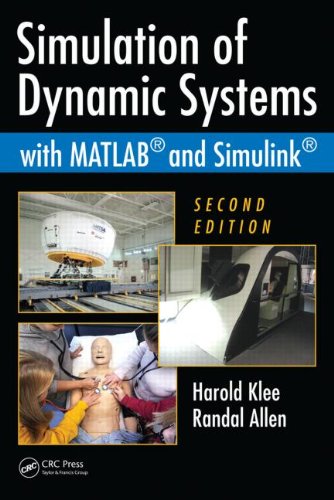
Simulation of Dynamic Systems with MATLAB and Simulink Second Edition by Harold Klee, Randal Allen ISBN 1439836736 978-1439836736

Original price was: $50.00.$35.00Current price is: $35.00.
Simulation of Dynamic Systems with MATLAB and Simulink Second Edition by Harold Klee, Randal Allen – Ebook PDF Instant Download/Delivery: 1439836736, 978-1439836736
Full download Simulation of Dynamic Systems with MATLAB and Simulink Second Edition after payment
Product details:
ISBN 10: 1439836736
ISBN 13: 978-1439836736
Author: Harold Klee, Randal Allen
“… a seminal text covering the simulation design and analysis of a broad variety of systems using two of the most modern software packages available today. … particularly adept [at] enabling students new to the field to gain a thorough understanding of the basics of continuous simulation in a single semester, and [also provides] a more advanced treatment of the subject for researchers and simulation professionals.”
—From the Foreword by Chris Bauer, PhD, PE, CMSP
Continuous-system simulation is an increasingly important tool for optimizing the performance of real-world systems, and a massive transformation has occurred in the application of simulation in fields ranging from engineering and physical sciences to medicine, biology, economics, and applied mathematics. As with most things, simulation is best learned through practice—but explosive growth in the field requires a new learning approach.
A response to changes in the field, Simulation of Dynamic Systems with MATLAB® and Simulink®, Second Edition has been extensively updated to help readers build an in-depth and intuitive understanding of basic concepts, mathematical tools, and the common principles of various simulation models for different phenomena.
Includes an abundance of case studies, real-world examples, homework problems, and equations to develop a practical understanding of concepts
Accomplished experts Harold Klee and Randal Allen take readers through a gradual and natural progression of important topics in simulation, introducing advanced concepts only after they construct complete examples using fundamental methods. Presented exercises incorporate MATLAB® and Simulink®—including access to downloadable M-files and model files—enabling both students and professionals to gain experience with these industry-standard tools and more easily design, implement, and adjust simulation models in their particular field of study.
More universities are offering courses—as well as masters and Ph.D programs—in both continuous-time and discrete-time simulation, promoting a new interdisciplinary focus that appeals to undergraduates and beginning graduates from a wide range of fields. Ideal for such courses, this classroom-tested introductory text presents a flexible, multifaceted approach through which simulation can play a prominent role in validating system design and training personnel involved.
Become an O’Reilly member and get unlimited access to this title plus top books and audiobooks from O’Reilly and nearly 200 top publishers, thousands of courses curated by job role, 150+ live events each month,
and much more.
Table of contents:
Chapter 1 Mathematical Modeling
1.1 Introduction…
1.1.1 Importance of Models
1.2 Derivation of a Mathematical Model
Exercises.
1.3 Difference Equations
1.3.1 Recursive Solutions.
Exercises.
1.4 First Look at Discrete-Time Systems.
1.4.1 Inherently Discrete-Time Systems
Exercises.
1.5 Case Study: Population Dynamics (Single Species).
Exercises.
Chapter 2 Continuous-Time Systems
2.1 Introduction PDF Enhancer
2.2 First-Order Systems.
2.2.1 Step Response of First-Order Systems..
Exercises.
2.3 Second-Order Systems..
2.3.1 Conversion of Two First-Order Equations to a Second-Order Model.
Exercises.
2.4 Simulation Diagrams
2.4.1 Systems of Equations
Exercises..
2.5 Higher-Order Systems.
Exercises.
2.6 State Variables
2.6.1 Conversion from Linear State Variable Form to Single Input-Single Output Form
2.6.2 General Solution of the State Equations.
Exercises.
2.7 Nonlinear Systems.
2.7.1 Friction
2.7.2 Dead Zone and Saturation.
2.7.3 Backlash
2.7.4 Hysteresis.
2.7.5 Quantization.
2.7.6 Sustained Oscillations and Limit Cycles.
Exercises.
2.8 Case Study: Submarine Depth Control System
Exercises.
Chapter 3 Elementary Numerical Integration
3.1 Introduction.
3.2 Discrete-Time System Approximation of a Continuous-Time Integrator…..
Exercises..
3.3 Euler Integration
3.3.1 Backward (Implicit) Euler Integration
Exercises..
3.4 Trapezoidal Integration.
Exercises…..
3.5 Numerical Integration of First-Order and Higher Continuous-Time Systems..
3.5.1 Discrete-Time System Models from Simulation Diagrams.
3.5.2 Nonlinear First-Order Systems.
3.5.3 Discrete-Time State Equations.
3.5.4 Discrete-Time State System Matrices
Exercises.
Improvements to Euler Integration. 3.6
3.6.1 Improved Euler Method.
3.6.2 Modified Euler Integration
Exercises.
3.7 Case Studya Vedical Ascent of a Dihancer.
3.7.1 Maximum Cable Force for Safe Ascent..
3.7.1.1 Trial and Error
3.7.1.2 Analytical Solution
3.7.2 Diver Ascent with Decompression Stops.
Exercises.
Chapter 4 Linear Systems Analysis
4.1 Introduction.
4.2 Laplace Transform..
4.2.1 Properties of the Laplace Transform.
4.2.2 Inverse Laplace Transform..
4.2.3 Laplace Transform of the System Response.
4.2.4 Partial Fraction Expansion.
Exercises.
4.3 Transfer Function.
4.3.1 Impulse Function
4.3.2 Relationship between Unit Step Function and Unit Impulse Function….
4.3.3 Impulse Response.
4.3.4 Relationship between Impulse Response and Transfer Function…
4.3.5 Systems with Multiple Inputs and Outputs.
4.3.6 Transformation from State Variable Model to Transfer Function….
Exercises.
4.4 Stability of Linear Time Invariant Continuous-Time Systems
4.4.1 Characteristic Polynomial…
4.4.2 Feedback Control System.
Exercises..
4.5 Frequency Response of LTI Continuous-Time Systems….
4.5.1 Stability of Linear Feedback Control Systems Based on Frequency Response.
Exercises.
4.6 z-Transform..
4.6.1 Discrete-Time Impulse Function.
4.6.2 Inverse z-Transform…..
4.6.3 Partial Fraction Expansion.
Exercises.
4.7 z-Domain Transfer Function..
4.7.1 Nonzero Initial Conditions
4.7.2 Approximating Continuous-Time System Transfer Functions
4.7.3 Simulation Diagrams and State Variables
4.7.4 Solution of Linear Discrete-Time State Equations
4.7.5 Weighting Sequence (Impulse Response Function).
Exercises..
4.8 Stability of LTI Discrete-Time Systems
4.8.1 Complex Poles of H(z)
Exercises.
4.9 Frequency Response of Discrete-Time Systems
4.9.1 Steady State Sinusoidal Responsancer
4.9.2 Properties of the Discrete-Time Frequency Response Function..
4.9.3 Sampling Theorem
4.9.4 Digital Filters.
Exercises.
4.10 Control System Toolbox
4.10.1 Transfer Function Models
4.10.2 State-Space Models
4.10.3 State-Space/Transfer Function Conversion.
4.10.4 System Interconnections..
4.10.5 System Response.
4.10.6 Continuous-/Discrete-Time System Conversion..
4.10.7 Frequency Response.
4.10.8 Root Locus.
Exercises.
4.11 Case Study: Longitudinal Control of an Aircraft..
4.11.1 Digital Simulation of Aircraft Longitudinal Dynamics
4.11.2 Simulation of State Variable Model.
Exercises..
4.12 Case Study: Notch Filter for Electrocardiograph Waveform.
4.12.1 Multinotch Filters
Exercises.
Chapter 5 Simulink®
5.1 Introduction..
5.2 Building a Simulink® Model.
5.2.1 Simulink Library.
5.2.2 Running a Simulink® Model..
Exercises…
5.3 Simulation of Linear Systems
5.3.1 Transfer Fen Block
5.3.2 State-Space Block..
Exercises..
5.4 Algebraic Loops
5.4.1 Eliminating Algebraic Loops
5.4.2 Algebraic Equations
Exercises.
5.5 More Simulink® Blocks
5.5.1 Discontinuities
5.5.2 Friction
5.5.3 Dead Zone and Saturation..
5.5.4 Backlash
5.5.5 Hysteresis..
5.5.6 Quantization.
Exercises.
5.6 Subsystems
5.6.1 PHYSBE.
5.6.2 Car-Following Subsystem
5.6.3 Subsystem Using Fen Blocks.
Exercises.
5.7 Discrete-Time SysteDF Enhancer
5.7.1 Simulation of an Inherently Discrete-Time System.
5.7.2 Discrete-Time Integrator.
5.7.3 Centralized Integration.
5.7.4 Digital Filters..
5.7.5 Discrete-Time Transfer Function
Exercises.
5.8 MATLAB® and Simulink® Interface
Exercises.
5.9 Hybrid Systems: Continuous- and Discrete-Time Components
Exercises…
5.10 Monte Carlo Simulation
5.10.1 Monte Carlo Simulation Requiring Solution of a Mathematical Model
Exercises.
5.11 Case Study: Pilot Ejection.
Exercises.
5.12 Case Study: Kalman Filtering
5.12.1 Continuous-Time Kalman Filter.
5.12.2 Steady-State Kalman Filter.
5.12.3 Discrete-Time Kalman Filter
5.12.4 Simulink® Simulations.
5.12.5 Summary.
Exercise
Chapter 6 Intermediate Numerical Integration.
6.1 Introduction
6.2 Runge-Kutta (RK) (One-Step Methods).
6.2.1 Taylor Series Method
6.2.2 Second-Order Runge-Kutta Method.
6.2.3 Truncation Errors…
6.2.4 High-Order Runge-Kutta Methods.
6.2.5 Linear Systems: Approximate Solutions Using RK Integration..
6.2.6 Continuous-Time Models with Polynomial Solutions.
6.2.7 Higher-Order Systems
Exercises..
6.3 Adaptive Techniques
6.3.1 Repeated RK with Interval Halving.
6.3.2 Constant Step Size (T=1 min)..
6.3.3 Adaptive Step Size (Initial T=1 min).
6.3.4 RK-Fehlberg
Exercises.
6.4 Multistep Methods.
6.4.1 Explicit Methods
6.4.2 Implicit Methods
6.4.3 Predictor-Corrector Methods
Exercises..
6.5 Stiff Systems.
6.5.1 Stiffness Property in First-Order System
6.5.2 Stiff Second-Order Systemhancer
6.5.3 Approximating Stiff Systems with Lower-Order Nonstiff System Models
Exercises.
6.6 Lumped Parameter Approximation of Distributed Parameter Systems
6.6.1 Nonlinear Distributed Parameter System….
Exercises..
6.7 Systems with Discontinuities.
6.7.1 Physical Properties and Constant Forces Acting on the Pendulum BOB
Exercises.
6.8 Case Study: Spread of an Epidemic..
Exercises.
Chapter 7 Simulation Tools
7.1 Introduction…
7.2 Steady-State Solver.
7.2.1 Trim Function.
7.2.2 Equilibrium Point for a Nonautonomous System.
Exercises.
7.3 Optimization of Simulink® Models.
7.3.1 Gradient Vector
7.3.2 Optimizing Multiparameter Objective Functions Requiring Simulink® Models.
7.3.3 Parameter Identification..
7.3.4 Example of a Simple Gradient Search…
7.3.5 Optimization of Simulink® Discrete-Time System Models….
Exercises.
7.4 Linearization
7.4.1 Deviation Variables
7.4.2 Linearization of Nonlinear Systems in State Variable Form..
7.4.3 Linmod Function
7.4.4 Multiple Linearized Models for a Single System
Exercises…
7.5 Adding Blocks to the Simulink Library Browser.
7.5.1 Introduction
7.5.2 Summary.
Exercise
7.6 Simulation Acceleration
7.6.1 Introduction
7.6.2 Profiler
7.6.3 Summary.
Exercise
Chapter 8 Advanced Numerical Integration
8.1 Introduction….
8.2 Dynamic Errors (Characteristic Roots, Transfer Function).
8.2.1 Discrete-Time Systems and the Equivalent
A Continuous-Time Systemsnhancer.
8.2.2 Characteristic Root Errors
8.2.3 Transfer Function Errors
8.2.4 Asymptotic Formulas for Multistep Integration Methods…
8.2.5 Simulation of Linear System with Transfer Function H(s)
Exercises.
8.3 Stability of Numerical Integrators.
8.3.1 Adams-Bashforth Numerical Integrators.
8.3.2 Implicit Integrators
8.3.3 Runge-Kutta (RK) Integration…
Exercises.
8.4 Multirate Integration.
8.4.1 Procedure for Updating Slow and Fast States:
Master/Slave =RK-4/RK-4.
8.4.2 Selection of Step Size Based on Stability
8.4.3 Selection of Step Size Based on Dynamic Accuracy
8.4.4 Analytical Solution for State Variables..
8.4.5 Multirate Integration of Aircraft Pitch Control System.
8.4.6 Nonlinear Dual Speed Second-Order System..
8.4.7 Multirate Simulation of Two-Tank System
8.4.8 Simulation Trade-Offs with Multirate Integration.
Exercises.
8.5 Real-Time Simulation…
8.5.1 Numerical Integration Methods Compatible with Real-Time Operation….
8.5.2 RK-1 (Explicit Euler).
8.5.3 RK-2 (Improved Euler
).
8.5.4 RK-2 (Modified Euler).
8.5.5 RK-3 (Real-Time Incompatible)
8.5.6 RK-3 (Real-Time Compatible).
8.5.7 RK-4 (Real-Time Incompatible).
8.5.8 Multistep Integration Methods.
8.5.9 Stability of Real-Time Predictor-Corrector Method.
8.5.10 Extrapolation of Real-Time Inputs.
8.5.11 Alternate Approach to Real-Time Compatibility: Input Delay…
Exercises.
8.6 Additional Methods of Approximating Continuous-Time
System Models
8.6.1 Sampling and Signal Reconstruction.
8.6.2 First-Order Hold Signal Reconstruction..
8.6.3 Matched Pole-Zero Method.
8.6.4 Bilinear Transform with Prewarping..
Exercises.
8.7 Case Study: Lego Mindstorms
NXT
8.7.1 Introduction
8.7.2 Requirements and Installation.
8.7.3 Noisy Model.
8.7.4 Filtered Model
8.7.5 Summary.
Exercise
People also search for:
simulation of dynamic systems with matlab
simulation of dynamic systems with matlab and simulink pdf
simulation of dynamic systems with matlab and simulink 3rd edition
simulink dynamic system
matlab dynamic system
Tags: Harold Klee, Randal Allen, Simulation of Dynamic, Systems with MATLAB