
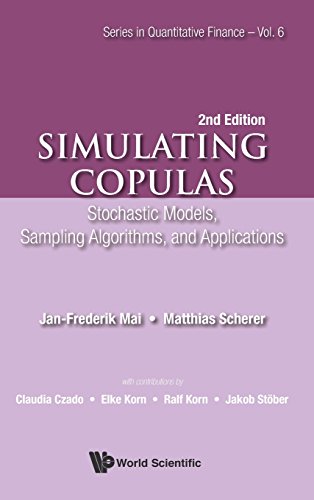
Simulating Copulas Stochastic Models Sampling Algorithms and Applications 2nd Edition by Jan-Frederik Mai, Matthias Scherer ISBN 978-9813149267 9813149267


Original price was: $50.00.$35.00Current price is: $35.00.
Simulating Copulas Stochastic Models Sampling Algorithms and Applications 2nd Edition by Jan-Frederik Mai, Matthias Scherer- Ebook PDF Instant Download/Delivery: 978-9813149267, 9813149267
Full download Simulating Copulas Stochastic Models Sampling Algorithms and Applications 2nd Edition after payment
Product details:
ISBN 10: 9813149267
ISBN 13: 978-9813149267
Author: Jan-Frederik Mai, Matthias Scherer
‘The book remains a valuable tool both for statisticians who are already familiar with the theory of copulas and just need to develop sampling algorithms, and for practitioners who want to learn copulas and implement the simulation techniques needed to exploit the potential of copulas in applications.’Mathematical ReviewsThe book provides the background on simulating copulas and multivariate distributions in general. It unifies the scattered literature on the simulation of various families of copulas (elliptical, Archimedean, Marshall-Olkin type, etc.) as well as on different construction principles (factor models, pair-copula construction, etc.). The book is self-contained and unified in presentation and can be used as a textbook for graduate and advanced undergraduate students with a firm background in stochastics. Besides the theoretical foundation, ready-to-implement algorithms and many examples make the book a valuable tool for anyone who is applying the methodology.
Table of contents:
1. Introduction
1.1 Copulations
Analytical Properties
1.1.2 Sklar’s Theorem and Survival Copulas
1.1.3 General Sampling Methodology in Low
Dimensions
1.1.4 Graphical Visualization
1.1.5 Concordance Measures
1.1.6 Measures of Extremal Dependence
1.2 General Classifications of Copulas
1.2.1 Radial Symmetry
1.2.2 Exchangeability
1.2.3 Homogeneous Mixture Models
1.2.4 Heterogeneous Mixture Models/Hierarchical Models
1.2.5 Extreme-Value Copulas
2. Archimedean Copulas
2.1 Motivation
2.2 Extendible Archimedean Copulas
2.2.1 Kimberling’s Result and Bernstein’s Theorem
2.2.2 Properties of Extendible Archimedean Copulas
2.2.3 Constructing Multi-Parametric Families.
2.2.4 Parametric Families
2.3 Exchangeable Archimedean Copulas
2.3.1 Constructing Exchangeable Archimedean Copulas
2.3.2 Sampling Exchangeable Archimedean Copulas
2.3.3 Properties of Exchangeable Archimedean Copulas
2.4 Hierarchical (H-Extendible) Archimedean Copulas
2.4.1 Compatibility of Generators
2.4.2 Probabilistic Construction and Sampling
2.4.3 Properties
2.4.4 Examples.
2.5 Other Topics Related to Archimedean Copulas
2.5.1 Simulating from the Generator
2.5.2 Asymmetrizing Archimedean Copulas
3. Marshall-Olkin Copulas
3.1 The General Marshall-Olkin Copula
3.1.1 Canonical Construction of the MO Distribution
3.1.2 Alternative Construction of the MO Distribution
3.1.3 Properties of Marshall-Olkin Copulas
3.2 The Exchangeable Case
3.2.1 Reparameterizing Marshall-Olkin Copulas
3.2.2 The Inverse Pascal Triangle
3.2.3 Efficiently Sampling eMO
3.2.4 Hierarchical Extensions
3.3 The Extendible Case
3.3.1 Precise Formulation and Proof of Theorem 3.1
3.3.2 Proof of Theorem 3.2
3.3.3 Efficient Simulation of Lévy-Frailty Copulas
3.3.4 Hierarchical (H-Extendible) Lévy-Frailty Copulas
4. Elliptical Copulas
4.1 Spherical Distributions
4.2 Elliptical Distributions
4.3 Parametric Families of Elliptical Distributions.
4.4 Elliptical Copulas.
4.5 Parametric Families of Elliptical Copulas
4.6 Sampling Algorithms
4.6.1 A Generic Sampling Scheme
4.6.2 Sampling Important Parametric Families
5. Pair Copula Constructions
5.1 Introduction to Pair Copula Constructions.
5.2 Copula Construction by Regular Vine Trees
5.2.1 Regular Vines
5.2.2 Regular Vine Matrices
5.3 Simulation from Regular Vine Distributions
5.3.1 h-Functions for Bivariate Copulas and Their Rotated Versions
5.3.2 The Sampling Algorithms.
5.4 Dependence Properties
5.5 Application
5.5.1 Time Series Model for Each Margin
5.5.2 Parameter Estimation
5.5.3 Forecasting Value at Risk
5.5.4 Backtesting Value at Risk
5.5.5 Backtest Results
6. Sampling Univariate Random Variables
6.1 General Aspects of Generating Random Variables.
6.2 Generating Uniformly Distributed Random Variables.
6.2.1 Quality Criteria for RNG.
6.2.2 Common Causes of Trouble
6.3 The Inversion Method
6.4 Generating Exponentially Distributed Random Numbers
6.5 Acceptance-Rejection Method.
6.6 Generating Normally Distributed Random Numbers
6.6.1 Calculating the Cumulative Normal
6.6.2 Generating Normally Distributed Random
Numbers via Inversion
6.6.3 Generating Normal Random Numbers with Polar Methods
6.7 Generating Lognormal Random Numbers
6.8 Generating Gamma-Distributed Random Numbers
6.8.1 Generating Gamma-Distributed RNs with ẞ >1.
6.8.2 Generating Gamma-Distributed RNs with β<1.
6.8.3 Relations to Other Distributions
6.9 Generating Chi-Square-Distributed RNs
6.10 Generating t-Distributed Random Numbers
6.11 Generating Pareto-Distributed Random Numbers
6.12 Generating Inverse Gaussian-Distributed Random Numbers.
6.13 Generating Stable-Distributed Random Numbers
6.14 Generating Discretely Distributed Random Numbers
6.14.1 Generating Random Numbers with Geometric and Binomial Distribution
6.14.2 Generating Poisson-Distributed Random Numbers
7. The Monte Carlo Method
7.1 First Aspects of the Monte Carlo Method
7.2 Variance Reduction Methods
7.2.1 Antithetic Variates
7.2.2 Antithetic Variates for Radially Symmetric Copulas.
7.2.3 Control Variates
7.2.4 Approximation via a Simpler Dependence Structure
7.2.5 Importance Sampling
7.2.6 Importance Sampling via Increasing the Dependence
7.2.7 Further Comments on Variance Reduction Methods
8. Further Copula Families with Known Extendible Subclass
8.1 Exogenous Shock Models
8.1.1 Extendible Exogenous Shock Models
8.2 Extreme-Value Copulas
8.2.1 Multivariate Distributions with Exponential Minima
8.2.2 Hierarchical (H-extendible) Extreme-Value Copulas.
People also search for:
copulas
discrete copulas
copulas for dummies
copula density
simulate from copula
Tags: Jan-Frederik Mai, Matthias Scherer, Simulating Copulas, Models Sampling, Algorithms and Applications