
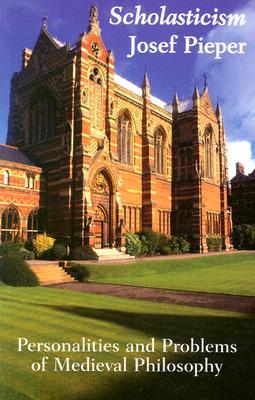
Scholasticism Personalities and Problems of Medieval Philosophy 1st Edition by Josef Pieper ISBN 978-1587317507 1587317507


Original price was: $50.00.$35.00Current price is: $35.00.
Scholasticism Personalities and Problems of Medieval Philosophy 1st Edition by Josef Pieper – Ebook PDF Instant Download/Delivery: 978-1587317507, 1587317507
Full download Scholasticism Personalities and Problems of Medieval Philosophy 1st Edition after payment
Product details:
ISBN 10: 1587317507
ISBN 13: 978-1587317507
Author: Josef Pieper
No better guide over the thousand-year period called the Middle Ages could be found than Josef Pieper. In this amazing tour de monde medievale, he moves easily back and forth between the figures and the doctrines that made medieval philosophy unique in Western thought. After reflecting on the invidious implications of the phrase “Middle Ages,” Pieper turns to the fascinating personality of Boethius whose contribution to prison literature, The Consolation of Philosophy, is second only to the Bible in the number of manuscript copies. The Neo-Platonic figures – Dionysius and Eriugena – are the occasion for a discussion of negative theology. The treatment of Anselm of Canterbury’s proof of God’s existence involves later voices, e.g., Kant. Like other historians, Pieper is enamored of the twelfth century, which is regularly eclipsed by accounts of the thirteenth century. Pieper does justice to both. His account of the rivalry between Peter Abelard and Bernard of Clairvaux is masterful, nor does he fail to give John of Salisbury the space he deserves.
The account is broken by the gradual replacement of the synthesis of faith and reason that had been achieved in the early Middle Ages by a new one that made use of Aristotle. Pieper gives a thorough and lively account of the struggle between Aristotelians and anti-Aristotelians, and the famous condemnations that put the effort of Saint Thomas Aquinas at risk. But the Summa theologiae is regarded by Pieper as the unique achievement of the period.
If the early centuries, the medieval period, can be seen as moving toward the thirteenth and Thomas’s unique achievement, subsequent centuries saw the decline of scholasticism and theappearance of harbingers of modern philosophy.
The book closes with Pieper’s thoughts on the permanent philosophical and theological significance of scholasticism and the Middle Ages. Once again, wearing his learning lightly, writing with a clarity that delights, Josef Pieper has taken the field from stuffier and more extended accounts.
Table of contents:
I. The Concept of the Middle Ages
The “middle” age as a term of opprobrium
The boundary between medieval and classical times: the symbolic year 529
Christian philosophy
The youthful peoples “learn” tradition in its own language
The difficulty of determining the “end” of the Middle Ages
II. Boethius and the Transition Between Eras
Boethius: mediator in the no-man’s-land between eras
His faultless instinct in choosing the subjects of translation: Plato and Aristotle
The Consolation of Philosophy
The “first scholastic”: the conjunction of faith and reason
Cassiodorus and the new “sanctuary”: the monastery
The rescue of the seed-corn
III. Eastern Influence and Negative Theology
The “Eastern” corrective to rationalism: Dionysius the Areopagite
The riddle of the pseudonym and its consequences
Johannes Eriugena
Negative theology
Thomas and Dionysius Areopagita
IV. Anselm of Canterbury and the Faith-Reason Conjunction
The life of Anselm of Canterbury
The believer in search of understanding of his faith: credo ut intelligam
The dubiousness of “necessary reasons”
The “Anselmic argument” for the existence of God (Descartes, Kant, Hegel, Karl Barth)
The Yea and Nay of Thomas Aquinas
The Platonist Anselm
V. Contrasting Contemporaries in the Twelfth Century
Peter Abélard, Bernard of Clairvaux, John of Salisbury
Abélard’s Historia calamitatum
“In all of philosophy logic most attracted me”
New aspect of the conjunction of faith and reason
The heroic task of Bernard of Clairvaux
His “philosophical” interest: the salvation of man
The mystic: “The soul seeks the Word”
John of Salisbury: Anglo-Saxon empiricism against logical formalism and metaphysical speculation
VI. The First Scholastic Syntheses
Hugh of Saint-Victor: the first Summa of the Middle Ages
Books of sentences
Peter Lombard: the medieval textbook of philosophy and theology, an “Augustine breviary”
The commentaries on the Sentences
VII. The Aristotelian Revolution
The shattering of the Platonic-Augustinian world view: translation of Aristotle into Latin
The detour by way of the Arabs
The great commentators on Aristotle
The irresistible advance of Aristotelian theories: prohibition and promotion side by side
VIII. Albertus Magnus and the Rise of Empiricism
The first “Aristotelian”: Albertus Magnus
The empiricist: De vegetabilibus and De animalibus
The primacy of concrete knowledge
New obstacle to the conjunction of fides and ratio
IX. Late Aristotelianism and Early Signs of Decline
Siger of Brabant: fascination with the manifold possibilities of investigating the world of nature
“Double truth”: adumbrations of the end of the Middle Ages
Historicism in philosophy
X. The Condemnation of 1277 and Its Consequences
The condemnation of 1277: the turning point in scholasticism
Apparently an intrigue, nevertheless an inevitable act
“Condemnations” in general
Paralysis of free disputation
“Schools”: obstacles to genuine debate
The end of the “honeymoon”
XI. Voluntarism and the Parting of Faith and Reason
Anselm’s “necessary reasons” and “Greek necessitarianism”
The indispensable corrective: freedom
The key word of Duns Scotus
Within the realm of God’s absolute freedom there is no room for philosophical speculation
What is the meaning of “voluntarism”?
“Critical” philosophy and “Biblical” theology
By-passing the reality of Creation
The step out of the Middle Ages: William of Ockham
“Absolute freedom of God” and empiricism
The parting of fides and ratio: end of the Middle Ages
XII. Reflections on the Legacy of the Middle Ages
The question of the liveness of the past
First: “scholastic” acquisition of the materials of tradition — the “Great Books”
Second: the modern world of work peers over the fence of theoria‘s preserve
Third: the contemporaneity of “Christian philosophy”
People also search for:
scholasticism personalities and problems of medieval philosophy
what is scholasticism in philosophy
scholasticism characteristics
scholasticism examples
scholasticism kid definition
Tags: Josef Pieper, Scholasticism Personalities, Medieval Philosophy