
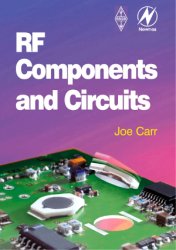
RF Components and Circuits 1st Edition by Joe Carr ISBN 0750648449 9780750648448
Original price was: $50.00.$35.00Current price is: $35.00.
RF Components and Circuits 1st Edition by Joe Carr – Ebook PDF Instant Download/Delivery: 0750648449, 9780750648448
Full download RF Components and Circuits 1st Edition after payment
Product details:
ISBN 10: 0750648449
ISBN 13: 9780750648448
Author: Joe Carr
Some basic knowledge of electronics is assumed, but the essential features of RF are fully described, including the important topic of receiver dynamic which is often overlooked in basic textbooks. The theory and circuit descriptions are geared towards genuine design applications rather than the oversimiplifications and skeleton circuits of many college texts.
During his career, the late Joe Carr was one of the world’s leading writers on electronics and radio, and an authority on the design and use of RF systems. Whether you are looking for a complete self-study course in RF technology, or a concise reference text to dip into, this book has the solution.
A complete course in understanding and designing RF circuits
Practical design knowhow from a world-class author
RF Components and Circuits 1st Table of contents:
-
Chapter 1: Introduction to Radio Frequencies
- What are “radio frequencies”?
- Why are radio frequencies different?
- What this book covers
-
Chapter 2: Signals and Noise
- Types of signals (Static, Periodic, Repetitive, Transient, Sampled)
- Fourier series and waveform symmetry
- Noise (Types, Signal-to-noise ratio, Noise factor, Noise figure, Noise temperature)
- Noise reduction strategies
-
Chapter 3: Radio Receivers
- The tuner
- Tuned Radio-Frequency (TRF) receivers
- Superheterodyne receivers
- Receiver circuits you can build
- Interpreting radio receiver specifications (Units of measure, Dynamic performance, Dynamic range, Receiver improvement strategies)
-
Chapter 4: RF Amplifiers
- Small-signal amplifiers
- RF power amplifiers
- RF amplifier and preselector circuits (JFET, MOSFET, Broadband, IC IF amplifiers)
-
Chapter 5: Mixers
- Introduction to mixers
- Using the double-balanced mixer (DBM)
- Diplexer circuits
- JFET and MOSFET doubly balanced mixer circuits
- Doubly balanced diode mixer circuits
- Bipolar transconductance cell DBMs
- Preamplifiers and postamplifiers
-
Chapter 6: Oscillators
- RF L-C oscillator circuits
- RF crystal oscillator circuits
- RF frequency synthesizers
-
Chapter 7: IF Amplifiers and Filters
- Building IF amplifiers (Amplifier circuits, Cascode pair, “Universal” IF amplifier)
- Coupling to other filters
- IC IF amplifiers
- IF processing ICs
- Filter switching in IF amplifiers
-
Chapter 8: Demodulators (likely covers various types of AM, FM, and other signal demodulation techniques)
-
Chapter 9: Capacitors
- Types of capacitors
- Capacitance and its properties at RF
- Voltage and current in capacitor circuits
- Variable capacitors in RF circuits (Straight-line capacitance vs. straight-line frequency, Special variable capacitors, Varactor applications)
-
Chapter 10: Inductors
- Inductance and inductors
- Winding your own coils
- Amidon Associates coil system
- Making your own toroid-core inductors and RF transformers
- Ferrite and powdered-iron rods
-
Chapter 11: Tuning and Matching
- Tuned resonant circuits (LC resonant circuits)
- Impedance matching: Methods and circuits (L-section, Pi-networks, Split-capacitor, Transmatch, Coaxial cable balun, Matching stubs, Quarter-wavelength matching sections)
-
Chapter 12: Splitters and Hybrids
- RF splitters and combiners
- The RF hybrid coupler (Applications, Phase-shifted hybrids)
-
Chapter 13: Monolithic Microwave Integrated Circuits (MMICs) (A brief overview of integrated RF components)
-
Chapter 14: Measuring Inductors and Capacitors
- Techniques for measuring component values at RF
-
Chapter 15: RF Power Measurement
- Methods and equipment for measuring RF power
-
Chapter 16: Filtering Against EMI/RFI
- Means of EMI transmission
- Electronic noise
- Counters to EMI
- Common mode and differential currents
- AC power line filtering
- Special medical EMI problems
- Computer EMI
- LC RF filter circuits (Low pass, high pass, bandpass, notch, Filter applications, Filter construction, Filter design approach)
-
Chapter 17: Noise (May be a more detailed or application-focused chapter building on Chapter 2)
-
Chapter 18: Direct-Conversion Radio Receivers
- Basic theory of operation
- Problems associated with DCR designs
- Practical design approaches
-
Chapter 19: Building Simple VLF Radio Receivers
- Receiver types
- Tuning circuit problems
- A VLF receiver project
-
Chapter 20: What’s That Mess Coming From My Receiver?
- Radio station interference
- Other interference
-
Chapter 21: Building and Using the RF Noise Bridge
- Adjusting antennas
- Resonant frequency
- Capacitance and inductance measurements
-
Chapter 22: Vectors for RF Circuits (Explaining the use of vectors in RF analysis)
-
Chapter 23: PIN Diodes and Their Uses
- PIN diode switch circuits
- PIN diode applications
-
Chapter 24: UHF and Microwave Diodes, Transistors (Likely an overview of these specialized components)
-
Chapter 25: Time-Domain Reflectometry on a Budget
- The basis of TDR
- The pulse source
- Test set-up and actual measurements
People also search for RF Components and Circuits 1st:
rf components and circuits
rf components and circuits pdf
rf concepts components and circuits for beginners
what is rf circuit
what is rf circuit design
Tags: Joe Carr, RF, Components