
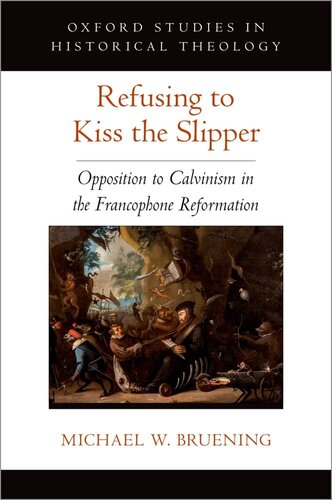
Refusing to Kiss the Slipper Opposition to Calvinism in the Francophone Reformation 1st Edition by Michael Bruening ISBN 0197566952 978-0197566954

Original price was: $50.00.$35.00Current price is: $35.00.
Refusing to Kiss the Slipper Opposition to Calvinism in the Francophone Reformation 1st Edition by Michael W. Bruening – Ebook PDF Instant Download/Delivery: 0197566952, 978-0197566954
Full download Refusing to Kiss the Slipper Opposition to Calvinism in the Francophone Reformation 1st Edition after payment
Product details:
ISBN 10: 0197566952
ISBN 13: 978-0197566954
Author: Michael W. Bruening
History has long viewed French Protestants as Calvinists. Refusing to Kiss the Slipper re-examines the Reformation in francophone Europe, presenting for the first time the perspective of John Calvin’s evangelical enemies and revealing that the French Reformation was more complex and colorful than previously recognized. Michael Bruening brings together a cast of Calvin’s opponents from various French-speaking territories to show that opposition to Calvinism was stronger and better organized than has been recognized. He examines individual opponents, such as Pierre Caroli, Jerome Bolsec, Sebastian Castellio, Charles Du Moulin, and Jean Morély, but more importantly, he explores the anti-Calvinist networks that developed around such individuals.
Each group had its own origins and agenda, but all agreed that Calvin’s claim to absolute religious authority too closely echoed the religious sovereignty of the pope. These oft-neglected opponents refused to offer such obeisance-to kiss the papal slipper-arguing instead for open discussion of controversial doctrines. They believed Calvin’s self-appointed leadership undermined the bedrock principle of the Reformation that the faithful be allowed to challenge religious authorities. This book shows that the challenge posed by these groups shaped the way the Calvinists themselves developed their reform strategies. Bruening’s work demonstrates that the breadth and strength of the anti-Calvinist networks requires us to abandon the traditional assumption that Huguenots and other francophone Protestants were universally Calvinist.
Table of contents:
1 Reforming the French National Church: Marguerite of Navarre’s Network
1.1 Introduction
1.2 The Duchess, the Bishop, and the Scholar
1.2.1 The Duchess, Marguerite of Navarre
1.2.2 The Bishop, Guillaume Briçonnet
1.2.3 The Scholar, Jacques Lefèvre d’Étaples
1.3 The Meaux Experiment, 1521–1525
1.4 Gérard Roussel and the Choice between National Reform and International Protestantism, 1526–1534
1.4.1 Gérard Roussel and the Strasbourg Exile
1.4.2 Marguerite as Evangelical Patron
1.4.3 Expansion of the Evangelical Movement, 1530–1533
1.4.4 The Evangelical Movement Stalls, 1533–1534
1.5 Gérard Roussel in Oloron: Diocesan Reform Revisited, 1536–1555
1.5.1 Roussel’s Forme de visite de diocese
1.5.2 Roussel’s Familiere exposition
1.6 Reconsidering Roussel and Early French Reform
2 The Formation of the Farellian and Calvinist Networks
2.1 Introduction
2.2 Guillaume Farel Makes French Reform “Reformed,” 1521–1530
2.2.1 Farel with Lefèvre and the Meaux Group, 1509–1523
2.2.2 Farel, the Reformed Theologians, and the Eucharist, 1523–1529
2.2.3 Farel’s Break from His French Colleagues, 1526
2.3 Farel’s Network in the Suisse Romande, 1526–1536
2.3.1 Farel, the Bernese, and the French Exiles
2.3.2 The Propaganda Campaign
2.3.3 Early Anti-Nicodemism
2.3.4 Evangelical Success and Failure in Romandie
2.4 The Calvinist Network
2.4.1 Calvin’s Shifting Position on Nicodemism, 1530–1536
2.4.2 Calvin’s Introduction of Ecclesiastical Discipline, 1536–1538
2.4.3 The Formation of the Calvinist Network
2.4.4 The Calvinist Doctrinal Trinity: Excommunication, the Eucharist, and Predestination
3. Anti-Calvinists of Francophone Switzerland
3.1 Introduction
3.2 Pierre Caroli and the Origins of the Opposition
3.2.1 Caroli’s Early Career in France, 1520–1534
3.2.2 Caroli in Geneva, Basel, and Neuchâtel, 1535–1536
3.2.3 Caroli versus the Calvinists, 1536–1537
3.3 Antoine Marcourt and the Supporters of Close Church–State Relations
3.3.1 Marcourt in Neuchâtel, 1531–1538
3.3.2 Marcourt and Jean Morand Replace Calvin and Farel in Geneva, 1538
3.3.3 Conflict over the Christmas Eucharist in Geneva, 1538
3.3.4 Political and Theological Factionalism in Geneva and the Vaud, 1538–1540
3.3.5 The Lausanne Quarrel over Ecclesiastical Goods, 1542–1543
3.3.6 Swiss and French Precedents for Church–State Relations
3.4 The Formation of Anti-Calvinist Outposts in the Pays de Vaud
3.4.1 The Failure of Calvinist Reform Efforts, 1541–1542
3.4.2 Farel’s Failure in Neuchâtel
3.4.3 Viret’s Failures in Lausanne
3.4.4 Yverdon
3.4.5 Pays de Gex
3.4.6 Morges
3.4.7 A Test Case: Jean Chaponneau’s Critique of Fraternal Corrections, 1544
4. The Consolidation of Anti-Calvinism in Francophone Switzerland
4.1 Introduction
4.2 André Zébédée’s Early Career: From Friend to Foe of the Calvinists, 1534–1547
4.2.1 Zébédée at the Collège de Guyenne, 1533/34–1538
4.2.2 Zébédée as a “Zwinglian Calvinist” While Pastor of Orbe and Yverdon, 1538–1547
4.2.3 Zébédée’s Appointment to the Lausanne Academy, 1547
4.3 Zébédée and the Fight for the Future of the Lausanne Academy
4.3.1 Disputes on the Ministry at the Lausanne Colloquies
4.3.2 Disputes on the Eucharist at the Houbraque Examination, December 1547
4.3.3 Zébédée’s Denunciation of Viret to the Bernese, Spring–Summer 1548
4.3.4 Supporters of Both Zébédée and Viret, and Bern’s Final Decision
4.4 Jerome Bolsec, the Seigneur de Falais, Zébédée, and the Consolidation of the Anti-Calvinist Party in the Suisse Romande
4.4.1 The Bolsec Affair in Geneva, 1551
4.4.2 Falais’s Break from Calvin, 1551–1552
4.4.3 Falais’s Estate as Center of Opposition to Calvin, 1551–1555
4.4.4 Philippe de Ecclesia and Jean Trolliet against Calvin, 1552–1553
4.4.5 François de Saint-Paul against the Calvinists on Predestination, 1552–1553
4.4.6 Zébédée Enters the Fray, 1553–1554
4.4.7 Calvin, “Heretic,” 1554–1555
4.4.8 The Condemnation of Calvinism in Bern, 1555
4.5 The Critical Year of 1555: Calvinist Victory or Defeat?
4.6 Epilogue: The Collapse of Calvinism in the Vaud
5. Sebastian Castellio’s Liberal Challenge
5.1 Introduction
5.2 Castellio’s Early Life, Schooling in Lyon, and Move to Geneva, 1515–1543
5.3 Castellio’s Break with Calvin, 1543–1544
5.4 Castellio’s Early Publications in Basel, 1545–1551
5.5 The Servetus Affair and Concerning Heretics
5.5.1 Opposition to Servetus’s Execution
5.5.2 Castellio’s First Criticism of the Execution, December 1553
5.5.3 Concerning Heretics, 1554
5.6 The Castellian Theological Program
5.6.1 “To kill a man is not to defend a doctrine, but to kill a man”: Castellio on Religious Toleration
5.6.2 “Reason, I say, is a sort of eternal word of God”: Doubt, Belief, and Exegesis
5.6.3 “God wants all to be saved through Christ”: Predestination
5.6.4 “The way to salvation is to obey God’s will”: Faith, Works, and Justification
5.7 Castellio and the Liberal Protestant Tradition
6. Castellio’s Long Shadow
6.1 Introduction
6.2 Castellionists in the Suisse Romande and Montbéliard
6.2.1 The Suisse Romande
6.2.2 Montbéliard
6.3 Persecution, Predestination, and Piety: The Ties That Bound International Networks of Castellionists
6.3.1 Persecution and Toleration
6.3.2 Predestination and Free Will
6.3.3 Piety and Discipline
6.4 The Pivotal Case of a Castellionist in France: Jean Saint-Vertuinen de Lavau
6.4.1 The Charges against Lavau
6.4.2 Impact of the Lavau Affair on French Church Organization and Geneva’s Missionary Program
7. The Gallican Evangelicals: State-Sponsored French Religious Reform Revisited
7.1 Introduction
7.2 Jean de Monluc, François Bauduin, and the Colloquy of Poissy
7.2.1 Jean de Monluc in Roussel’s Footsteps, 1554–1560
7.2.2 François Bauduin’s Path from Calvinism to Religious Concord, 1545–1558
7.2.3 Bauduin and Antoine of Navarre’s Plan for Reform, 1558
7.2.4 The Colloquy of Poissy, 1561
7.3 Bauduin versus “The Lemanic Lord,” 1561–1565
7.3.1 Calvin’s Argument
7.3.2 Bauduin’s Response
7.3.3 Bauduin’s Postwar Efforts at Religious Concord
7.4 Charles Du Moulin: Idiosyncratic Prophet for a Syncretistic Religion in France
7.4.1 Du Moulin among the Reformed, 1552–1556
7.4.2 Du Moulin’s Continued Evangelicalism in France, 1557–1565
7.4.3 Du Moulin’s Assault on the Calvinists
7.5 The External Attack on the French Evangelical Movement
8. Jean Morély’s Assault on Calvinist Ecclesiology
8.1 Introduction
8.2 Morély’s Controversial Book: The Treatise on Christian Discipline and Polity
8.2.1 The Calvinist Status Quo
8.2.2 Morély’s Program
8.2.3 Reassessing Morély’s Model
8.3 Morély’s Path to Fame (or Infamy)
8.3.1 Morély among Calvinists and Anti-Calvinists, 1545–1560
8.3.2 Possible Influences on Morély’s Ecclesiology
8.3.3 Publication and Condemnation of Morély’s Treatise
8.4 Morély’s Network
8.4.1 Morély’s Supporters among the Reformed Pastors
8.4.2 Morély and the Huguenot Nobility
8.4.3 Morély and Jeanne d’Albret
8.4.4 French Churches with Morellian Ecclesiology
8.4.5 Petrus Ramus, Nicolas Bergeron, and the 1572 Synod of Nîmes
8.5 Epilogue: Pierre Charpentier’s “God-Fearing Ministers Who Detest ‘The Cause’”
People also search for:
refusing to kiss on screen
refused to be kissed
refusing kiss
how to refuse a kiss politely
he’s trying to confuse. he’s slippery. watch out
Tags:
Michael Bruening,Refusing to Kiss,the Slipper Opposition,the Francophone