
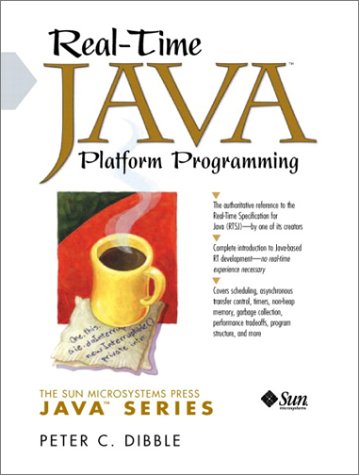
Real Time Java Platform Programming 1st Edition by Peter Dibble ISBN 0130282618 978-0130282613


Original price was: $50.00.$35.00Current price is: $35.00.
Real Time Java Platform Programming 1st Edition by Peter C. Dibble – Ebook PDF Instant Download/Delivery: 0130282618 978-0130282613
Full download Real Time Java Platform Programming 1st Edition after payment
Product details:
ISBN 10: 0130282618
ISBN 13: 978-0130282613
Author: Peter C. Dibble
Table of contents:
Preface
Introduction
1. Landscape
Java Technology and Real Time
Real-Time Programming Requirements
Java and Embedded Real Time
Definition of Real Time
Precision of Measurement
Consistency
Utility Function Curve
Java”s Problem Domain
Real-Time Java”s Problem Domain
Summary
2. Architecture of the Java Virtual Machine
Write Once, Run Anywhere: Maybe
JVM Components
Class Loading
Bytecode Interpreter
Security Manager
Garbage Collector
Thread Management
Input/Output
Graphics
Interpreter Implementation
Standard Interpreter
Optimized Interpreter
JIT
Snippets
Compilation to Independent Process
Native Methods
Compilation to a Native Method
Compilation to the JIT Interface
3. Hardware Architecture
Worst-Case Execution of One Instruction
Worst-Case Scenario
Practical Measures
Management of Troublesome Hardware
Managing Demand Paging
Managing DMA
Managing Cache
Managing Address Translation Cache
Managing Interrupts
Effects on the JVM
4. Garbage Collection
Reference Counting
Basic Garbage Collection
Mark and Sweep
Defragmentation
Copying Collectors
Incremental Collection
Incremental Garbage Collection in Practice
Generational Garbage Collection
Intergenerational References
Large Object Store
Real-Time Issues
5. Priority Scheduling
Scheduling Terms
Execution Sequences
. Preemption
The Seductive Charm of Nonpreemptive Scheduling
Fixed versus Dynamic Priority
Priority Inversion
Why 32 Priorities?
Problems with Priority Scheduling
6. Scheduling with Deadlines
Underlying Mechanism
Scope of the Scheduler
Some Systems
Earliest Deadline First (EDF)
Least Laxity
Periodic Scheduling
Aperiodic Servers
Handling Overload
Timing Is Usually Probabilistic
7. Rate Monotonic Analysis
Theorems
Liu and Layland”s Theorem
A Graphical Approach
Lehoczky, Sha, and Ding”s Theorem
Restrictions
Independent Tasks
Deadlines Equal to Periods
Multiprocessor Systems
8. Introduction to the Real-Time Java Platform
A Brief History of Real-Time Java
Major Features of the Specification
Threads and Scheduling
Garbage Collection
Asynchronous Event Handlers
Asynchronous Transfer of Control
Memory Allocation
Memory Access
Implementation
RTSJ Hello World
9. Closures
The Language Construct
Java Closures
Closure Structure
Closures in the RTSJ
Limitations of Closures
Readability
Local Variables
Constructors
Nesting
10. High-Resolution Time
Resolution
The “clock”
HighResolutionTime Base Class
Absolute Time
Relative Time
Rational Time
11. Async Events
Binding a Happening to an Event
Basic Async Event Operation
Async Events without Happenings
Time Triggering
Fault Triggering
Software Event Triggering
Implementation Discussion
12. Real-Time Threads
Creation
Scheduling
Inversion Handling
Fixed Priority
Feasibility
Periodic Threads without Handlers
Feasibility Analysis
Periodic Threads with Handlers
Interactions with Normal Threads
Changing the Scheduler
13. Non-Heap Memory
The Advantage of Non-Heap Memory
The Allocation Regimes
Rules
Mechanisms for Allocating Immortal Memory
Mechanisms for Allocating from Scoped Memory
Allocation Time
Creating Scoped Memory
Allocation Mechanisms
Finalizers
Using Nested Scoped Memory
The Scope Stack (Tree)
The DAG
Practical Use of Nested Scopes
Every Nested Scope Involves Two Memory Areas
Pitfalls
Using executeInArea
Using Standard Classes
Using Shared Scoped Memory
The Scope Stack Revisited
Scope Portals
Fine Print
Quick Examples
14. Non-Heap Access
Interaction with Scheduler
Rules
Samples
Final Remarks
Notes
15. More Async Events
Async Events and the Scheduler
The createReleaseParameters Method
Bound Async Event Handlers
Async Event Handlers and Non-Heap Memory
No-Heap Event Handlers vs
No-Heap Threads
Scheduling
Minimum Interarrival Time
Async Event Handlers and Threads
Special Async Events
16. Reusing Immortal Memory
Using Fixed-Object Allocators
Carrier Objects
Limitations
Recycling RT Threads
Recycling Async Event Handlers
17. Asynchronous Transfer of Control
Thread Interrupt in Context
Asynchronous Interrupt Firing
The Timed Class
The interrupt Method
The fire Method
In Summary
Replacement Rules
Rules for Async Exception Propagation
Oblivious catch
Nonmatching doInterruptible
Matching doInterruptible
Internals
Application Handling for Asynchronous Interrupts
Noninterruptible Code
Special Issues for Synchronized blocks
Legacy Code
Use of ATC for Thread Termination
18. Physical Memory
Physical and Virtual Memory
Physical Memory Manager
Memory Type
Removable Memory
Immortal Physical Memory
Scoped Physical Memory
19. Raw Memory Access
Security
Peek and Poke
Get/Set Methods
Mapping
The RawMemoryFloatAccess Class
20. Synchronization without Locking
Principles of Wait-Free Queues
Constructors
Common Methods
The Wait-Free Write Queue
Methods
Sharing the Wait-Free Queue
The Wait-Free Read Queue
The Extra Constructor
Methods
The Wait-Free Double-Ended Queue
Methods
No-Wait Queues and Memory
Implementation Notes
21. Recommended Practice
Powerful and Easy-to-Use Features of the RTSJ
Real-Time Threads
Periodic Threads
Asynchronous Event Handlers
High-Resolution Time
Happenings
Very Powerful and Dangerous Features of the RTSJ
Simple
Leaky
Viral
Very Powerful and Finicky Features of the RTSJ
Scoped Memory
No-Heap Asynchronous Event Handlers
No-Heap Real-Time Threads
Asynchronously Interrupted Exceptions
Selection of Priorities
Index
People also search for:
real time application of java
java real time project explanation
java real time programs
java real time coding
real-time programming
Tags:
Peter Dibble,Real Time,Java Platform,Platform Programming