
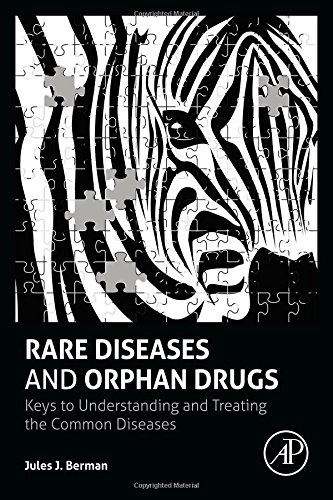
Rare Diseases and Orphan Drugs Keys to Understanding and Treating the Common Diseases 1st Edition by Jules Berman ISBN 978-0124199880 0124199887
Original price was: $50.00.$35.00Current price is: $35.00.
Rare Diseases and Orphan Drugs Keys to Understanding and Treating the Common Diseases 1st Edition by Jules J. Berman – Ebook PDF Instant Download/Delivery: 978-0124199880, 0124199887
Full download Rare Diseases and Orphan Drugs Keys to Understanding and Treating the Common Diseases 1st Edition after payment
Product details:
ISBN 10: 0124199887
ISBN 13: 978-0124199880
Author: Jules J. Berman
Rare Diseases and Orphan Drugs shows that much of what we now know about common diseases has been achieved by studying rare diseases. It proposes that future advances in the prevention, diagnosis, and treatment of common diseases will come as a consequence of our accelerating progress in the field of rare diseases.
Understanding the complex steps in the development of common diseases, such as cancer, cardiovascular disease, and metabolic diseases, has proven a difficult problem. Rare diseases, however, are often caused by aberrations of a single gene. In rare diseases, we may study how specific genetic defects can trigger a series of events that lead to the expression of a particular disease. Often, the disease process manifested in a certain rare disease is strikingly similar to the disease process observed in a common disease.
This work ties the lessons learned about rare diseases to our understanding of common ones. Chapters covering the number of common diseases are minimized, while rare diseases are introduced as single diseases or as members of diseases classes. After reading this book, readers will appreciate how further research into the rare diseases may lead to new methods for preventing, diagnosing, and treating all diseases, rare or common.
- Makes rare diseases relevant to clinicians and researchers by tying lessons learned about the rare diseases to our understanding of the common diseases
- Stresses basic pathologic mechanisms that account for human disease (e.g., disorders of cell development, replication, maintenance, function and structure), that can be understood without prior training in pathology
- Discusses advanced concepts in molecular biology and genetics in a simple, functional context appropriate for medical trainees and new researchers
- Offers insights into how further research into rare diseases may lead to new methods for preventing, diagnosing, and treating all diseases
Table of contents:
Chapter 1. What are the Rare Diseases, and Why do we Care?
Abstract
1.1 The definition of rare disease
1.2 Remarkable progress in the rare diseases
References
Chapter 2. What are the Common Diseases?
Abstract
2.1 The common diseases of humans, a short but terrifying list
2.2 The recent decline in progress against common diseases
2.3 Why medical scientists have failed to eradicate the common diseases
References
Chapter 3. Six Observations to Ponder while Reading this Book
Abstract
3.1 Rare diseases are biologically different from common diseases
3.2 Common diseases typically occur in adults; rare diseases are often diseases of childhood
3.3 Rare diseases usually occur with a Mendelian pattern of inheritance. common diseases are non-Mendelian
3.4 Rare diseases often occur as syndromes, involving several organs or physiologic systems, often in surprising ways. common diseases are typically non-syndromic (see Section 10.1)
3.5 Environmental factors play a major role in the cause of common diseases; less so in the inherited rare diseases
3.6 The difference in rates of occurrence of the rare diseases compared with the common diseases is profound, often on the order of a thousand-fold
3.7 There are many more rare diseases than there are common diseases
References
Chapter 4. Aging
Abstract
4.1 Normal patterns of aging
4.2 Aging and immortality
4.3 Premature aging disorders
4.4 Aging as a disease of non-renewable cells
References
Chapter 5. Diseases of the Heart and Vessels
Abstract
5.1 Heart attacks
5.2 Rare desmosome-based cardiomyopathies
5.3 Sudden death and rare diseases hidden in unexplained clinical events
5.4 Hypertension and obesity: quantitative traits with cardiovascular co-morbidities
References
Chapter 6. Infectious Diseases and Immune Deficiencies
Abstract
6.1 The burden of infectious diseases in humans
6.2 Biological taxonomy: where rare infectious diseases mingle with the common infectious diseases
6.3 Biological properties of the rare infectious diseases
6.4 Rare diseases of unknown etiology
6.5 Fungi as a model infectious organism causing rare diseases
References
Chapter 7. Diseases of Immunity
Abstract
7.1 Immune status and the clinical expression of infectious diseases
7.2 Autoimmune disorders
References
Chapter 8. Cancer
Abstract
8.1 Rare cancers are fundamentally different from common cancers
8.2 The dichotomous development of rare cancers and common cancers
8.3 The Genetics of Rare Cancers and Common Cancers
8.4 Using rare diseases to understand carcinogenesis
References
Chapter 9. Causation and the Limits of Modern Genetics
Abstract
9.1 The inadequate meaning of biological causation
9.2 The complexity of the so-called monogenic rare diseases
9.3 One monogenic disorder, many genes
9.4 Gene variation and the limits of pharmacogenetics
9.5 Environmental phenocopies of rare diseases
References
Chapter 10. Pathogenesis: Causation’s Shadow
Abstract
10.1 The mystery of tissue specificity
10.2 Cell regulation and epigenomics
10.3 Disease phenotype
10.4 Dissecting pathways using rare diseases
10.5 Precursor lesions and disease progression
References
Chapter 11. Rare Diseases and Common Diseases: Understanding their Fundamental Differences
Abstract
11.1 Review of the fundamentals in light of the incidentals
11.2 A trip to Monte Carlo: how normal variants express a disease phenotype
11.3 Associating genes with common diseases
11.4 Mutation versus variation
References
Chapter 12. Rare Diseases and Common Diseases: Understanding their Relationships
Abstract
12.1 Shared genes
12.2 Shared phenotypes
References
Chapter 13. Shared Benefits
Abstract
13.1 Shared prevention
13.2 Shared diagnostics
13.3 Shared cures
References
Chapter 14. Conclusion
Abstract
14.1 Progress in the rare diseases: social and political issues
14.2 Smarter clinical trials
14.3 For the common diseases, animals are poor substitutes for humans
14.4 Hubris
References
People also search for:
3rd international conference on rare diseases and orphan drugs
european congress on rare diseases and orphan drugs
international journal of rare diseases and orphan drugs
international journal of rare diseases and orphan drugs impact factor
11th international meeting on pulmonary rare diseases and orphan drugs
Tags: Jules Berman, Rare Diseases, Orphan Drugs Keys, Understanding and Treating