
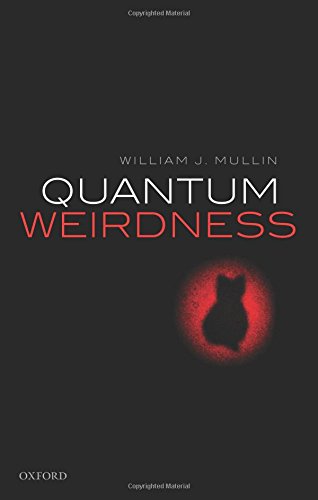
Quantum weirdness 1st Edition by William Mullin ISBN 0198795130 978-0198795131

Original price was: $50.00.$35.00Current price is: $35.00.
Quantum weirdness 1st Edition by William J. Mullin- Ebook PDF Instant Download/Delivery: 0198795130, 978-0198795131
Full download Quantum weirdness 1st Edition after payment
Product details:
ISBN 10: 0198795130
ISBN 13: 978-0198795131
Author: William J. Mullin
Quantum mechanics allows a remarkably accurate description of nature and powerful predictive capabilities. The analyses of quantum systems and their interpretation lead to many surprises, for example, the ability to detect the characteristics of an object without ever touching it in any way, via “interaction-free measurement,” or the teleportation of an atomic state over large distances. The results can become downright bizarre.
Quantum mechanics is a subtle subject that usually involves complicated mathematics — calculus, partial differential equations, etc., for complete understanding. Most texts for general audiences avoid all mathematics. The result is that the reader misses almost all deep understanding of the subject, much of which can be probed with just high-school level algebra and trigonometry. Thus, readers with that level of mathematics can learn so much more about this fundamental science.
The book starts with a discussion of the basic physics of waves (an appendix reviews some necessary classical physics concepts) and then introduces the fundamentals of quantum mechanics, including the wave function, superposition, entanglement, Bell’s theorem, etc., and applications to Bose–Einstein condensation, quantum computing, and much more. The interpretation of the mathematics of quantum mechanics into a world view has been the subject of much controversy. The result is a variety of conflicting interpretations, from the famous Copenhagen view of Bohr to the multiple universes of Everett. We discuss these interpretations in the chapter “What is a wave function?” and include some very recent advances, for example, quantum Bayesianism, and measurements of the reality of the wave function.
Table of contents:
1. Waves
1.1 Some history
1.2 Classical wave dynamics
2. Quantum Particles and Waves
2.1 Planck, Einstein, deBroglie, and Heisenberg
2.2 The particle in a box
2.3 A note on probability
3. Harmonic Oscillators
3.1 Classical oscillators
3.2 Quantum oscillators
4. Superposition
4.1 The double oscillator
4.2 The two-slit experiment
5. Entanglement
5.1 Two particles in the double well
5.2 A diversion on spin
5.3 One-spin superposition
5.4 Entanglement: Two-particle superpositions
5.4.1 “Spooky action at a distance”
5.4.2 What’s a hidden variable?
5.4.3 EPR’s argument
6. The Mach-Zehnder Interferometer
6.1 Interferometers
6.2 Particle versus wave experiments
6.3 Delayed choice
7. Bell’s Theorem and the Mermin Machine
7.1 The Mermin machine
7.2 What quantum mechanics predicts
7.3 What a hidden-variables theory might say
7.4 A Bell inequality
8. What Is a Wave Function?
8.1 Schrödinger’s cat
8.2 Wigner’s friend
8.3 Quantum interference of macroscopically distinct objects
8.4 Decoherence
8.5 Quantum Bayesianism
8.6 Tests of the reality of the wave function
9. Bose-Einstein Condensation and Superfluidity
9.1 Temperature
9.2 Fermions and bosons
9.3 The laser
9.4 Superfluid helium
9.5 Bose-Einstein condensation in dilute gases
10. The Quantum Zeno Effect
10.1 Measuring an atom’s energy level
10.2 Rotating polarization
10.3 Bomb detection: The EV effect
11. Bosons and Fermions
11.1 Wave functions
11.2 Examples of Fermi and Bose effects
11.2.1 Average particle separation
11.2.2 The second virial coefficient
11.2.3 Interatomic forces
11.2.4 White dwarf stars
11.3 Inclusion of spin
11.3.1 Polarization methods
11.3.2 Transport processes
11.3.3 Ferromagnetism
11.4 The Hong-Ou-Mandel effect
11.5 The Hanbury Brown-Twiss experiment
11.6 What more?
12. The Quantum Eraser
12.1 Erasing with atoms, photons, and cavities
12.2 Using photons and polarization
13. Virtual Particles and the Four Forces
13.1 Survey of the four forces
13.2 Sizes of the forces
13.3 Virtual particles
13.4 Photons and the electromagnetic force
13.5 Gravitons
13.6 Gluons and the strong interaction
13.7 The W and Z mesons and the weak interaction
13.8 The particle zoo
13.9 Forces in condensed matter physics
14. Teleportation of a Quantum State
14.1 How it is done
14.2 Measuring Bell states
15. Quantum Computing
15.1 Deutch’s problem
15.2 Grover’s search algorithm
15.3 Shor’s period-finding algorithm
15.4 The solution to Deutch’s problem
15.4.1 Preliminaries
15.4.2 The solution
15.5 Is anything built yet?
16. Weird Measurements
16.1 Weak measurement
16.2 Measuring two-slit trajectories
16.3 Measuring a wave function
People also search for:
the quantum weirdness of the almost kiss
where quantum weirdness hides
synopsis of the quantum weirdness of the almost kiss
the quantum weirdness of the almost kiss summary
the quantum weirdness of the almost kiss pdf
Tags: William Mullin, Quantum weirdness