
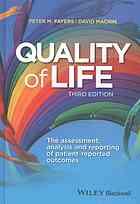
Quality of Life The Assessment Analysis and Interpretation of Patient reported Outcomes 2nd Edition by Peter M Fayers, David Machin ISBN 1444337955 9781444337952


Original price was: $50.00.$35.00Current price is: $35.00.
Quality of Life The Assessment Analysis and Interpretation of Patient reported Outcomes 2nd Edition by Peter M. Fayers, David Machin – Ebook PDF Instant Download/Delivery: 1444337955, 9781444337952
Full download Quality of Life The Assessment Analysis and Interpretation of Patient reported Outcomes 2nd Edition after payment
Product details:
ISBN 10: 1444337955
ISBN 13: 9781444337952
Author: Peter M. Fayers, David Machin
The assessment of patient reported outcomes and health-related quality of life continue to be rapidly evolving areas of research and this new edition reflects the development within the field from an emerging subject to one that is an essential part of the assessment of clinical trials and other clinical studies.
The analysis and interpretation of quality-of-life assessments relies on a variety of psychometric and statistical methods which are explained in this book in a non-technical way. The result is a practical guide that covers a wide range of methods and emphasizes the use of simple techniques that are illustrated with numerous examples, with extensive chapters covering qualitative and quantitative methods and the impact of guidelines. The material in this new third edition reflects current teaching methods and content widened to address continuing developments in item response theory, computer adaptive testing, analyses with missing data, analysis of ordinal data, systematic reviews and meta-analysis.
This book is aimed at everyone involved in quality-of-life research and is applicable to medical and non-medical, statistical and non-statistical readers. It is of particular relevance for clinical and biomedical researchers within both the pharmaceutical industry and clinical practice.
Table of contents:
Part 1: Developing and Validating Instruments for Assessing Quality of Life and Patient-Reported Outcomes
1. Introduction
-
Patient-reported outcomes
-
What is a patient-reported outcome?
-
What is quality of life?
-
Historical development
-
Why measure quality of life?
-
Which clinical trials should assess QoL?
-
How to measure quality of life
-
Instruments
-
Computer-adaptive instruments
-
Conclusions
2. Principles of measurement scales
-
Scales and items
-
Constructs and latent variables
-
Single global questions vs. multi-item scales
-
Single-item vs. multi-item scales
-
Effect indicators and causal indicators
-
Psychometrics, factor analysis, item response theory
-
Psychometric vs. clinimetric scales
-
Sufficient causes, necessary causes, scoring items
-
Discriminative, evaluative, and predictive instruments
-
Measuring quality of life: reflective, causal, composite indicators
-
Further reading and conclusions
3. Developing a questionnaire
-
General issues
-
Defining target population
-
Phases of development: generation of issues, item development, pre-testing, cognitive interviewing, translation, field-testing
-
Multi-item scales, wording of questions, face and content validity
-
Conclusions and further reading
4. Scores and measurements: validity, reliability, sensitivity
-
Content, criterion, construct validity
-
Repeated assessments and change over time
-
Reliability
-
Sensitivity and responsiveness
-
Conclusions and further reading
5. Multi-item scales
-
Significance tests, correlations, construct validity
-
Cronbach’s α, internal consistency
-
Validation or alteration
-
Implications for formative or causal items
-
Conclusions
6. Factor analysis and structural equation modelling
-
Correlation patterns, path diagrams
-
Factor analysis, uses, assumptions
-
Confirmatory factor analysis and structural equation modelling
-
Chi-square goodness-of-fit, approximate fit indices, comparative fit
-
Bifactor analysis, formative or causal relationships
-
Conclusions and further reading
7. Item response theory and differential item functioning
-
Item characteristic curves, logistic models
-
Polytomous IRT models, test design, validation
-
Differential item functioning, sample size, quantification, exploration
-
Conclusions and further reading
8. Item banks, item linking, and computer-adaptive tests
-
Item banks, evaluation, reduction, calibration
-
Item linking, test equating, test information
-
Computer-adaptive testing, stopping rules, software
-
CATs for PROs, computer-assisted tests, short-form tests
-
Conclusions and further reading
Part 2: Assessing, Analysing and Reporting Patient-Reported Outcomes and Quality of Life
9. Choosing and scoring questionnaires
-
Finding instruments, generic vs. specific, content, presentation
-
Choice of instrument, scoring multi-item scales
-
Conclusions and further reading
10. Clinical trials
-
Basic design issues, compliance, administering QoL assessments
-
Writing protocols, standard operating procedures
-
Summary, checklist, further reading
11. Sample sizes
-
Significance tests, p-values, power
-
Estimating sample size for comparing groups, reference populations, non-inferiority studies
-
Non-normal distributions, multiple testing, specifying target difference
-
Attrition, pre-study considerations
-
Conclusions and further reading
12. Cross-sectional analysis
-
Types of data, comparing groups, adjusting for covariates
-
Changes from baseline, analysis of variance, models, graphical summaries, endpoints
-
Conclusions
13. Exploring longitudinal data
-
Area under the curve, graphical/tabular presentations, reporting
-
Conclusions
14. Modelling longitudinal data
-
Preliminaries, auto-correlation, repeated measures, other situations
-
Modelling vs. area under the curve
-
Conclusions
15. Missing data
-
Introduction, types, missing items and forms
-
Imputation methods, multiple imputation, pattern mixture models
-
Degrees of freedom, sensitivity analysis
-
Conclusions and further reading
16. Practical and reporting issues
-
Reporting design issues, data analysis, graphics, errors, guidelines
-
Further reading
17. Death and quality-adjusted survival
-
Attrition due to death, preferences/utilities, multi-attribute utility measures
-
Utility-based instruments, QALYs, Q-TWiST, sensitivity analysis
-
Prognosis, alternatives to QALY
-
Conclusions and further reading
18. Clinical interpretation
-
Statistical significance, absolute levels/changes, threshold values
-
Population norms, minimal important difference, anchoring, minimum detectable change
-
Expert judgement, impact, life events, effect size statistics, patient variability, number needed to treat
-
Conclusions and further reading
19. Biased reporting and response shift
-
Bias types, recall bias, selective reporting, other biases
-
Response shift, assessing, impact in clinical trials and non-randomised studies
-
Conclusions
20. Meta-analysis
-
Introduction, defining objectives/outcomes, literature searching, quality assessment
-
Summarising results, measures of treatment effect, combining studies
-
Forest plots, heterogeneity, publication bias, funnel plots
-
Conclusions and further reading
People also search for:
physical quality of life index
lap of love quality of life
best quality of life countries
define quality of life
lap of love quality of life scale
health related quality of life
minecraft quality of life mods
Tags: Peter M Fayers, David Machin, Quality of Life, Assessment, Analysis, Interpretation, Patient reported Outcomes