
Quadruplex Nucleic Acids 1st Edition by Stephen Neidle,Shankar Balasubramanian, William A Harrell Jr ISBN 978-0854043743 0854043748


Original price was: $50.00.$35.00Current price is: $35.00.
Quadruplex Nucleic Acids 1st Edition by Stephen Neidle,Shankar Balasubramanian, William A Harrell Jr – Ebook PDF Instant Download/Delivery: 978-0854043743, 0854043748
Full download Quadruplex Nucleic Acids 1st Editionafter payment
Product details:
ISBN 10: 0854043748
ISBN 13: 978-0854043743
Author: Stephen Neidle,Shankar Balasubramanian, William A Harrell Jr
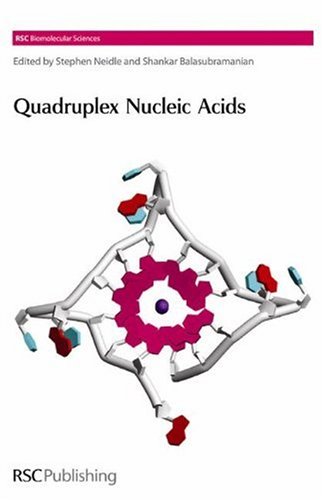
Guanine rich DNA has been known for decades to form unusual structures, although their biological relevance was little understood. Recent advances have demonstrated that quadruplex structures can play a role in gene expression and provide opportunities for a new class of anticancer therapeutics. A number of quadruplex-specific proteins have also been discovered. Quadruplex Nucleic Acids discusses all aspects of the fundamentals of quadruplex structures, including their structure in solution and the crystalline state, the kinetics of quadruplex folding, and the role of cations in structure and stability. The biology of quadruplexes and G-rich genomic regions and G-quartets in supramolecular chemistry and nanoscience are also considered. Surveying the current state of knowledge, and with contributions from leading experts, this is the first comprehensive review of this rapidly growing area. Quadruplex Nucleic Acids is ideal for researchers interested in areas related to chemistry, chemical biology, medicinal chemistry, molecular pharmacology, and structural and molecular biology.
Table of contents:
Chapter 1
Fundamentals of Quadruplex Structures
Gary Nigel Parkinson
1.1 Background and Introduction to Quadruplexes
1.2 Fundamental Components of DNA and RNA
1.2.1 Building Blocks
1.2.2 DNA/RNA as a Helical Structure
1.2.3 Stabilizing Factors in Quadruplexes
1.3 Folding and Topology of Quadruplexes
1.3.1 Loop Length, Sequence, and Stability
1.3.2 Polymorphism in Sequence and in Topology
1.3.3 Other Quadruplex Forming Sequences
1.4 Experimental Methods Used in Quadruplex Characterization
1.4.1 UV Melting Experiments
1.4.2 Circular Dichroism Spectroscopy
1.4.3 Polyacrylamide Gels Electrophoresis
1.4.4 Fluorescence Resonance Energy Transfer (FRET)
1.4.5 Sedimentation Velocity Analysis and Sedimentation Equilibrium
1.4.6 Cross-Linking DNA and Topology
References
Chapter 2
Energetics, Kinetics and Dynamics of Quadruplex Folding
Jean-Louis Mergny, Julien Gros, Anne De Cian, Anne Bourdoncle, Frederic Rosu, Barbara Saccà, Lionel Guittat, Samir Amrane, Martin Mills, Patrizia Alberti, Masashi Takasugi and Laurent Lacroix
2.1 Introduction
2.2 Thermodynamics
2.2.1 Enthalpy and Entropy of Formation
2.2.2 Loop Contribution to Folding and Dynamics
2.2.3 Stability under Physiological Conditions
2.2.4 Which Quadruplexes are the Most Stable: Intra-, Bi- or Tetramolecular? Parallel or Antiparallel?
2.2.5 Competition with Duplexes
2.3 Cations Play a Central Role!
2.3.1 Modes of Interaction
2.3.2 Location of Ions
2.3.3 Dynamics of Ions
2.3.4 Proton Exchange, Transient Opening of the Quartet
2.4 Multiple Quadruplex Conformations
2.4.1 Initial Observations
2.4.2 Telomeric Repeats
2.4.3 Consequences of Polymorphism
2.5 Kinetic Analysis: Technical Considerations
2.5.1 Elementary Precautions
2.5.2 General Considerations
2.5.3 Limitations of the Current Methods
2.6 Kinetics of Intramolecular Quadruplexes
2.6.1 Presentation
2.6.2 Kinetic Analysis
2.6.3 Quadruplex Interconversion
2.7 Kinetics of Bimolecular Quadruplexes
2.7.1 Presentation
2.7.2 Kinetic Analysis
2.7.3 Quadruplex Interconversion
2.8 Kinetics of Tetramolecular Quadruplexes
2.8.1 Presentation
2.8.2 Thermal Stability
2.8.3 Association Process
2.9 Higher Order Structures
2.9.1 Quadruplex Dimers
2.9.2 G-Wires
2.10 Effect of Chemical Modifications
2.10.1 RNA and 2′-Sugar Modified Analogues
2.10.2 Further Backbone Modifications
2.10.3 Base Substitutions
2.11 Effect of Quadruplex Ligands
2.11.1 Small Ligands and Bimolecular Quadruplexes
2.11.2 Small Ligands and Intramolecular Quadruplexes
2.11.3 Small Ligands and Tetramolecular Quadruplexes
2.11.4 Effects of Proteins
2.12 Implications for the Folding Pathway
2.12.1 Tetramolecular Quadruplexes
2.12.2 Are G-G Hairpins Plausible Intermediates for Bimolecular Quadruplexes?
2.12.3 Molecular Modelling of Intermediate States
2.13 Conclusion
Acknowledgements
References
Chapter 3
Structural Diversity of G-Quadruplex Scaffolds
Anh Tuân Phan, Vitaly Kuryavyi, Kim Ngoc Luu and Dinshaw J. Patel
3.1 Introduction
3.2 Core and Loops in G-Quadruplexes
3.2.1 G-Tetrad Core
3.2.2 Loops
3.3 G-Quadruplexes with Different Structural Elements
3.3.1 Triad-Containing Edgewise Loops
3.3.2 Triad-Containing Diagonal Loops
3.3.3 V-Shaped Loop
3.3.4 Interlocked G-Quadruplexes
3.3.5 Pentads, Hexads, Heptads, and Octads
3.3.6 Mixed Tetrads
3.3.7 Four-Repeat Human Telomeric Sequence
3.3.8 (3+1) G-Tetrad Core Topology
3.3.9 Fold-Back G-Quadruplex
3.3.10 Bulged and Interrupted G-Tetrad Core
3.3.11 Intercalation of Tetrads
3.4 Conclusion
Chapter 4
The Role of Cations in Determining Quadruplex Structure and Stability
Nicholas V. Hud and Janez Plavec
4.1 Introduction
4.2 Crystallographic Analysis of Cation Coordination within G-Quadruplexes
4.3 Localization of Cation Coordination Sites in G-Quadruplexes in the Solution State
4.4 Measuring the Dynamics of Cation Exchange by NMR Spectroscopy
4.5 Thermodynamics of G-Quadruplex Cation-Dependent Stability and Cation Selectivity
4.5.1 Monovalent Cations
4.5.2 Divalent Cations
4.6 Cations and G-Quadruplex Polymorphism
4.6.1 Minor Cation-Dependent Polymorphisms
4.6.2 Major Cation-Dependent Polymorphisms
4.7 Cation-Driven Conformational Switches
4.8 Possible Applications of Cation-Dependent G-Quadruplex Formation
4.9 Summary
Acknowledgment
References
Chapter 5
DNA Quadruplex-Ligand Recognition: Structure and Dynamics
Mark S. Searle and Graham D. Balkwill
5.1 Telomeric DNA and Cell Immortalisation
5.2 Structural Diversity of Quadruplex-Targeted Ligands
5.3 Structural Studies of Ligand-Quadruplex Interactions: Intercalation or End-Stacking?
5.4 Modelling Ligand-Quadruplex Interactions
5.5 Structure and Dynamics of a Quino-Acridinium Cation Bound to a G-Quadruplex
5.6 High-Resolution X-Ray Analysis of Drug-Quadruplex Interactions
5.7 Quadruplex-Targeted Small Molecule-Peptide Conjugates
5.8 Quadruplex Recognition by Distamycin: In the Grooves or End-Stacking?
5.9 Selectivity of Telomestatin for Different G-Quadruplex Isoforms
5.10 Porphyrin Interaction with the c-myc-Derived Quadruplex
5.11 Conclusions
Acknowledgements
References
Chapter 6 Quadruplex Ligand Recognition: Biological Aspects
Jean-François Riou, Dennis Gomez, Hamid Morjani and
Chantal Trentesaux
6.1 Introduction
6.2 G-Quadruplex Ligands as Telomerase Inhibitors
6.3 Telomere Dysfunction Induced by G-Quadruplex Ligands
6.4 Resistance to G-Quadruplex Ligands
6.4.1 Resistance and Telomere Component Expression
6.4.2 Resistance and Apoptosis
6.5 The Single-Strand G-Overhang Is Altered and Degraded
6.6 Deregulation of Telomere-Binding Proteins
6.7 Importance of Telomere Ends and Replication Processes
6.8 Concluding Remarks
Acknowledgments
References
Chapter 7
DNA Quadruplexes and Gene Regulation
Thomas S. Dexheimer, Michael Fry and Laurence H. Hurley
7.1 Transcription
7.2 G-Rich Clusters in the Promoter Regions of Mammalian Genes
7.2.1 Chicken B-Globin Gene
7.2.2 Muscle-Specific Genes
7.2.3 Human c-myc Gene
7.3 DNA Tandem Repeat Sequences
7.3.1 Human FMR1 Gene
7.3.2 Human Insulin Gene
7.4 Summary
References
Chapter 8
Quadruplexes in the Genome
Julian Huppert
8.1 Introduction
8.2 What is a Quadruplex?
8.2.1 Strand Stoichiometry
8.2.2 Number of Tetrads
8.2.3 Discontinuities in G-Tracts
8.2.4 Loop Length and Composition
8.3 Characterised Quadruplex-Forming Sequences
8.4 Proteins Interact with Quadruplexes
8.5 Possible Functions of Quadruplexes in the Genome
8.6 Genome-Wide Studies on Quadruplexes
8.7 Frequency of PQS
8.8 Location of Putative Quadruplexes
8.9 Distribution of Loop Lengths
8.10 Loop Sequences
8.11 RNA Processing
8.12 Conclusions and Future Directions
References
Chapter 9
Quadruplexes and the Biology of G-Rich Genomic Regions
Nancy Maizels
9.1 Structural Potential of G-Rich DNA
9.1.1 G-Rich Nucleic Acids Spontaneously Form G4 DNA or G4 RNA In vitro
9.1.2 The Uses and Limitations of Chemical Probing
in Assaying G4 DNA Formation
9.1.3 G4 DNA is Stable
9.1.4 G4 DNA has a Distinctive Structure and Enzymology
9.1.5 G4 DNA Formation In vivo Could Threaten Genomic Stability
9.2 G-Rich Genomic Regions
9.2.1 Telomeres
9.2.2 rDNA
9.2.3 Immunoglobulin Heavy Chain Switch Regions
9.2.4
Hypervariable Repeats
9.2.5 G-Rich Single-Copy Genes
9.3 G4 DNA Forms in Living Cells
9.3.1 G-Loops and G4 DNA Formation in Transcribed G-Rich Regions
9.3.2 G4 DNA in Ciliate Macronuclei
9.4 Critical Roles of G-Rich Telomeres in Health and Disease
9.4.1
Telomeres in Aging and Cancer
9.4.2
Telomeric G4 DNA as a Therapeutic Target
9.4.3
Genetic Diseases Due to Impaired Telomerase Activity
9.4.4 Animal Models for Human Telomerase Deficiencies
9.5 Formation of G4 DNA Regulates Telomere Extension by Telomerase
9.5.1
Telomeric End-Binding Proteins
9.5.2
POTI Disrupts G-Quadruplexes to Promote Telomere Extension by Telomerase
9.5.3 ΤΕΒΡα/B Regulate G4 DNA Formation at Ciliate Telomeres
9.6 G4 DNA in Immunoglobulin Class Switch Recombination
9.6.1
G-Rich Switch (S) Regions are Targets for Recombination
9.6.2 Structure-Specific Recombination at Transcribed S Regions
9.7 Special Properties of G-Rich Single-Copy Genes: c-myc
9.7.1
Quadruplex Formation by the c-myc Promoter
9.7.2
c-myc Translocations in B Cell Lymphomas
9.8 G4
DNA and Genomic Stability and Instability
9.8.1 Specialized Helicases Maintain G-Rich Genomic Regions
9.8.2 Potential Functions of MutSa in Recognition and Repair of G4 DNA
9.8.3
Nucleases that Cleave G4 DNA
9.8.4 Cotranscriptional RNA/DNA Hybrids and Genomic Instability
9.9 Perspective and Future Directions
9.10 Acknowledgments
References
Chapter 10
The G-Quartet in Supramolecular Chemistry and Nanoscience
Mark S. Kaucher, William A. Harrell JR. and Jeffery T. Davis
10.1 Guanosine Self-Assembly in Supramolecular Chemistry
10.1.1 Guanosine Self-Assembly in Water
10.1.2 Self-Assembly of Lipophilic Guanosine Analogs
10.1.3 Controlling Supramolecular Structure with Monomer Building Blocks
10.1.4 Enantiomeric Self-Association of Lipophilic Nucleosides
10.1.5 Self-Assembled Ionophores as Selective Metal Ion Extractants
10.1.6
“Empty” G-Quartets
10.1.7
New Hydrogen-Bonded Assemblies form Other Nucleoside Analogs
10.1.8
The G-Quartet and Dynamic Covalent Chemistry
10.2 Biosensors and Nanostructures Based on DNA G-Quadruplex Structures
10.2.1
The Thrombin Binding Aptamer
10.2.2
Potassium Ion Sensors
10.2.3
G-Quadruplexes as Optical Sensors for Proteins
10.2.4
G-Quadruplexes in the Electrochemical Detection of Proteins
10.2.5 Biosensors for Nucleic Acids
10.2.6
The Use of G-Quadruplexes in Building Nanomachines
10.2.7
New G-Quadruplex Structures from Synthetic DNA Analogs
10.3 Summary References
Subject Index
People also search for:
attosecond physics and quantum information science
advanced topics in quantum information theory
arxiv quantum information
advanced quantum information
applications of quantum information
Tags: Stephen Neidle, Shankar Balasubramanian, William A Harrell Jr, Quadruplex Nucleic