
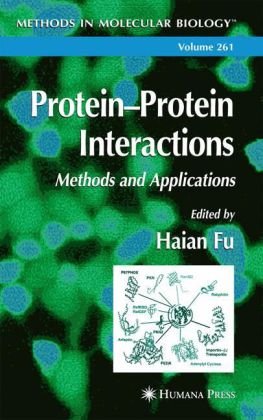
Protein Protein Interactions Methods and Applications 1st Edition by Robert Liddington, Haian Fu ISBN 9781588291202 1588291200


Original price was: $50.00.$35.00Current price is: $35.00.
Protein Protein Interactions Methods and Applications 1st Edition by Robert C. Liddington, Haian Fu – Ebook PDF Instant Download/Delivery: 9781588291202, 1588291200
Full download Protein Protein Interactions Methods and Applications 1st Edition after payment
Product details:
ISBN 10: 1588291200
ISBN 13: 9781588291202
Author: Robert C. Liddington, Haian Fu
As the mysteries stored in our DNA have been more completely revealed, scientists have begun to face the extraordinary challenge of unraveling the int- cate network of protein–protein interactions established by that DNA fra- work. It is increasingly clear that proteins continuously interact with one another in a highly regulated fashion to determine cell fate, such as proliferation, diff- entiation, or death. These protein–protein interactions enable and exert str- gent control over DNA replication, RNA transcription, protein translation, macromolecular assembly and degradation, and signal transduction; essentially all cellular functions involve protein–protein interactions. Thus, protein–p- tein interactions are fundamental for normal physiology in all organisms. Alt- ation of critical protein–protein interactions is thought to be involved in the development of many diseases, such as neurodegenerative disorders, cancers, and infectious diseases. Therefore, examination of when and how protein–p- tein interactions occur and how they are controlled is essential for understa- ing diverse biological processes as well as for elucidating the molecular basis of diseases and identifying potential targets for therapeutic interventions. Over the years, many innovative biochemical, biophysical, genetic, and computational approaches have been developed to detect and analyze p- tein–protein interactions. This multitude of techniques is mandated by the diversity of physical and chemical properties of proteins and the sensitivity of protein–protein interactions to cellular conditions.
Table of contents:
- Front Matter
- Structural Basis of Protein‑Protein Interactions
- Quantitative Analysis of Protein‑Protein Interactions
- In Vitro Techniques
- Characterization of Protein‑Protein Interactions by Isothermal Titration Calorimetry
- Circular Dichroism Analysis for Protein‑Protein Interactions
- Protein‑Protein Interaction Analysis by Nuclear Magnetic Resonance Spectroscopy
- Measuring Rhodopsin‑G‑Protein Interactions by Surface Plasmon Resonance
- Using Light Scattering to Determine the Stoichiometry of Protein Complexes
- Sedimentation Equilibrium Studies
- Analysis of Protein‑Protein Interactions by Simulation of Small‑Zone Gel Filtration Chromatography
- Fluorescence Gel Retardation Assay to Detect Protein‑Protein Interactions
- Fluorescence Polarization Assay to Quantify Protein‑Protein Interactions
- Studying Protein‑Protein Interactions via Blot Overlay or Far Western Blot
- Glutathione‑S‑Transferase‑Fusion Based Assays for Studying Protein‑Protein Interactions
- Affinity Capillary Electrophoresis Analyses of Protein–Protein Interactions in Target‑Directed Drug Discovery
- Mapping Protein‑Ligand Interactions by Hydroxyl‑Radical Protein Footprinting
- Use of Phage Display and Polyvalency to Design Inhibitors of Protein‑Protein Interactions
- Detecting Protein‑Protein Interactions in Heterologous Systems
- Detecting Protein–Protein Interactions in Heterologous Systems
- A Bacterial Two‑Hybrid System Based on Transcription Activation – Simon L. Dove & Ann Hochschild
- Using the Yeast Two‑Hybrid System to Identify Interacting Proteins – John Miller & Igor Stagljar
- Analysis of Protein–Protein Interactions Utilizing Dual Bait Yeast Two‑Hybrid System – Ilya G. Serebriiskii & Elena Kotova
- The Split‑Ubiquitin Membrane‑Based Yeast Two‑Hybrid System – Safia Thaminy, John Miller & Igor Stagljar
- Reverse Two‑Hybrid Techniques in the Yeast Saccharomyces cerevisiae – Matthew A. Bennett, Jack F. Shern & Richard A. Kahn
- Mammalian Two‑Hybrid Assay for Detecting Protein–Protein Interactions In Vivo – Jae Woon Lee & Soo‑Kyung Lee
- Co‑Immunoprecipitation from Transfected Cells – Shane C. Masters
- Probing Protein–Protein Interactions in Living Cells
- Microscopic Analysis of Fluorescence Resonance Energy Transfer (FRET) – Brian Herman, R. Venkata Krishnan & Victoria E. Centonze
- Monitoring Molecular Interactions in Living Cells Using Flow Cytometric Analysis of FRET – Francis Ka‑Ming Chan
- Fluorescence Correlation Spectroscopy – Keith M. Berland
- Confocal Microscopy for Intracellular Co‑Localization of Proteins – Toshiyuki Miyashita
- Mapping Biochemical Networks With Protein‑Fragment Complementation Assays – Ingrid Remy & Stephen W. Michnick
- In Vivo Protein Cross‑Linking – Fabrice Agou, Fei Ye & Michel Véron
- Proteomics‑Based Approaches
- Computational Prediction of Protein‑Protein Interactions – John C. Obenauer & Michael B. Yaffe
- Affinity Methods for Phosphorylation‑Dependent Interactions – Greg Moorhead & Carol MacKintosh
- Two‑Dimensional Gel Electrophoresis for Analysis of Protein Complexes – Karin Barnouin
- Sample Preparation of Gel‑Electrophoretically Separated Protein Binding Partners for Analysis by Mass Spectrometry – Rainer Cramer, Malcolm Saxton & Karin Barnouin
People also search for:
protein protein interactions methods and applications
what are protein-protein interactions
protein-protein interactions methods for detection and analysis
protein-protein interaction techniques
protein-protein interaction examples
Tags: Robert Liddington, Haian Fu, Protein Protein, Interactions Methods