
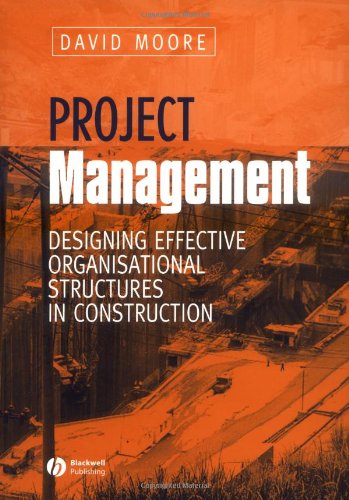
Project Management Designing Effective Organisational Structures in Construction 1st Edition by David Moore ISBN 978-0632063932 0632063939

Original price was: $50.00.$35.00Current price is: $35.00.
Project Management Designing Effective Organisational Structures in Construction 1st Edition by David Moore – Ebook PDF Instant Download/Delivery: 978-0632063932, 0632063939
Full download Project Management Designing Effective Organisational Structures in Construction 1st Edition after payment
Product details:
ISBN 10: 0632063939
ISBN 13: 978-0632063932
Author: David Moore
Organisation structure can make or break the project manager…
New forms of organisation are emerging in the construction industry – from partnering to virtual teams. There is a growing need to consider project organisational structures carefully. This book differs from the many other texts on project management by concentrating on the challenges of devising relevant structures for project management.
It examines the diverse factors to be considered when determining an initial overall organisation for new construction projects. It also looks at how to vary the organisation in response to the differing environments over the lifetime of a project.
In a pragmatic, accessible style, the author has both added to the body of knowledge in this area and provided the project management with a set of effectivemanagement tools to:
examine the criteria for designing structures within an organisation
identify the factors relevant to the development of an initial project organisation structure
assess the significance of an individual factor in the operation of a structure
Table of contents:
PART I: STRUCTURE PAST
CHAPTER 1
Searching for the Real Project: The Historical Approach
-
Introduction
-
1.1 Information as a Production Resource
-
1.2 Identifying the Project Nature in System Terms
-
1.3 Effects on the Internal Environment
-
1.4 The Conversion Process
-
1.5 Conclusions
CHAPTER 2
Open System Characteristics in Industrial Terms: Relatively Recent Developments
-
Introduction
-
2.1 Energy
-
2.2 Throughput
-
2.3 Output
-
2.4 Event Management
-
2.5 Entropy and the Issue of Noise
-
2.6 Feedback
-
2.7 Steady State
-
2.8 Differentiation – Further Discussion of Case Study 1
-
2.9 Equifinality
-
2.10 Conclusions
PART II: STRUCTURE PRESENT
CHAPTER 3
Establishing a Project’s Relevant Environmental Forces: Recognise the Relevant – Ignore Everything Else?
-
Introduction
-
3.1 Gathering Information
-
3.2 Application: A Hypothetical Project Scenario
-
3.3 Project Objectives and Organisation Structure
-
3.4 Traditional Organisation Structures
-
3.5 Variations on the Basic Themes
-
3.6 Selecting an Organisational Form
-
3.7 Integrated Project Teams (IPTs)
-
3.8 Conclusions
CHAPTER 4
Further Factors in a Possible Model for Organisation Structure Design
-
Introduction
-
4.1 Changes in the External Environment
-
4.2 Environments Becoming Unfavourable
-
4.3 Virtual Teams
-
4.4 Transformational Organisation Structures
-
4.5 Conclusions
CHAPTER 5
Control is Not Total
-
Introduction
-
5.1 Project Boundaries
-
5.2 Control of the Human Resource
-
5.3 Caveat Emptor
-
5.4 Conclusions
PART III: STRUCTURE FUTURE?
CHAPTER 6
The Genome Approach
-
Introduction
-
6.1 The Simplified Genome
-
6.2 Expanding the Start Genome
-
6.3 Conclusions
CHAPTER 7
Taking Up the Options
-
Introduction
-
7.1 Required Structure Characteristics: Discussion of Skunkworks
-
7.2 Achieving the Project-Specific Genome (PSG)
-
7.3 Implementing the Structure
-
7.4 The Learning Organisation
-
7.5 The Humorous Organisation
-
7.6 Conclusions
CHAPTER 8
Future Challenges
-
Introduction
-
8.1 The Short Term
-
8.2 The Medium Term
-
8.3 The Long Term
People also search for:
project management design
project management design thinking
project management design phase
project management effectiveness
effective project management pushes decision making down in the organization
Tags: David Moore, Project Management, Designing Effective, Organisational Structures