
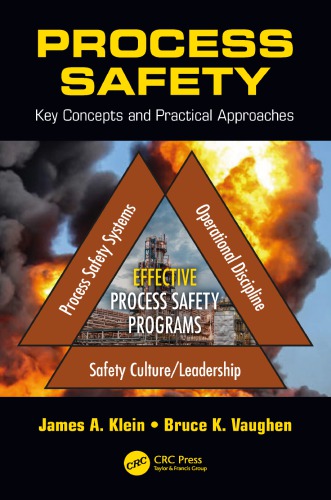
Process Safety Practical Applications for Safe and Reliable Operations 1st Edition by James Klein, Bruce Vaughen ISBN 978-0367736170 0367736179

Original price was: $50.00.$35.00Current price is: $35.00.
Process Safety Practical Applications for Safe and Reliable Operations 1st Edition by James A. Klein, Bruce K. Vaughen – Ebook PDF Instant Download/Delivery: 978-0367736170, 0367736179
Full download Process Safety Practical Applications for Safe and Reliable Operations 1st Edition after payment
Product details:
ISBN 10: 0367736179
ISBN 13: 978-0367736170
Author: James A. Klein, Bruce K. Vaughen
Effective process safety programs consist of three interrelated foundations―safety culture and leadership, process safety systems, and operational discipline―designed to prevent serious injuries and incidents resulting from toxic releases, fires, explosions, and uncontrolled reactions. Each of these foundations is important and one missing element can cause poor process safety performance.
Process Safety: Key Concepts and Practical Approaches takes a systemic approach to the traditional process safety elements that have been identified for effective process safety programs. More effective process safety risk reduction efforts are achieved when these process safety systems, based on desired activities and results rather than by specific elements, are integrated and organized in a systems framework. This book provides key concepts, practical approaches, and tools for establishing and maintaining effective process safety programs to successfully identify, evaluate, and manage process hazards.
It introduces process safety systems in a way that helps readers understand the purpose, design, and everyday use of overall process safety system requirements. Understanding what the systems are intended to achieve, understanding why they have been designed and implemented in a specific way, and understanding howthey should function day-to-day is essential to ensure continued safe and reliable operations.
Table of contents:
Section I Key Concepts of Process Safety
1. Introduction to Process Safety
1.1 Introduction
1.1.1 Purpose and Scope..
1.1.2 Application
1.2 Key Concepts.
1.2.1 What Is Process Safety?.
1.2.2 Process Safety Is Not “Personal Safety”
1.3 Why Is Process Safety Important?.
1.3.1 Business Impact..
1.3.2 Code of Ethics..
1.3.3 Conservation of Life
1.4 Case Studies
1.4.1 Large Companies
1.4.2 Small Companies.
1.4.3 Universities.
1.5 Key Questions…
References
2. Process Safety Culture, Leadership, and Performance
2.1 Introduction
2.2 Key Concepts.
2.2.1 What Is Safety Culture?
2.2.2 Characteristics of Safety Cultures..
2.2.3 Employee Participation..
2.3 Evaluating and Improving Safety Cultures
2.4 Process Safety Leadership
2.5 Process Safety Performance.
2.6 Case Study.
References
3. Process Safety Systems
3.1 Introduction
3.2 Key Concepts.
3.2.1 Process Risk
3.2.2 Managing Process Risk
3.2.3 Protection Layer Model.
3.3 Process Safety Systems.
3.4 Barrier Protection Layer Models.
3.4.1 Swiss Cheese Model
3.4.2 Bow Tie Diagrams..
3.5 Case Study…
References
4. Operational Discipline
4.1 Introduction
4.2 Key Concepts.
4.2.1 Benefits of Strong OD…
4.2.2 OD Program Characteristics.
4.2.2.1 Organizational OD
4.2.2.2 OD personnel
4.3 Improving OD
4.4 Evaluating OD…
4.4.1 General Approaches.
4.4.2 Evaluating Personal OD.
4.5 Leadership Processes.
4.6 Case Study…
References
Section II
Practical Approaches for Designing Safe Processes
5. Design Safe Processes
5.1 Introduction
5.2 Key Concepts.
5.2.1 Using Codes and Standards.
5.2.2 Documenting the Technology
5.2.3 Sustaining the Information…
5.3 The Process and Equipment Design Basis.
5.3.1 Applying Inherently Safer Process Design
5.3.2 Understanding the Hazards.
5.3.3 Understanding the Process Risks
5.3.4 Selecting the Equipment.
5.3.5 Selecting Safe Operating Limits for Process Equipment….
5.3.6 Establishing Safe Equipment Layout.
5.3.7 Establishing Equipment Integrity
5.3.8 Documenting the Process and Equipment Design Specifications.
5.4 Case Studies
5.5 Measures of Success.
References
6. Identify and Assess Process Hazards
6.1 Introduction
6.2 Key Concepts
6.2.1 Physical Property Data.
6.2.2 Completing the Intrinsic Hazards Assessment.
6.3 Toxicity Hazards.
6.3.1 Assessing Toxicity Hazards.
6.3.2 Case Study
6.4 Flammability Hazards.
6.4.1 Assessing Flammability Hazards.
6.4.2 Assessing Explosion Hazards…
6.4.3 Case Study.
6.5 Combustible Dust Hazards
6.5.1 Assessing Combustible Dust Hazards..
6.5.2 Case Study
6.6 Chemical Reactivity Hazards.
6.6.1 Assessing Chemical Reactivity Hazards
6.6.2 Developing a Chemical Compatibility Matrix
6.6.3 Case Study
6.7 Other Process Hazards
6.8 Measures of Success..
References
7. Evaluate and Manage Process Risks
7.1 Introduction
7.2 Key Concepts.
7.2.1 What Is Process Hazards and Risk Analysis (PHRA)?….
7.2.2 When Is a PHRA Done?
7.2.3 Who Does a PHRA?.
7.2.4 How Is a PHRA Done?.
7.3 Process Hazards Identification.
7.4 Consequence Analysis……
7.5 Hazardous Event Evaluation
7.5.1 HAZOP
7.5.2 What-If/Checklist.
7.5.3 Other Methodologies..
7.6 Human Factors
7.7 Facility Siting.
7.8 Inherently Safer Processes.
7.9 Protection Layers.
7.10 Risk Analysis.
7.10.1 Qualitative Risk Analysis.
7.10.2 Layer of Protection Analysis.
7.10.3 Quantitative Risk Analysis
7.11 PHRA Revalidation
7.12 Measures of Success.
References
Section III
Practical Approaches for Implementing Process Safety
8. Operate Safe Processes
8.1 Introduction…
8.2 Key Concepts
8.2.1 Using Procedures
8.2.2 Providing Competency Training.
8.2.3 Sustaining Safe Processes..
8.3 Developing Procedures: Process Safety Systems.
8.4 Developing Procedures: Safe Operations
8.5 Developing Capability: Process Safety Systems.
8.6 Developing Capability: Safe Operations.
8.7 Measures of Success…
References
9. Maintain Process Integrity and Reliability
9.1 Introduction
9.2 Key Concepts…
9.2.1 Inspection, Testing, and Preventative Maintenance Programs
9.2.2 The Difference between Integrity and Reliability.
9.2.3 Ensuring Equipment Fitness for Service
9.2.4 Maintenance Capability and Competency.
9.3 Identifying Critical Equipment…
9.4 Identifying Causes of Equipment Failure
9.5 Developing an Effective Maintenance System
9.5.1 Questions Posed When Developing the Maintenance System.
9.5.2 Equipment Risk Based Inspection Programs.
9.5.3 Equipment Reliability Programs
9.5.4 Equipment Quality Assurance Programs..
9.5.5 Equipment Integrity Programs
9.5.6 Combining Programs..
9.6 Ensuring Equipment Fitness for Service
9.7 Addressing Equipment Deficiencies.
9.8 Monitoring the Equipment Maintenance System
9.9 Case Study
9.10 Measures of Success
References
10. Change Processes Safely
10.1 Introduction.
10.2 Key Concepts.
10.2.1 Defining Changes..
10.2.2 Managing Changes.
10.2.3 Communicating Changes.
10.3 Case Study
10.4 Understanding Organizational Changes.
10.5 Understanding Technology Changes
10.6 How Change is Managed
10.7 Measures of Success
References
11. Manage Incident Response and Investigation
11.1 Introduction
11.2 Key Concepts
11.2.1 The Six Phases for Managing Incidents.
11.2.2 Effective Investigations
11.3 Classifying the Types of Responses and Incidents.
11.3.1 Defining Emergencies.
11.3.2 Defining Incidents.
11.4 Planning and Responding to Emergencies..
11.4.1 Planning for Incidents
11.4.2 Responding during the Incident.
11.5 Recovering From and Investigating Incidents.
11.5.1 Recovering from the Incident.
11.5.2 Investigating after the Incident.
11.5.3 Combining Resources When Recovering and Investigating
11.6 Changing and Sustaining after the Incident
11.6.1 Implementing the Changes.
11.6.2 Sustaining the Changes.
11.7 Incident Investigation Methods.
11.7.1 Why-Trees.
11.7.2 Fishbone Diagrams.
11.7.3 Root Cause Analyses.
11.7.4 Fault Tree Analyses.
11.8 Applying Bow Tie Diagrams to Investigations.
11.8.1 Searching for the Event-Related Causes..
11.8.2 Visualizing Barrier Weaknesses on the Bow Tie Diagram….
11.8.3 Searching for the Systemic Causes.
11.8.4 Visualizing Systemic Weaknesses on the Bow Tie Diagram……
11.8.5 Searching for the Foundational Causes.
11.9 Case Study.
11.10 Measures of Success.
References
12. Monitor Process Safety Program Effectiveness
12.1 Introduction
12.2 Key Concepts.
12.2.1 Sensitivity to Operations
12.2.2 Learning Organizations.
12.3 Process Safety Metrics (Key Performance Indicators).
12.3.1 Development of Metrics
12.3.2 Use of Metrics.
12.4 Process Safety Audits..
12.4.1 Preparing for an Audit.
12.4.2 Conducting an Audit..
12.4.3 Documenting an Audit
12.5
Measures of Success..
References
Section IV
Practical Approaches for Achieving Process Safety Excellence
13. Develop Personal Capability in Process Safety
13.1 Introduction
13.2 Process Safety Roles and Responsibilities.
13.3 How to Be Effective in Process Safety Roles.
13.3.1 Developing Technical Process Safety Knowledge
13.3.2 Influencing the Organization..
13.3.3 Thinking and Communicating Independently.
13.4 Developing a Learning Plan
References
14. Commit to a Safe Future
14.1 Maintaining an Effective Process Safety
Program
14.2 Looking to the Future of Process Safety.
References
People also search for:
process safety practical applications
what is a process safety
process safety program
process safety analysis
process safety analysis template
Tags: James Klein, Bruce Vaughen, Process Safety, Applications for Safe, Reliable Operations