
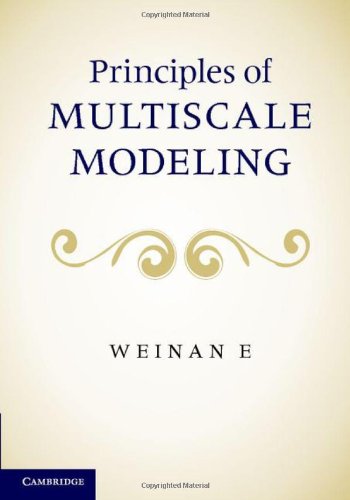
Principles of Multiscale Modeling 1st Edition by Weinan E ISBN 978-0521825443 1107096545

Original price was: $50.00.$35.00Current price is: $35.00.
Principles of Multiscale Modeling 1st Edition by Weinan E- Ebook PDF Instant Download/Delivery: 978-0521825443, 1107096545
Full download Principles of Multiscale Modeling 1st Edition after payment
Product details:
ISBN 10: 1107096545
ISBN 13: 978-0521825443
Author: Weinan E
Physical phenomena can be modeled at varying degrees of complexity and at different scales. Multiscale modeling provides a framework, based on fundamental principles, for constructing mathematical and computational models of such phenomena, by examining the connection between models at different scales. This book, by a leading contributor to the field, is the first to provide a unified treatment of the subject, covering, in a systematic way, the general principles of multiscale models, algorithms and analysis. After discussing the basic techniques and introducing the fundamental physical models, the author focuses on the two most typical applications of multiscale modeling: capturing macroscale behavior and resolving local events. The treatment is complemented by chapters that deal with more specific problems. Throughout, the author strikes a balance between precision and accessibility, providing sufficient detail to enable the reader to understand the underlying principles without allowing technicalities to get in the way.
Table of contents:
1 Introduction
1.1 Examples of multiscale problems
1.1.1 Multiscale data and their representation
1.1.2 Differential equations with multiscale data
1.1.3 Differential equations with small parameters
1.2 Multi-physics problems
1.2.1 Examples of scale-dependent phenomena
1.2.2 Deficiencies of the traditional approaches to modeli
1.2.3 The multi-physics modeling hierarchy
1.3 Analytical methods
1.4 Numerical methods
1.4.1 Linear scaling algorithms
1.4.2 Sublinear scaling algorithms
1.4.3 Type A and type B multiscale problems
1.4.4 Concurrent vs. sequential coupling
1.5 What are the main challenges?
1.6 Notes..
2 Analytical Methods
2.1 Matched asymptotics
2.1.1 A simple advection-diffusion equation.
2.1.2 Boundary layers in incompressible flows.
2.1.3 Structure and dynamics of shocks
2.1.4 Transition layers in the Allen-Cahn equation
2.2 The WKB method
2.3 Averaging methods
2.3.1 Oscillatory problems
2.3.2 Stochastic ordinary differential equations
2.3.3 Stochastic simulation algorithms.
2.4 Multiscale expansions.
2.4.1 Removing secular terms
2.4.2 Homogenization of elliptic equations
2.4.3 Homogenization of the Hamilton-Jacobi equations
2.4.4 Flow in porous media.
2.5 Scaling and self-similar solutions.
2.5.1 Dimensional analysis
2.5.2 Self-similar solutions of PDEs
2.6 Renormalization group analysis
2.6.1 The Ising model and critical exponents
2.6.2 An illustration of the renormalization transformation
2.6.3 RG analysis of the two-dimensional Ising model
2.6.4 A PDE example
2.7 The Mori-Zwanzig formalism.
2.8 Notes.
3 Classical Multiscale Algorithms
3.1 Multigrid method
3.2 Fast summation methods.
3.2.1 Low rank kernels
3.2.2 Hierarchical algorithms
3.2.3 The fast multi-pole method
3.3 Adaptive mesh refinement
3.3.1 A posteriori error estimates and local error indicators
3.3.2 The moving mesh method
3.4 Domain decomposition methods
3.4.1 Non-overlapping domain decomposition methods.
3.4.2 Overlapping domain decomposition methods
3.5 Multiscale representation
3.5.1 Hierarchical bases
3.5.2 Multi-resolution analysis and wavelet bases
3.6 Notes.
4 The Hierarchy of Physical Models
4.1 Continuum mechanics
4.1.1 Stress and strain in solids
4.1.2 Variational principles in elasticity theory
4.1.3 Conservation laws.
4.1.4 Dynamic theory of solids and thermoelasticity
4.1.5 Dynamics of fluids
4.2 Molecular dynamics
4.2.1 Empirical potentials
4.2.2 Equilibrium states and ensembles
4.2.3 The elastic continuum limit the Cauchy-Born rule
4.2.4 Non-equilibrium theory.
4.2.5 Linear response theory and the Green-Kubo formula
4.3 Kinetic theory
4.3.1 The BBGKY hierarchy
4.3.2 The Boltzmann equation
4.3.3 The equilibrium states
4.3.4 Macroscopic conservation laws
4.3.5 The hydrodynamic regime
4.3.6 Other kinetic models
4.4 Electronic structure models
4.4.1 The quantum many-body problem
4.4.2 Hartree and Hartree-Fock approximation
4.4.3 Density functional theory
4.4.4 Tight-binding models
4.5 Notes.
5 Examples of Multi-physics Models
5.1 Brownian dynamics models of polymer fluids.
5.2 Extensions of the Cauchy-Born rule
5.2.1 High order, exponential and local Cauchy-Born rules
5.2.2 An example of a one-dimensional chain
5.2.3 Sheets and nanotubes.
5.3 The moving contact line problem
5.3.1 Classical continuum theory.
5.3.2 Improved continuum models
5.3.3 Measuring the boundary conditions using molecular dynamics
5.4 Notes.
6 Capturing the Macroscale Behavior
6.1 Some classical examples
6.1.1 The Car-Parrinello molecular dynamics
6.1.2 The quasi-continuous method
6.1.3 The kinetic scheme
6.1.4 Cloud-resolving convection parametrization.
6.2 Multi-grid and the equation-free approach
6.2.1 Extended multi-grid method
6.2.2 The equation-free approach
6.3 The heterogeneous multiscale method
6.3.1 The main components of HMM
6.3.2 Simulating gas dynamics using molecular dynamics
6.3.3 The classical examples from the HMM viewpoint
6.3.4 Modifying traditional algorithms to handle multiscale problems
6.4 Some general remarks.
6.4.1 Similarities and differences
6.4.2 Difficulties with the three approaches
6.5 Seamless coupling
6.6 Application to fluids
6.7 Stability, accuracy and efficiency
6.7.1 The heterogeneous multiscale method
6.7.2 The boosting algorithm.
6.7.3 The equation-free approach
6.8 Notes.
7 Resolving Local Events or Singularities
7.1 Domain decomposition method
7.1.1 Energy-based formulation
7.1.2 Dynamic atomistic and continuum methods for solids
7.1.3 Coupled atomistic and continuum methods for fluids
7.2 Adaptive model refinement or model reduction
7.2.1 The nonlocal quasicontinuum method
7.2.2 Coupled gas dynamic-kinetic models
7.3 The heterogeneous multiscale method
7.4 Stability issues
7.5 Consistency issues illustrated using QC
7.5.1 The appearance of the ghost force
7.5.2 Removing the ghost force
7.5.3 Truncation error analysis
7.6 Notes.
8 Elliptic Equations with Multiscale Coefficients
8.1 Multiscale finite element methods
8.1.1 The generalized finite element method
8.1.2 Residual-free bubbles
8.1.3 Variational multiscale methods
8.1.4 Multiscale basis functions
8.1.5 Relations between the various methods
8.2 Upscaling via successive elimination of small scale components
8.3 Sublinear scaling algorithms
8.3.1 Finite element HMM
8.3.2 The local microscale problem
8.3.3 Error estimates
8.3.4 Information about the gradients
8.4 Notes.
9 Problems with Multiple Time Scales
9.1 ODEs with disparate time scales.
9.1.1 General setup for limit theorems.
9.1.2 Implicit methods
9.1.3 Stablized Runge-Kutta methods
9.1.4 HMM
9.2 Application of HMM to stochastic simulation algorithms
9.3 Coarse-grained molecular dynamics
9.4 Notes.
10 Rare Events
10.1 Theoretical background
10.1.1 Metastable states and reduction to Markov chains
10.1.2 Transition state theory
10.1.3 Large deviation theory
10.1.4 First exit times
10.1.5 Transition path theory
10.2 Numerical algorithms
10.2.1 Finding transition states
10.2.2 Finding the minimal energy path
10.2.3 Finding the transition path ensemble or the transition tubes
10.3 Accelerated dynamics and sampling methods
10.3.1 TST-based acceleration techniques
10.3.2 Metadynamics
10.3.3 Temperature-accelerated molecular dynamics
10.4 Notes.
11 Some Perspectives
11.0.1 Variational model reduction
11.0.2 Modeling memory effects
People also search for:
principles of multiscale modeling weinan
principles of capacity
principles of design scale
principles of multimedia learning
principles of multimedia design
Tags: Weinan E, Multiscale Modeling