
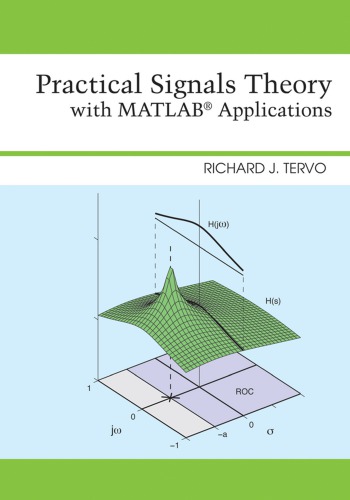
Practical Signals Theory with MATLAB Applications 1st Edition by Richard Tervo ISBN 978-1118115398 1118115398

Original price was: $50.00.$35.00Current price is: $35.00.
Practical Signals Theory with MATLAB Applications 1st Edition by Richard J. Tervo – Ebook PDF Instant Download/Delivery: 978-1118115398 1118115398
Full download Practical Signals Theory with MATLAB Applications 1st Edition after payment
Product details:
ISBN 10: 1118115398
ISBN 13: 978-1118115398
Author: Richard J. Tervo
Practical Signals Theory with MATLAB Applications is organized around applications, first introducing the actual behavior of specific signals and then using them to motivate the presentation of mathematical concepts. Tervo sequences the presentation of the major transforms by their complexity: first Fourier, then Laplace, and finally the z-transform.
The goal is to help students who can’t visualize phenomena from an equation to develop their intuition and learn to analyze signals by inspection.
Finally, most examples and problems are designed to use MATLAB, making the presentation more in line with modern engineering practice.
Table of contents:
Chapter 1: Introduction to Signals and Systems
1.1 Introduction
1.2 Introduction to Signal Manipulation
1.3 A Few Useful Signals
1.4 The Sinusoidal Signal
1.5 Phase Change vs. Time Shift
1.6 Useful Hints and Help with MATLAB
1.7 Conclusions
Chapter 2: Classification of Signals
2.1 Introduction
2.2 Periodic Signals
2.3 Odd and Even Signals
2.4 Energy and Power Signals
2.5 Complex Signals
2.6 Discrete Time Signals
2.7 Digital Signals
2.8 Random Signals
2.9 Useful Hints and Help with MATLAB
2.10 Conclusions
Chapter 3: Linear Systems
3.1 Introduction
3.2 Definition of a Linear System
3.3 Linear System Response Function h(t)
3.4 Convolution
3.5 Determining h(t) in an Unknown System
3.6 Causality
3.7 Combined Systems
3.8 Convolution and Random Numbers
3.9 Useful Hints and Help with MATLAB
3.10 Chapter Summary
3.11 Conclusions
Chapter 4: The Fourier Series
4.1 Introduction
4.2 Expressing Signals by Components
4.3 Part One—Orthogonal Signals
4.4 Orthogonality
4.5 Part Two—The Fourier Series
4.6 Computing Fourier Series Components
4.7 Fundamental Frequency Component
4.8 Practical Harmonics
4.9 Odd and Even Square Waves
4.10 Gibb’s Phenomenon
4.11 Setting Up the Fourier Series Calculation
4.12 Some Common Fourier Series
4.13 Part Three—The Complex Fourier Series
4.14 The Complex Fourier Series
4.15 Complex Fourier Series Components
4.16 Properties of the Complex Fourier Series
4.17 Analysis of a DC Power Supply
4.18 The Fourier Series with MATLAB
4.19 Conclusions
Chapter 5: The Fourier Transform
5.1 Introduction
5.2 Properties of the Fourier Transform
5.3 The Rectangle Signal
5.4 The Sinc Function
5.5 Signal Manipulations: Time and Frequency
5.6 Fourier Transform Pairs
5.7 Rapid Changes vs. High Frequencies
5.8 Conclusions
Chapter 6: Practical Fourier Transforms
6.1 Introduction
6.2 Convolution: Time and Frequency
6.3 Transfer Function of a Linear System
6.4 Energy in Signals: Parseval’s Theorem for the Fourier Transform
6.5 Data Smoothing and the Frequency Domain
6.6 Ideal Filters
6.7 A Real Lowpass Filter
6.8 The Modulation Theorem
6.9 Periodic Signals and the Fourier Transform
6.10 The Analog Spectrum Analyzer
6.11 Conclusions
Chapter 7: The Laplace Transform
7.1 Introduction
7.2 The Laplace Transform
7.3 Exploring the s-Domain
7.4 Visualizing the Laplace Transform
7.5 Properties of the Laplace Transform
7.6 Differential Equations
7.7 Laplace Transform Pairs
7.8 Circuit Analysis with the Laplace Transform
7.9 State Variable Analysis
7.10 Conclusions
Chapter 8: Discrete Signals
8.1 Introduction
8.2 Discrete Time vs. Continuous Time Signals
8.3 A Discrete Time Signal
8.3.1 A Periodic Discrete Time Signal
8.4 Data Collection and Sampling Rate
8.5 Introduction to Digital Filtering
8.6 Illustrative Examples
8.7 Discrete Time Filtering with MATLAB
8.8 Conclusions
Chapter 9: The z-Transform
9.1 Introduction
9.2 The z-Transform
9.3 Calculating the z-Transform
9.4 A Discrete Time Laplace Transform
9.5 Properties of the z-Transform
9.6 z-Transform Pairs
9.7 Transfer Function of a Discrete Linear System
9.8 MATLAB Analysis with the z-Transform
9.9 Digital Filtering—FIR Filter
9.10 Digital Filtering—IIR Filter
9.11 Conclusions
Chapter 10: Introduction to Communications
10.1 Introduction
10.2 Amplitude Modulation
10.3 Suppressed Carrier Transmission
10.4 Superheterodyne Receiver
10.5 Digital Communications
10.6 Phase Shift Keying
10.7 Conclusions
People also search for:
practical signals theory with matlab applications
practical signals theory with matlab applications pdf
signals and systems theory and practical explorations with python
system theory and practical applications of biomedical signals
practical signals theory with matlab applications solution