
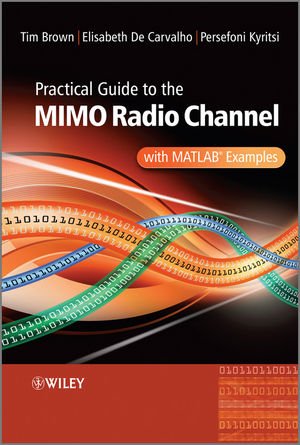
Practical Guide to MIMO Radio Channel with MATLAB Examples 1st Edition by Tim Brown, Persefoni Kyritsi, Elizabeth De Carvalho ISBN 0470994495 978-0470994498


Original price was: $50.00.$35.00Current price is: $35.00.
Practical Guide to MIMO Radio Channel with MATLAB Examples 1st Edition by Tim Brown, Persefoni Kyritsi, Elizabeth De Carvalho – Ebook PDF Instant Download/Delivery: 0470994495, 978-0470994498
Full download Practical Guide to MIMO Radio Channel with MATLAB Examples 1st Edition after payment
Product details:
ISBN 10: 0470994495
ISBN 13: 978-0470994498
Author: Tim Brown, Persefoni Kyritsi, Elizabeth De Carvalho
This book provides an excellent reference to the MIMO radio channel
In this book, the authors introduce the concept of the Multiple Input Multiple Output (MIMO) radio channel, which is an intelligent communication method based upon using multiple antennas. Moreover, the authors provide a summary of the current channel modeling approaches used by industry, academia, and standardisation bodies. Furthermore, the book is structured to allow the reader to easily progress through the chapters in order to gain an understanding of the fundamental and mathematical principles behind MIMO. It also provides examples (i.e. Kroenecker model, Weicheselberger model, geometric and deterministic models, and ray tracing), system scenarios, trade-offs, and visual explanations. The authors explain and demonstrate the use and application of these models at system level.
Key Features:
Provides a summary of the current channel modeling approaches used by industry, academia and standardisation bodies
Contains experimental and measurement based results
Provides a comprehensive down to earth approach with concise and visual explanations of MIMO Radio Channel
Covers a variety of system scenarios and explains the trade-offs involved in each
Accompanying website containing MATLAB code and solutions to related problems
http://www.tim.brown76.name/MIMObook)
Practical Guide to the MIMO Radio Channel with MATLAB examples is an invaluable reference for R&D engineers and professionals in industry requiring familiarisation with the concept, and engineers entering the field or working in related fields seeking an introduction to the topic. Postgraduate and graduate students will also find this book of interest.
Table of contents:
1 Introduction
1.1 From SISO to MISO/ SIMO to MIMO
1.1.1 Single Input Single Output SISO
1.1.2 Single Input Multiple Output, SIMO, and Multiple Input Single Output, MISO
1.1.3 Multiple Input Multiple Output, MIMO
1.2 What Do We Need MIMO For?
1.2.1 The Single User Perspective
1.2.2 The Multiple User Perspective
1.3 How Does MIMO Work? Two Analogies
1.3.1 The Single User Perspective
1.3.2 The Multiple User Perspective
1.4 Conditions for MIMO to Work
1.5 How Long Has MIMO Been Around?
1.6 Where is MIMO Being Used?
1.7 Purpose of the Book
2 Capacity of MIMO Channels
2.1 Some Background on Digital Communication Systems
2.1.1 Generation of Digital Signals
2.1.2 Conversion/Formatting for Transmission
2.1.3 Complex Baseband Representation
2.1.4 Decoder
2.2 Notion of Capacity
2.2.1 Abstract Communication System
2.2.2 Definition of Capacity
2.2.3 Capacity Achieving Transceivers
2.3 Channel State Information and Fading
2.3.1 Fast and Slow Fading
2.3.2 Channel State Information
2.4 Narrowband MIMO Model
2.5 Capacity of the Time-Invariant Channel
2.5.1 Capacity of the Time-Invariant SISO Channel
2.5.2 Time-Invariant SIMO Channel
2.5.3 Time-Invariant MISO Channel
2.5.4 Time-Invariant MIMO Channel: A Set of Parallel Independent AWGN Channels
2.5.5 Maximal Achievable Rate for Fixed Input Covariance Matrix
2.6 Fast Fading Channels with CSIT Distribution: Ergodic Capacity
2.6.1 Ergodic Capacity: Basic Principles
2.6.2 Fast Fading SISO Channel with CSIT Distribution
2.6.3 Fast Fading SIMO Channel with CSIT Distribution
2.6.4 Fast Fading MISO Channel with CSIT Distribution
2.6.5 Fast Fading MIMO Channels with CSIT Distribution
2.7 Slow Fading Channel with CSIT Distribution: Outage Probability and Capacity with Outage
2.7.1 Outage: Basic Principles
2.7.2 Diversity to Improve Communication Reliability
2.7.3 Slow Fading SISO Channels with CSIT Distribution
2.7.4 Slow Fading SIMO Channel with CSIT Distribution: Receive Diversity
2.7.5 Slow Fading MISO Channel with CSIT Distribution: Transmit Diversity
2.7.6 Slow Fading MIMO Channel with CSIT Distribution
2.8 Chapter Summary Tables
2.9 Further Reading
3 MIMO Transceivers
3.1 MIMO Receivers
3.1.1 General MIMO Architecture
3.1.2 Maximum Likelihood Receiver
3.1.3 Classes of Receivers Considered in the Chapter
3.1.4 Spatial Matched Filtering
3.1.5 Zero Forcing Receiver
3.1.6 MMSE Receiver
3.1.7 SIC Receiver and V-Blast
3.1.8 Performance
3.2 Transceivers with CSI at Transmitter and Receiver: Transmit and Receive Beamforming
3.2.1 Principle of Beamforming
3.2.2 Multiple Transmit and Receive Beams
3.2.3 Transmit Beamforming (MISO System)
3.2.4 Receive Beamforming (SIMO)
3.2.5 Single Beam MIMO: Maximal Eigenmode Beamforming
3.2.6 Eigenmode Transmission
3.2.7 Performance of Beamforming Schemes
3.3 Space–Time Block Codes
3.3.1 Orthogonal Design for a 2 × 1 MISO System: Alamouti STBC
3.3.2 STBC for More than Two Transmit Antennas
3.4 D-Blast
3.4.1 Diagonal Encoding
3.4.2 Diagonal Decoding
3.4.3 D-Blast: Outage Optimal
3.4.4 Performance Gains
3.4.5 Error Propagation
3.4.6 Numerical Evaluations: Comparison of D-Blast with STBC
3.5 Chapter Summary Tables
3.6 Further Reading
4 MIMO Channel Models
4.1 SISO Models and Channel Fundamentals
4.1.1 Models for the Prediction of the Power
4.1.2 Models for the Prediction of the Temporal Variation of the Channel
4.1.3 Narrowband and Wideband Channels
4.1.4 Polarisation
4.1.5 Summary of Parameters Required for SISO Channel Modelling
4.2 Challenges in MIMO Channel Modelling
4.2.1 Deterministic Models
4.2.2 Stochastic Models
4.3 Summary
5 MIMO Antenna Design
5.1 Antenna Element Fundamentals
5.1.1 Isotropic Radiator
5.1.2 Directivity and Gain
5.1.3 Far Field and Rayleigh Distance
5.1.4 Three Dimensional Antenna Patterns
5.1.5 Impedance and Return Loss
5.1.6 Reciprocity
5.1.7 Antenna Polarisation
5.1.8 Mean Effective Gain
5.2 Single Antenna Design
5.3 Designing Array Antennas for MIMO
5.3.1 Spatial Correlation
5.3.2 Angular and Polarised Correlation
5.3.3 Impact of Nonuniform Angles of Arrival
5.4 Impact of Antenna Design on the MIMO Radio Channel
5.5 Evaluating Antenna Impact on the MIMO Channel
5.5.1 A Crude Evaluation of the Impact of Antennas on MIMO Channel Capacity
5.5.2 Advanced Techniques to Evaluate MIMO Antenna Performance
5.6 Challenges in Compact MIMO Antenna Design and Examples
5.7 Summary
6 MIMO in Current and Future Standards
6.1 Wireless Channel Modelling in Standards
6.2 Current Wireless Standards Employing MIMO and the Corresponding Channel Models
6.2.1 IEEE 802.11n
6.2.2 IEEE 802.16–WiMAX
6.2.3 3GPP-LTE
6.2.4 Comparison of the IEEE 802.11n, WiMAX and 3GPP Models
6.3 MIMO in Other Areas
6.3.1 MIMO for DVB-T2
6.3.2 MIMO in the HF Band
6.3.3 MIMO for Satellite Communications
6.3.4 Ultrawideband MIMO
6.3.5 MIMO for On-body Communications
6.3.6 MIMO for Vehicular Communications
6.3.7 MIMO in Small Cellular Environments
6.4 Concluding Remarks and Future Wireless Systems
People also search for:
practical guide to mimo radio
practical guide to mimo radio channel with matlab examples
tutorial mimo
mimo tutorial pdf
mimo techniques
Tags: Tim Brown, Persefoni Kyritsi, Elizabeth De Carvalho, Practical Guide, MIMO Radio, MATLAB Examples