
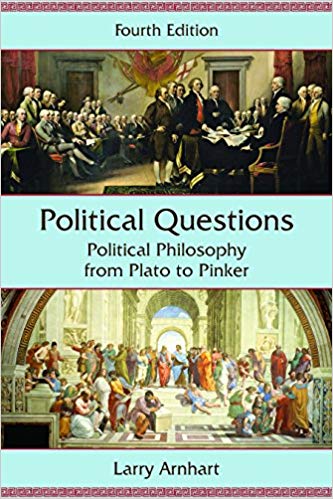

Political Questions Political Philosophy from Plato to Pinker Fourth Edition by Larry Arnhart – Ebook PDF Instant Download/Delivery: 1478629061, 978-1478629061
Full download Political Questions Political Philosophy from Plato to Pinker Fourth Edition after payment

Product details:
ISBN 10: 1478629061
ISBN 13: 978-1478629061
Author: Larry Arnhart
In this enhanced edition, Larry Arnhart continues to ask thought-provoking questions that illuminate the philosophies of some of the most prominent political thinkers throughout history. This clear, well-written guide is an ideal supplement to the original texts he recommends at the beginning of each chapter. In addition to his analysis of Plato, Aristotle, Augustine, Aquinas, Machiavelli, Descartes, Rousseau, Hegel, Marx, Nietzsche, and Rawls, the author’s well-organized and insightful approach provides an even more comprehensive overview than the earlier editions:
Supplementing the discussion of Leviathan, the chapter on Thomas Hobbes coversBehemoth.
The chapter on John Locke includes his Letter Concerning Toleration as well as the original discussion of Second Treatise of Government.
A chapter on Adam Smith has been added, which discusses Theory of Moral Sentiments and Wealth of Nations.
Leo Strauss is featured, with an examination of Persecution and the Art of Writing and Natural Right and History.
A final chapter analyzes Steven Pinker’s The Better Angels of Our Nature.
Table of contents:
9. Participatory Democracy: Rousseau’s First Discourse, Second Discourse, and The Social Contract
- Does popular enlightenment subvert political freedom? (282)
- Were human beings naturally good as solitary animals in the state of nature? (284)
- Has the evolution of civilization deprived us of our natural freedom and happiness? (290)
- Does participatory democracy promote or threaten individual liberty? (293)
- Does a participatory democracy require a godlike founder? (297)
- Is representative democracy disguised slavery? (298)
- Does democracy need a civil religion? (299)
- Is a true democracy impossible? (301)
10. Morals and Markets in the Commercial Society: Smith’s Theory of Moral Sentiments and Wealth of Nations
- Is Smithian moral sentimentalism rooted in selfishness, vanity, conformism, and emotivism? (312)
- Do evolutionary science and experimental game theory confirm Smith’s moral theory? (316)
- Does religion make people moral? (328)
- Do markets degrade morals? (334)
- In the commercial society, does commerce take the place of virtue? (340)
- Does the commercial society promote the bourgeois virtues? (343)
- Is Smith a man of the left, or even a proto-Marxist, in supporting distributive justice for the poor? (348)
- Does the system of natural liberty require private property anarchism? (354)
- Does the recent history of economic and financial crises show the failure of Smithian free-market thinking? (359)
- Has capitalism created a climate change that could soon destroy civilization? (365)
11. History and the Modern State: Hegel’s Philosophy of Right and Philosophy of History
- Does history have an ultimate meaning? (378)
- Is every political philosopher “a child of his time”? (381)
- What is freedom? (383)
- Can the modern state unite individual rights and political duties? (384)
- Does war preserve the health of the state? (388)
- Is the United States a state? (389)
- Have we reached the end of history? (392)
12. Socialism: Marx’s Communist Manifesto
- Do economic interests determine history? (400)
- Must capitalists exploit their workers? (403)
- Does capitalism prevent workers from finding joy in their work? (404)
- Does capitalism inevitably create an unjust inequality, with wealth concentrated in the hands of the richest 1 percent of the capitalists? (406)
- Would socialism emancipate human beings? (410)
- Can a socialist economy work? (414)
- Can we have Marx without Stalin? (416)
- Can socialism be democratic? (417)
- Can social democracy combine the best features of capitalism and socialism? (420)
- Do we need a new communism? (424)
- Is socialist anarchism more liberating than Marxist communism? (425)
13. The Death of God and the Will to Power: Nietzsche’s The Birth of Tragedy; Human, All Too Human; Thus Spoke Zarathustra; and Beyond Good and Evil
- Do we need the mythic illusions of music and drama to conceal the meaningless chaos of the world? (440)
- Can a free-spirited science of Darwinian evolution give us “humble truths”? (442)
- Can human beings live without transcendent longings? (444)
- Is a free-spirited science compatible with modern liberal democracy? (446)
- Who is Zarathustra? (447)
- Can life be explained as will to power and eternal return? (451)
- Is Nietzsche too pious? (453)
- Does going “beyond good and evil” lead us to a new nobility or a new barbarism? (455)
- Is Nietzsche’s Darwinian aristocratic liberalism superior to his Dionysian aristocratic radicalism? (457)
14. Relativism and Natural Right in the Crisis of Liberalism: Strauss’s Persecution and the Art of Writing and Natural Right and History
- Is esoteric writing necessary to protect philosophy and politics from mutual harm? (469)
- Can philosophers refute modern relativism and nihilism by proving the truth of natural right? (473)
- Can modern biology support the natural teleology required for natural right? (476)
- Is the unnatural character of slavery an example of natural right that can be defended against historicist and positivist relativism? (478)
- Is the philosophic life of the few naturally superior to the moral, religious, and political lives of the many? (483)
- Does Lockean natural right teach hedonistic relativism, in which “life is the joyless quest for joy”? (489)
- Was Strauss a Jewish Nazi? (491)
- Does liberalism allow for human excellence and the philosophic life through liberal education? (499)
15. The Social Justice of Equal Liberty: Rawls’s A Theory of Justice
- Are the principles of justice those we would choose under impartial conditions of fairness? (510)
- Should government force the more fortunate people of a society to help those less fortunate? (513)
- Does justice require social equality? (520)
- Does justice require capitalist liberty? (521)
- Should we seek equality of opportunity but not equality of result, even when that allows a cognitive elite to become the ruling class? (523)
- Is an instinctive moral grammar of justice part of our evolved human nature? (529)
- Does a liberal conception of justice require the coercive enforcement of a liberal way of life as the best life for human beings? (534)
16. The Classical Liberalism of Declining Violence: Pinker’s The Better Angels of Our Nature
- Were prehistoric human foragers ignoble savages with a naturally evolved propensity for war? (548)
- Does history show declining violence? (554)
- Does religious ideology promote violence? (558)
- Is capitalist ideology more likely than communist ideology to promote violence? (560)
- Does the liberal peace require a world of flat souls without manly virtues? (563)
- Can a decline in violence arise from a genetic evolution towards the bourgeois virtues through survival of the richest? (566)
- Are classical liberals more intelligent people? (569)
People also search for:
political philosophy questions examples
what is political philosophy in political science
political philosophy questions
political philosophical questions
political philosophy quizlet
Tags:
Larry Arnhart,Political Questions,Political Philosophy,Plato to Pinker


