
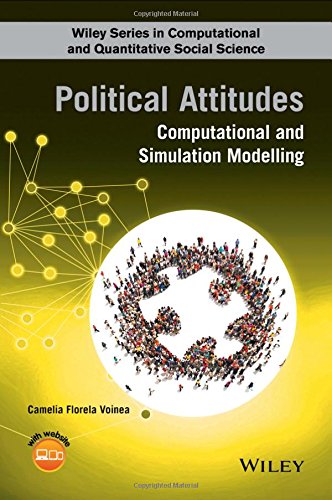
Political Attitudes Computational and Simulation Modelling 1st Edition by Camelia Florela Voinea ISBN 978-1118833148 1118833147

Original price was: $50.00.$35.00Current price is: $35.00.
Political Attitudes Computational and Simulation Modelling 1st Edition by Camelia Florela Voinea – Ebook PDF Instant Download/Delivery: 978-1118833148, 1118833147
Full download Political Attitudes Computational and Simulation Modelling 1st Edition after payment
Product details:
ISBN 10: 1118833147
ISBN 13: 978-1118833148
Author: Camelia Florela Voinea
Political Science has traditionally employed empirical research and analytical resources to understand, explain and predict political phenomena. One of the long-standing criticisms against empirical modeling targets the static perspective provided by the model-invariant paradigm. In political science research, this issue has a particular relevance since political phenomena prove sophisticated degrees of context-dependency whose complexity could be hardly captured by traditional approaches. To cope with the complexity challenge, a new modeling paradigm was needed. This book is concerned with this challenge. Moreover, the book aims to reveal the power of computational modeling of political attitudes to reinforce the political methodology in facing two fundamental challenges: political culture modeling and polity modeling. The book argues that an artificial polity model as a powerful research instrument could hardly be effective without the political attitude and, by extension, the political culture computational and simulation modeling theory, experiments and practice. This book: Summarizes the state of the art in computational modeling of political attitudes, with illustrations and examples featured throughout. Explores the different approaches to computational modeling and how the complexity requirements of political science should determine the direction of research and evaluation methods. Addresses the newly emerging discipline of computational political science. Discusses modeling paradigms, agent-based modeling and simulation, and complexity-based modeling. Discusses model classes in the fundamental areas of voting behavior and decision-making, collective action, ideology and partisanship, emergence of social uprisings and civil conflict, international relations, allocation of public resources, polity and institutional function, operation, development and reform, political attitude formation and change in democratic societies. This book is ideal for students who need a conceptual and operational description of the political attitude computational modeling phases, goals and outcomes in order to understand how political attitudes could be computationally modeled and simulated. Researchers, Governmental and international policy experts will also benefit from this book., Political Science has traditionally employed empirical research and analytical resources to understand, explain and predict political phenomena. One of the long-standing criticisms against empirical modeling targets the static perspective provided by the model-invariant paradigm. In political science research, this issue has a particular relevance since political phenomena prove sophisticated degrees of context-dependency whose complexity could be hardly captured by traditional approaches. To cope with the complexity challenge, a new modeling paradigm was needed. This book is concerned with this challenge. Moreover, the book aims to reveal the power of computational modeling of political attitudes to reinforce the political methodology in facing two fundamental challenges: political culture modeling and polity modeling. The book argues that an artificial polity model as a powerful research instrument could hardly be effective without the political attitude and, by extension, the political culture computational and simulation modeling theory, experiments and practice. This book: Summarizes the state of the art in the computational modeling of political attitudes, with illustrations and examples featured throughout. Explores the different approaches to computational modeling and how the complexity requirements of political science should determine the direction of research and evaluation methods. Addresses the newly emerging discipline of computational political science. Discusses modeling paradigms, agent-based modeling and simulation, and complexity-based modeling. Discusses model classes in the fundamental areas of voting behavior and decision-making, collective action, ideology and partisanship, emergence of social uprisings and civil conflict, international relations, allocation of public resources, polity and institutional function, operation, development and reform, political attitude formation and change in democratic societies. This book is ideal for students who need a conceptual and operational description of the political attitude computational modeling phases, goals and outcomes in order to understand how political attitudes could be computationally modeled and simulated. Researchers, Governmental and international policy experts will also benefit from this book., Political Science has traditionally employed empirical research and analytical resources to understand, explain and predict political phenomena. One of the long-standing criticisms against empirical modeling targets the static perspective provided by the model-invariant paradigm.
Table of contents:
PART I. SOCIAL AND POLITICAL ATTITUDE MODELLING
-
Attitudes: A Brief History of the Concept
-
Political Attitudes: Conceptual and Computational Modelling Backgrounds
PART II. SOCIAL AND POLITICAL INFLUENCE MODELS OF ATTITUDE CHANGE
3. Voting Choice Computer Simulation Model
4. Community Referendum Model
PART III. THE ROLE OF PHYSICAL SPACE IN POLITICAL ATTITUDE MODELLING
5. Social Impact Theory and Model
6. Dynamic Social Impact Theory and Model
PART IV. POLITICAL ATTITUDE APPROACHES BASED ON SOCIAL INFLUENCE, CULTURE CHANGE AND COLLECTIVE ACTION MODELLING
7. Culture Dissemination Model
8. Diversity Survival Model
9. Collective Action Modelling
PART V. MULTIDIMENSIONAL SPATIAL MODELS
10. The System Dynamics Modelling Paradigm
11. Multidimensional Attitude Change Models: Galileo
PART VI. POLITICAL COGNITION MODELLING
12. The JQP Model
13. Political Attitude Strength Simulation Modelling
PART VII. COMPUTATIONAL AND SIMULATION MODELLING OF IDEOLOGY
14. Ideological Polarization Model
15. Ideological Landscapes Model
16. Complex Integrative Models of Political Ideology
PART VIII. POLITY MODELLING
17. Polity Instability Models Featuring Ethnic and Nationalist Insurgence
18. Polity Instability Model Featuring Reconstruction after State Failure
19. Polity Dynamics Model Featuring the Relationship between Public Issue Emergence and Public Policy Development
20. Polity Instability Model Featuring Revolution against Authoritarian Regime
PART IX. EPILOGUE
21. Shaping New Science
Author Index
Subject Index
People also search for:
political attitudes definition psychology
a political compass
a computational approach to politeness with application to social factors
a political
a political analyst conducted an observational study in 2014
Tags: Camelia Florela Voinea, Political Attitudes Computational, Simulation Modelling