
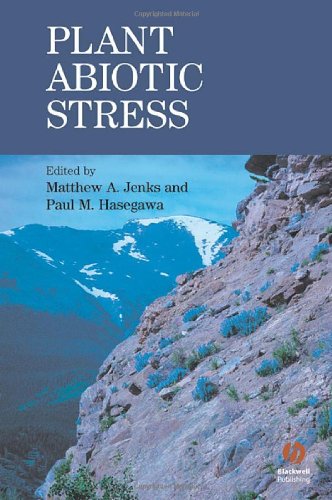
Plant Abiotic Stress Biological Sciences Series 1st Edition by Matthew Jenks, Paul Hasegawa ISBN 9781405122382, 1405122382
Original price was: $50.00.$35.00Current price is: $35.00.
Plant Abiotic Stress Biological Sciences Series 1st Edition by Matthew A. Jenks, Paul M. Hasegawa – Ebook PDF Instant Download/Delivery: 9781405122382 1405122382
Full download Plant Abiotic Stress Biological Sciences Series 1st Edition after payment
Product details:
ISBN 10: 1405122382
ISBN 13: 9781405122382
Author: Matthew A. Jenks, Paul M. Hasegawa
Over the past decade, our understanding of plant adaptation to environmental stress has grown considerably. This book focuses on stress caused by the inanimate components of the environment associated with climatic, edaphic and physiographic factors that substantially limit plant growth and survival. Categorically these are abiotic stresses, which include drought, salinity, non-optimal temperatures and poor soil nutrition. Another stress, herbicides, is covered in this book to highlight how plants are impacted by abiotic stress originating from anthropogenic sources. The book also addresses the high degree to which plant responses to quite diverse forms of environmental stress are interconnected, describing the ways in which the plant utilizes and integrates many common signals and subsequent pathways to cope with less favorable conditions.
The book is directed at researchers and professionals in plant physiology, cell biology and molecular biology, in both the academic and industrial sectors.
Table of contents:
1. Eco-physiological adaptations to limited water environments.
Andrew J. Wood, Department of Plant Biology, University of Southern Illinois, USA.
2. Plant cuticle function as a barrier to water loss.
S. Mark Goodwin and Matthew A. Jenks, Department of Horticulture and Landscape Architecture, Purdue University, West Lafayette, Indiana, USA.
3. Plant adaptive responses to salinity stress.
Miguel A. Botella and Abel Rosado, Depart. Biología Molecular y Bioquímica, Universidad de Málaga, Spain and Ray A. Bressan and Paul M. Hasegawa, Department of Horticulture and Landscape Architecture, Purdue University, West Lafayette, Indiana, USA.
4. The CBF cold-response pathway.
Sarah Fowler, Daniel Cook and Michael F. Thomashow, MSU-DOE Plant Research Laboratory, Michigan State University, East Lansing, USA.
5. Plant responses to high temperature.
Jane Larkindale, Michael Mishkind and Elizabeth Vierling, Department of Biochemistry and Molecular Biophysics, University of Arizona, Tucson, USA.
6. Adaptive responses in plants to non-optimal soil pH.
V. Ramírez-Rodríguez, J. López-Bucio and Luis Herrera-Estrella, Departamento de Ingeniería Genética de Plantas, Centro de Investigación y Estudios Avanzados de Instituto Politécnico Nacional, Guanajuato, Mexico.
7. Plant responses to herbicides.
William E. Dyer and Stephen C. Weller, Department of Horticulture and Landscape Architecture, Purdue University, West Lafayette, Indiana, USA.
8. Integration of abiotic stress signalling pathways.
Manu Agarwal and Jian-Kang Zhu, Department of Biochemistry and Molecular Biophysics, University of Arizona, Tucson, USA.
9. Genomic analysis of stress response.
Motoaki Seki, Junko Ishida, Maiko Nakajima et al, Plant Mutation Exploration Team, Plant Functional Genomics Research Group, RIKEN Genomic Sciences Center (GSC), RIKEN Yokohama Institute, Japan.
People also search for:
types of abiotic stress in plants
effect of abiotic stress on plants
plant breeding for abiotic stress tolerance
abiotic stress in plant breeding
abiotic stress in plant breeding ppt
Tags:
Matthew Jenks,Paul Hasegawa,Plant Abiotic,Biological Sciences Series