
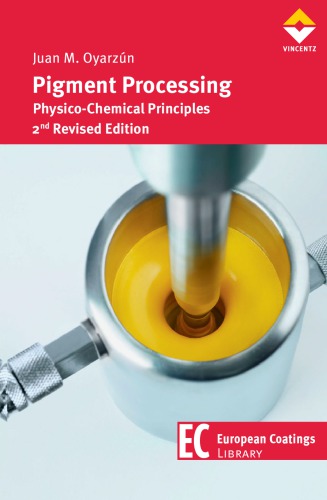
Pigment Processing Physico Chemical Principles 2nd Edition by Juan Oyarzúm ISBN 3866306653 978-3866306653

Original price was: $50.00.$35.00Current price is: $35.00.
Pigment Processing Physico Chemical Principles 2nd Edition by Juan M. Oyarzúm- Ebook PDF Instant Download/Delivery: 3866306653, 978-3866306653
Full download Pigment Processing Physico Chemical Principles 2nd Edition after payment
Product details:
ISBN 10: 3866306653
ISBN 13: 978-3866306653
Author: Juan M. Oyarzúm
Table of contents:
1. Physical Characterisation of Pigments
1.1 Particle morphology
1.2 Crystal structure
1.2.1 Crystal modifications: polymorphism
1.2.2 Isomorphism and anisotropy
1.2.3 X-ray crystallography
1.3 Particle size measurement
1.3.1 Particle size distribution
1.3.1.1 Sieve analysis
1.3.1.2 Determination by electron microscopy
1.3.1.3 Analysis by sedimentation techniques
1.3.1.4 Optical methods
1.3.1.5 Ultrasonic attenuation spectroscopy
1.3.1.6 Electroacoustic methods
1.3.1.7 The Coulter counter
1.3.1.8 Methods of presenting results
1.3.2 Specific surface area
1.3.2.1 The Freundlich adsorption isotherm
1.3.2.2 Langmuir’s adsorption theory
1.3.2.3 The adsorption isotherm according to Brunauer, Emmett and Teller
1.3.2.4 Determination of the average particle size
1.4 Surface character
1.4.1 Polarity and hydrophilicity
1.4.2.1 Surface tension
1.4.2.2 Capillarity
1.4.3 Electrical polarisability
1.4.3.1 Polarisation of dielectrics in an electric field
1.4.3.2 Polarisability and refractive index
1.4.3.3 Polarisability and pigment/binder-interaction
1.4.4 Surface treatment
2. Optical Properties of Pigmented Systems
2.1 Reflection, gloss and gloss haze
2.1.1 Gloss
2.1.2 Gloss haze
2.2 Light scattering by colloidal disperse particles
2.2.1 Rayleigh scattering
2.2.2 Mie theory
2.3 Absorption and scattering as factors in the tinctorial properties of pigments
2.3.1 Hiding power, semi-transparency and transparency
2.3.2 Lightening power
2.3.3 Tinting strength and depth of shade
2.3.4 Hue (or shade)
3. Rheological Behaviour of Pigment Dispersions
3.1 Introduction
3.2 Newton’s law of viscosity
3.3 Dependence of viscosity on temperature
3.4 Flow properties of concentrated suspensions and molecular colloids
3.4.1 Newtonian flow
3.4.2 Structural viscosity (pseudoplasticity)
3.4.3 Dilatancy
3.4.4 Plasticity
3.4.4.1 Bingham or linear-plastic flow
3.4.4.2 Non-linear plasticity (Casson viscosity)
3.4.4.3 Plastic-dilatant flow
3.4.5 Shear-time dependent flow
3.4.5.1 Thixotropy
3.4.5.2 Rheopexy
3.4.6 Viscoelasticity
3.4.6.1 Effect principles
3.4.6.2 Effect of molecular structure
3.4.7 Flow behaviour of water-thinnable binder systems
3.5 Rheological behaviour of pigmented systems in practice
3.5.1 Basic aspects
3.5.2 Printing inks
3.5.3 Paints and enamels
3.5.4 Plastics
3.6 Closing remarks
4. Dispersion Process: Physico-Chemical Fundamentals
4.1 Introduction
4.2 Stages of the dispersion process
4.2.1 Mechanical breakdown
4.2.1.1 Forces of interaction between the pigment particles
4.2.1.2 Types of mechanical breakdown
4.2.2.1 Energetic approach
4.2.2.2 Wetting kinetics
4.2.3 Stabilisation
4.2.3.1 Fundamental aspects
4.2.3.2 Stabilisation by steric hindrance
4.2.3.3 Electrostatic stabilisation: DLVO theory and zeta potential
4.2.3.4 Measuring zeta potentials
4.3 Stabilisation problems with pigmented systems after dispersion
4.3.1 Flocculation
4.3.1.1 Fundamental aspects
4.3.1.2 Testing and measuring flocculation behaviour
4.3.1.3 Kinetic approach to flocculation
4.3.1.4 Coflocculation
4.3.1.5 Prevention of flocculation
4.3.2 Flooding and floating
4.3.2.1 Discussion and theoretical explanation
4.3.2.2 Testing separation phenomena: spray-pouring test and rub-out test
4.3.2.3 Methods for overcoming flooding and floating
4.3.3 Shock effects and seeding
4.3.3.1 Pigment shock
4.3.3.2 Binder shock
4.3.3.3 Solvent shock
4.3.3.4 Seeding
5. Dispersion Process: Methods and Mathematical Models for Assessing the Degree of Dispersion
5.1 Introduction
5.2 Direct methods
5.2.1 Fineness-of-grind and dispersion curve
5.2.2 Examination with the optical microscope
5.3 Indirect methods
5.3.1 Tinting strength development
5.3.2 Assessment of the state of dispersion from gloss development
5.3.3 Increase in lightness flop
5.4 Concluding remarks
6. Dispersion Process: Mill Base Optimisation
6.1 General considerations
6.2 Description of the dispersion process by a probability function
6.2.1 Theoretical principles
6.2.2 Practical conclusions from the probability relationship for the dispersion process
6.3 Dispersibility of pigments
6.3.1 Critical approach to the definition of pigment dispersibility according to DIN ISO 18451-1
6.3.2 Testing and stating the dispersibility as specified in DIN EN ISO 8780 and DIN EN ISO 8781
6.3.3 Assessment of the dispersibility by means of a half-life value
6.3.4 Pragmatic definition for pigment dispersibility
6.4 Methods for mill base optimisation
6.4.1 Daniel flow-point procedure
6.4.2 Guggenheim factor
6.4.3 Efficiency of the dispersion process: new criterion for optimizing mill bases
6.4.4 Optimisation of several factors by means of an experimental design according to Plackett and Burman
6.4.5 Optimisation of the cost of the dispersion process by controlling energy input
Appendix
List of physical symbols and constants used
List of relevant norms
References
Index
People also search for:
pigment processing physico chemical principles
pigment processing physico chemical principles pdf
lake pigment process
physicochemical problems of mineral processing
pigment particles
Tags: Juan Oyarzúm, Pigment Processing, Physico Chemical Principles