
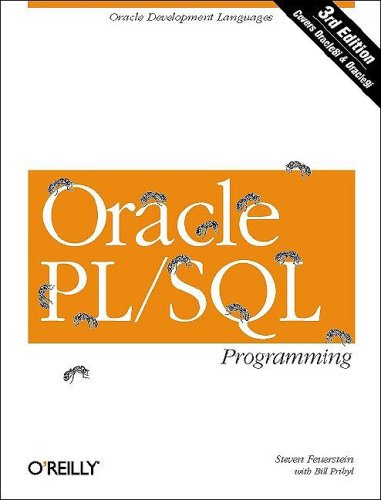
Oracle PL SQL Programming Third Edition by Steven Feuerstein ISBN 978-0596003814 0596003811
Original price was: $50.00.$35.00Current price is: $35.00.
Oracle PL SQL Programming Third Edition by Steven Feuerstein – Ebook PDF Instant Download/Delivery: 978-0596003814, 0596003811
Full download Oracle PL SQL Programming Third Edition after payment
Product details:
ISBN 10: 0596003811
ISBN 13: 978-0596003814
Author: Steven Feuerstein
Nearly a quarter-million PL/SQL programmers–novices and experienced developers alike–have found the first and second editions of “Oracle PL/SQL Programming to be indispensable references to this powerful language. Packed with examples and recommendations, this book has helped everyone, from Oracle Forms developers to database administrators, make the most of PL/SQL. This new edition is a comprehensive update of the original book, covering all versions of PL/SQL through Oracle9i Release 2. It adds much-requested new chapters on how to create and run PL/SQL programs, call Java methods from within PL/SQL, and define and use database triggers. An extensive new chapter–designed especially for experienced PL/SQL developers–describes PL/SQL’s runtime architecture and how to use knowledge of Oracle internals to get the best performance from PL/SQL.
Table of contents:
I. Programming in PL/SQL
1. Introduction to PL/SQL
The Origins of PL/SQL
So This Is PL/SQL About PL/SQL Versions Resources for PL/SQL Developers
Some Words of Advice
2. Creating and Running PL/SQL Code Performing Essential PL/SQL Tasks Oracle’s PL/SQL-Based Developer Tools Calling PL/SQL from Other Languages
And What Else?
3. Language Fundamentals
The PL/SQL Character Set
Identifiers
Literals
The Semicolon Delimiter
Comments
The PRAGMA Keyword
Labels
II. PL/SQL Program Structure
4. Conditional and Sequential Control
CASE Statements
The GOTO Statement
The NULL Statement
5. Iterative Processing with Loops
The Simple Loop
The WHILE Loop
The Numeric FOR Loop
The Cursor FOR Loop
Loop Labels
Tips for Iterative Processing
6. Exception Handlers
Defining Exceptions
Raising Exceptions
Handling Exceptions
III. PL/SQL Program Data
7. Working with Program Data
Overview of PL/SQL Datatypes
Declaring Program Data
Programmer-Defined Subtypes
Conversion Between Datatypes
8. Strings
String Datatypes
String Issues
String Functions
ASCII
ASCIISTR
CHR
COMPOSE
CONCAT
DECOMPOSE
GREATEST
INITCAP
INSTR, INSTRB, INSTRC, INSTR2, and INSTR4
LEAST
LENGTH, LENGTHB, LENGTHC, LENGTH2, and LENGTH4
LOWER
LPAD
LTRIM
REPLACE
RPAD
RTRIM
SOUNDEX
SUBSTR, SUBSTRB, SUBSTRC, SUBSTR2, and SUBSTR4
TO_CHAR
TO_MULTI_BYTE
TO_SINGLE_BYTE
TRANSLATE
TRANSLATE…USING
TRIM
UNISTR
UPPER
NLS Functions
NCHR
NLS_INITCAP
NLS_LOWER
NLS_UPPER
NLSSORT
TO_NCHAR
9. Numbers
Number Conversions
Numeric Functions
ABS
ACOS
ASIN
10. Dates and Timestamps
Date and Timestamp Conversions
Date/Time Arithmetic
Date/Time Functions
11. Records and Collections
Collections in PL/SQL
Declaring Collection Types and Collections
Where Collections Can Be Used
Collection Built-Ins (Methods)
Working with Collections
Collection Pseudo-Functions
Maintaining Collections
Choosing a Collection Type
12. Miscellaneous Datatypes
The RAW Datatype
The UROWID and ROWID Datatypes
The LOB Datatypes
Predefined Object Types
IV. SQL in PL/SQL
13. DML and Transaction Management
Bulk DML with the FORALL Statement
Transaction Management
Autonomous Transactions
14. Data Retrieval
Working with Implicit Cursors
Working with Explicit Cursors
BULK COLLECT
SELECT…FOR UPDATE
Cursor Variables
Cursor Expressions (Oracle9i)
15. Dynamic SQL and Dynamic PL/SQL
Multirow Queries with Cursor Variables
Binding Variables
Working with Objects and Collections
Building Applications with NDS
NDS Utility Package
Comparing NDS and DBMS_SQL
V. PL/SQL Application Construction
16. Procedures, Functions, and Parameters
Procedures
Functions
Parameters
Local Modules
Module Overloading
Forward Declarations
Advanced Topics
Go Forth and Modularize!
17. Packages
Rules for Building Packages
Rules for Calling Packaged Elements
Working with Package Data
When to Use Packages
Packages and Object Types
18. Triggers
DDL Triggers
Database Event Triggers
INSTEAD OF Triggers
AFTER SUSPEND Triggers
Maintaining Triggers
19. Managing PL/SQL Applications
Protecting Stored Code
Using Native Compilation
Testing PL/SQL Programs
Debugging PL/SQL Programs
Tuning PL/SQL Programs
Improving Application Performance
VI. Advanced PL/SQL Topics
20. PL/SQL’s Runtime Architecture
Dependency Management
PL/SQL’s Use of Memory in the Oracle Server
The Processing of Server-Side PL/SQL
PL/SQL Code on the Client
Execution Authority Models
Hardware for PL/SQL: Bigger = Better?
What You Need to Know
21. Object-Oriented Aspects of PL/SQL
An Extended Example
Object Views
Maintaining Object Types and Object Views
Pontifications
22. Calling Java from PL/SQL
Getting Ready to Use Java in Oracle
A Simple Demonstration
Using loadjava
Using dropjava
Managing Java in the Database
Using DBMS_JAVA
Publishing and Using Java in PL/SQL
23. External Procedures
The Oracle Net Configuration
Creating an Oracle Library
Writing the Call Specification
Raising an Exception from the Called C Program
Nondefault Agents
Maintaining External Procedures
Index
Colophon
People also search for:
oracle pl sql programming steven feuerstein pdf
oracle pl sql programming interview questions
oracle pl sql programming 7th edition pdf
oracle pl sql programming by steven feuerstein
oracle pl sql programming book pdf
Tags: Steven Feuerstein, Oracle PL SQL