
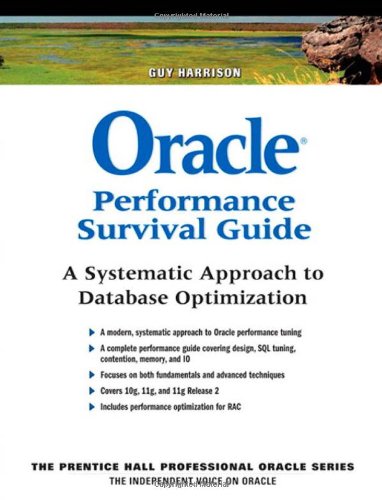
Oracle Performance Survival Guide A Systematic Approach to Database Optimization 1st Edition by Guy Harrison ISBN 0137011954 978-0137011957


Original price was: $50.00.$35.00Current price is: $35.00.
Oracle Performance Survival Guide A Systematic Approach to Database Optimization 1st Edition by Guy Harrison- Ebook PDF Instant Download/Delivery: 0137011954, 978-0137011957
Full download Oracle Performance Survival Guide A Systematic Approach to Database Optimization 1st Edition by Guy Harrisonafter payment
Product details:
ISBN 10: 0137011954
ISBN 13: 978-0137011957
Author: Guy Harrison
Oracle Performance Survival Guide
A Systematic Approach to Database Optimization
The fast, complete, start-to-finish guide to optimizing Oracle performance
Oracle Performance Survival Guide offers a structured, systematic, start-to-finish methodology for optimizing Oracle performance as efficiently as possible. Leading Oracle expert Guy Harrison shows how to maximize your tuning investment by focusing on causes rather than symptoms, and by quickly identifying the areas that deliver the greatest “bang for the buck.”
Writing for DBAs and developers with all levels of experience, Harrison covers every area of Oracle performance management, from application design through SQL tuning, contention management through memory and physical IO management. He also presents up-to-the-minute guidance for optimizing the performance of the Oracle 11g Release 2.
You’ll start by mastering Oracle structured performance tuning principles and tools, including techniques for tracing and monitoring Oracle execution. Harrison illuminates the interaction between applications and databases, guides you through choosing tuning tools, and introduces upfront design techniques that lead to higher-performance applications. He also presents a collection of downloadable scripts for reporting on all aspects of database performance.
Coverage includes
• “Tuning by layers,” the most effective, highest-value approach to Oracle performance optimization
• Making the most of Oracle’s core tools for tracing, monitoring, and diagnosing performance
• Highly efficient database logical and physical design, indexing, transaction design, and API use
• SQL and PL/SQL tuning, including the use of parallel SQL techniques
• Minimizing contention for locks, latches, shared memory, and other database resources
• Optimizing memory and physical disk IO
• Tuning Real Application Cluster (RAC) databases
guyharrison.net
informit.com/ph
Table of contents:
Chapter 1 Oracle Performance Tuning: A Methodical Approach
1 A Brief History of Oracle Performance Tuning
2 Moving Beyond a Symptomatic Approach
3 Stage 1 Minimizing the Application Workload
4 Stage 2 Reducing Contention and Bottlenecks
5 Stage 3 Reducing Physical IO
6 Stage 4 Optimizing Disk IO
7 Summary
Chapter 2 Oracle Server Architecture
8 The Oracle APIs
9 The Oracle Query Optimizer
10 Oracle Server Architecture
11 Segments and Files
12 Background Processes
13 Real Application Clusters
14 Summary
Chapter 3 SQL Execution and Monitoring
15 Explaining SQL Statements
16 Tracing Oracle Execution
17 Formatting Traces with tkprof
18 Using AUTOTRACE in SQL*PLUS
19 Monitoring the Oracle Server
20 Summary
Chapter 4 Logical and Physical Database Design
21 Logical Data Modeling
22 Logical to Physical
23 Denormalization
24 Star Schema Design
25 Physical Storage Options
26 Oracle Partitioning
27 Summary
Chapter 5 Indexing and Clustering
28 Overview of Oracle Indexing and Clustering
29 B*-Tree Indexes
30 Bitmap Indexes
31 Index Overhead
32 Clustering
33 Nested Tables
34 Choosing the Best Indexing Strategy
35 Summary
Chapter 6 Application Design and Implementation
36 SQL Statement Management
37 The Array Interface
38 Transaction Design
39 Using Stored Procedures to Reduce Network Traffic
40 Summary
Chapter 7 The Oracle Optimizer
41 The Oracle Optimizer
42 Using DBMS_STAT
43 Summary
Chapter 8 Execution Plan Management
44 Hints
45 Stored Outlines
46 SQL Tuning Sets
47 SQL Profiles and the SQL Tuning Advisor
48 SQL Baselines
49 Summary
Chapter 9 Query Optimization Techniques
50 Single Value Lookups
51 Avoiding “Accidental” Table Scans
52 Multicolumn Lookups
53 Searching for Ranges
54 Using the LIKE Operator
55 Multivalue Single-Column Lookups
56 Optimizing Necessary Full Table Scans
57 Summary
Chapter 10 Join Optimization
58 Types of Joins
59 Join Methods
60 Choosing the Right Join Method
61 Optimizing Joins
62 Avoiding Joins
63 Join Order
64 Special Joins
65 Subqueries
66 Summary
Chapter 11 Sorting and Aggregation
67 Sort Operations
68 Grouping and Aggregates
69 SET Operations
70 Summary
Chapter 12 PL/SQL Performance Optimization
71 Performance Advantages of PL/SQL
72 Measuring PL/SQL Performance
73 Data Access Optimization
74 PL/SQL Code Optimization
75 Other Optimizations
76 DML Trigger Performance
77 Summary
Chapter 13 Parallel SQL
78 Understanding Parallel SQL
79 Deciding When to Use Parallel Processing
80 Configuring Parallel Processing
81 Monitoring Parallel SQL
82 Optimizing Parallel Performance
83 Other Parallel Topics
84 Summary
Chapter 14 DML Performance Optimization
85 DML Performance Fundamentals
86 INSERT Specific Optimizations
87 DELETE Operations
88 UPDATE and MERGE Operations
89 COMMIT Optimization
90 Summary
Chapter 15 Lock Contention
91 Lock Types and Modes
92 Waiting for Locks
93 Monitoring and Analyzing Locks
94 Application Locking Strategies
95 When Row Level Locking Fails
96 System Locks
97 Summary
Chapter 16 Latch and Mutex Contention
98 Overview of Latch and Mutex Architecture
99 Measuring and Diagnosing Latch/Mutex Contention
100 Specific Latch/Mutex Scenarios
101 Is Latch Contention Inevitable?
102 Summary
Chapter 17 Buffer Cache and Redo Log Tuning
103 Buffer Cache Architecture
104 Free Buffer Waits
105 Recovery Writer (RVWR) Waits
106 Buffer Busy Waits
107 Redo Log Buffer Waits
108 Summary
Chapter 18 Buffer Cache Tuning
109 Buffer Cache Principles
110 Buffer Cache Configuration and Tuning
111 Automatic Shared Memory Management (ASMM)
112 Summary
Chapter 19 PGA and Memory Optimization
113 IO and PGA Memory
114 PGA Memory Management
115 Measuring PGA Usage and Efficiency
116 Sizing the PGA with V$PGA_TARGET_ADVICE
117 Over-Riding PGA Aggregate Target
118 Summary
Chapter 20 Overall Memory Optimization
119 Optimizing Overall Oracle Memory
120 Result Set Cache
121 Other Memory Optimizations
122 Summary
Chapter 21 Disk IO Tuning Fundamentals
123 Disk IO Concepts
124 Oracle IO Architecture
125 Measuring and Monitoring Oracle IO
126 Optimizing Datafile IO
127 Redo and Archive Optimization
128 Flashback Logs
129 Summary
Chapter 22 Advanced Storage Technologies
130 Automatic Storage Management (ASM)
131 Solid State Disk (SSD)
132 The Exadata Storage Server
133 Database Block Size
134 Summary
Chapter 23 Real Application Clusters (RAC) Optimization
135 RAC Overview
136 Measuring Cluster Overhead
137 Reducing Global Cache Latency
138 Optimizing the Interconnect
139 Cluster Balance
140 Minimizing Global Cache Requests
141 Summary
Chapter 24 Resources and References
142 The Oracle Documentation Set
143 Books
144 Internet Sites and Blogs
People also search for:
oracle performance survival guide pdf
oracle survival guide
oracle performance tuning guide
oracle performance survival guide
erp oracle system
Tags:
Guy Harrison,Oracle Performance,Survival Guide,Approach to Database