
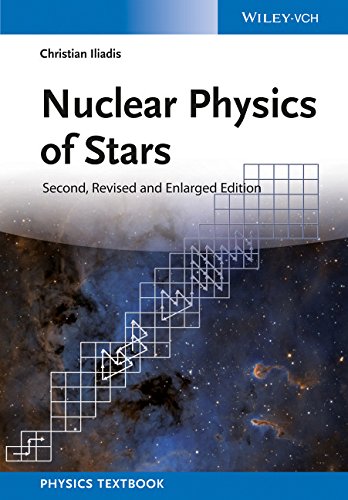
Nuclear Physics of Stars 2nd Edition by Christian Iliadis ISBN 978-3527336500 3527336500

Original price was: $50.00.$35.00Current price is: $35.00.
Nuclear Physics of Stars 2nd Edition by Christian Iliadis- Ebook PDF Instant Download/Delivery: 978-3527336500, 3527336500
Full download Nuclear Physics of Stars 2nd Edition after payment
Product details:
ISBN 10: 3527336500
ISBN 13: 978-3527336500
Author: Christian Iliadis
Most elements are synthesized, or “cooked”, by thermonuclear reactions in stars. The newly formed
elements are released into the interstellar medium during a star’s lifetime, and are subsequently
incorporated into a new generation of stars, into the planets that form around the stars, and into the life
forms that originate on the planets. Moreover, the energy we depend on for life originates from nuclear
reactions that occur at the center of the Sun. Synthesis of the elements and nuclear energy production
in stars are the topics of nuclear astrophysics, which is the subject of this book. It presents nuclear
structure and reactions, thermonuclear reaction rates, experimental nuclear methods, and nucleosynthesis
in detail. These topics are discussed in a coherent way, enabling the reader to grasp their interconnections
intuitively. The book serves both as a textbook for advanced undergraduate and graduate students, with
worked examples and end-of-chapter excercises, but also as a reference book for use by researchers
working in the field of nuclear astrophysics.
Table of contents:
1 Aspects of Nuclear Physics and Astrophysics
1.1 History
1.2 Nomenclature
1.3 Solar System Abundances
1.4 Astrophysical Aspects
1.4.1 General Considerations
1.4.2 Hertzsprung–Russell Diagram
1.4.3 Stellar Evolution of Single Stars
1.4.4 Binary Stars
1.5 Masses, Binding Energies, Nuclear Reactions, and Related Topics
1.5.1 Nuclear Mass and Binding Energy
1.5.2 Energetics of Nuclear Reactions
1.5.3 Atomic Mass and Mass Excess
1.5.4 Number Abundance, Mass Fraction, and Mole Fraction
1.5.5 Decay Constant, Mean Lifetime, and Half-Life
1.6 Nuclear Shell Model
1.6.1 Closed Shells and Magic Numbers
1.6.2 Nuclear Structure and Nucleon Configuration
1.7 Nuclear Excited States and Electromagnetic Transitions
1.7.1 Energy, Angular Momentum, and Parity
1.7.2 Transition Probabilities
1.7.3 Branching Ratio and Mixing Ratio
1.7.4 γ-Ray Transitions in a Stellar Plasma
1.7.5 Isomeric States and the Case of 26 Al
1.8 Weak Interaction
1.8.1 Weak Interaction Processes
1.8.2 Energetics
1.8.3 β-Decay Probabilities
1.8.4 β-Decays in a Stellar Plasma
Problems
2 Nuclear Reactions
2.1 Cross Sections
2.2 Reciprocity Theorem
2.3 Elastic Scattering and Method of Partial Waves
2.3.1 General Aspects
2.3.2 Relationship Between Differential Cross Section and Scattering Amplitude
2.3.3 The Free Particle
2.3.4 Turning the Potential On
2.3.5 Scattering Amplitude and Elastic Scattering Cross Section
2.3.6 Reaction Cross Section
2.4 Scattering by Simple Potentials
2.4.1 Square-Well Potential
2.4.2 Square-Barrier Potential
2.4.3 Transmission Through the Coulomb Barrier
2.5 Theory of Resonances
2.5.1 General Aspects
2.5.2 Logarithmic Derivative, Phase Shift, and Cross Section
2.5.3 Breit–Wigner Formulas
2.5.4 Extension to Charged Particles and Arbitrary Values of Orbital Angular Momentum
2.5.5 R-Matrix Theory
2.5.6 Experimental Tests of the One-Level Breit–Wigner Formula
2.5.7 Partial and Reduced Widths
2.6 Continuum Theory
2.7 Hauser–Feshbach Theory
Problems
3 Thermonuclear Reactions
3.1 Cross Sections and Reaction Rates
3.1.1 Particle-Induced Reactions
3.1.2 Photon-Induced Reactions
3.1.3 Abundance Evolution
3.1.4 Forward and Reverse Reactions
3.1.5 Reaction Rates at Elevated Temperatures
3.1.6 Reaction Rate Equilibria
3.1.7 Nuclear Energy Generation
3.2 Nonresonant and Resonant Thermonuclear Reaction Rates
3.2.1 Nonresonant Reaction Rates for Charged-Particle-Induced Reactions
3.2.2 Nonresonant Reaction Rates for Neutron-Induced Reactions
3.2.3 Nonresonant Reaction Rates for Photon-Induced Reactions
3.2.4 Narrow-Resonance Reaction Rates
3.2.5 Broad-Resonance Reaction Rates
3.2.6 Electron Screening
3.2.7 Total Reaction Rates
Problems
4 Nuclear Physics Experiments
4.1 General Aspects
4.1.1 Charged-Particle Beams
4.1.2 Neutron Beams
4.2 Interaction of Radiation with Matter
4.2.1 Interactions of Heavy Charged Particles
4.2.1.1 Stopping Power
4.2.1.2 Compounds
4.2.1.3 Energy Straggling
4.2.2 Interactions of Photons
4.2.2.1 Photoelectric Effect
4.2.2.2 Compton Effect
4.2.2.3 Pair Production
4.2.2.4 Photon Attenuation
4.2.3 Interactions of Neutrons
4.3 Targets and Related Equipment
4.3.1 Backings
4.3.2 Target Preparation
4.3.2.1 Evaporated and Sputtered Targets
4.3.2.2 Implanted Targets
4.3.2.3 Gas Targets
4.3.2.4 Target Thickness and Stability
4.3.3 Contaminants
4.3.4 Target Chamber and Holder
4.4 Radiation Detectors
4.4.1 General Aspects
4.4.2 Semiconductor Detectors
4.4.2.1 Silicon Charged-Particle Detectors
4.4.2.2 Germanium Photon Detectors
4.4.3 Scintillation Detectors
4.4.3.1 Inorganic Scintillator Photon Detectors
4.4.3.2 Organic Scintillator Charged-Particle and Neutron Detectors
4.4.4 Proportional Counters
4.4.5 Microchannel Plate Detectors
4.5 Nuclear Spectroscopy
4.5.1 Charged-Particle Spectroscopy
4.5.1.1 Energy Calibrations
4.5.1.2 Efficiencies
4.5.1.3 Elastic Scattering Studies
4.5.1.4 Nuclear Reaction Studies
4.5.2 γ-Ray Spectroscopy
4.5.2.1 Response Function
4.5.2.2 Energy Calibrations
4.5.2.3 Efficiency Calibrations
4.5.2.4 Coincidence Summing
4.5.2.5 Sum Peak Method
4.5.2.6 γ-Ray Branching Ratios
4.5.2.7 4π Detection of γ-Rays
4.5.3 Neutron Spectroscopy
4.5.3.1 Response Function
4.5.3.2 Moderated Proportional Counters
4.5.3.3 Efficiency Calibrations
4.6 Miscellaneous Experimental Techniques
4.6.1 Radioactive Ion Beams
4.6.2 Activation Method
4.6.3 Time-of-Flight Technique
4.7 Background Radiation
4.7.1 General Aspects
4.7.2 Background in Charged-Particle Detector Spectra
4.7.3 Background in γ-Ray Detector Spectra
4.7.3.1 γγ-Coincidence Techniques
4.7.4 Background in Neutron Detector Spectra
4.8 Yields and Cross Sections for Charged-Particle-Induced Reactions
4.8.1 Nonresonant and Resonant Yields
4.8.1.1 Constant σ and ε Over Target Thickness
4.8.1.2 Moderately Varying σ and Constant ε Over Target Thickness
4.8.1.3 Breit–Wigner Resonance σ and Constant ε Over Resonance Width
4.8.2 General Treatment of Yield Curves
4.8.2.1 Target of Infinite Thickness
4.8.2.2 Target of Finite Thickness
4.8.3 Measured Yield Curves and Excitation Functions
4.8.4 Determination of Absolute Resonance Strengths and Cross Sections
4.8.4.1 Experimental
People also search for:
4 nuclear forces
3 nuclear energy examples
z in nuclear physics
astro nuclear physics
wikipedia neutron stars
Tags: Christian Iliadis, Nuclear Physics of Stars