
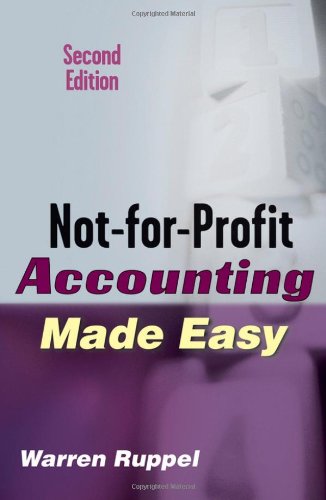
Not for Profit Accounting Made Easy 2nd Edition by Warren Ruppel ISBN 0471789798 978-0471789796

Original price was: $50.00.$35.00Current price is: $35.00.
Not for Profit Accounting Made Easy 2nd Edition by Warren Ruppel – Ebook PDF Instant Download/Delivery: 0471789798, 978-0471789796
Full download Not for Profit Accounting Made Easy 2nd Edition after payment
Product details:
ISBN 10: 0471789798
ISBN 13: 978-0471789796
Author: Warren Ruppel
A hands-on guide to the ins and outs of nonprofit accounting
Not-for-Profit Accounting Made Easy, Second Edition equips you with the tools you need to run the financial and accounting operations within your nonprofit organization. Even if you do not have a professional understanding of accounting principles and financial reporting, this handy guide makes it all clear with complex accounting rules explained in terms nonaccountants can easily understand in order to help you better fulfill your managerial and fiduciary duties. Always practical and never overtechnical, this helpful guide conforms to FASB and AICPA standards and:
*
Discusses federal single audit and its impact on nonprofits
*
Offers examples of various types of split-interest agreements
*
Shows you how to read and understand a nonprofit financial statement
*
Explains financial accounting and reporting standards
*
Helps you become conversant in the rules and principles of accounting
*
Updates board members, executive directors, and other senior managers on the accounting basics they should know for day-to-day operations
*
Features tables, exhibits, and charts that illustrate the content in a simple and easy-to-understand manner
Suitable for fundraising managers and executives–as well as anyone who needs to read and understand a nonprofit financial statement–this is the ultimate not-an-accountant’s guide to nonprofit accounting.
Table of contents:
Chapter 1. Understanding the Basics of Not-for-Profit Accounting
-
What Are Generally Accepted Accounting Principles?
-
Why Is Preparing GAAP Financial Statements Important?
-
Definitions and Examples of Assets, Liabilities, Revenues, and Expenses Usually Found in Not-for-Profit Organizations’ Financial Statements
-
What Is Meant by the Accrual Basis of Accounting? How Does This Differ from the Cash Basis of Accounting, and Which Is Better?
-
What Happened to Fund Accounting?
-
Summary
Chapter 2. Basic Financial Statements of a Not-for-Profit Organization
-
Statement of Financial Position
-
Statement of Activities
-
Statement of Cash Flows
-
Summary
Chapter 3. Accounting for Contributions
-
When Should Contributions Be Recorded?
-
Understanding the Impact of Donor Restrictions on the Reporting of Contributions
-
Accounting for Contributed Services
-
Accounting for Other Noncash Contributions
-
Pass-Through Contributions
-
Summary
Chapter 4. Accounting for Investments and Financial Instruments
-
Accounting for Investments
-
Accounting and Financial Reporting for Financial Instruments
-
Summary
Chapter 5. Accounting for Activities with Joint Costs and Indirect Cost Allocation
-
Accounting for the Costs of Activities that Include Fund-Raising
-
Allocation Methods
-
Indirect Cost Allocation Plans
-
Summary
Chapter 6. Affiliated Organizations
-
Affiliated Organizations
-
For-Profit Subsidiaries
-
Related-Party Disclosures
-
Summary
Chapter 7. Collections
-
What Is a Collection?
-
Accounting for Collections
-
Summary
Chapter 8. Split-Interest Agreements
-
Accounting Fundamentals
-
Revocable Split-Interest Agreements
-
Irrevocable Split-Interest Agreements
-
Examples of Split-Interest Agreements
-
Summary
Chapter 9. Accounting for Pension and Other Postretirement Employee Benefit Plans
-
Accounting for Pension Plans
-
Determining Pension Expense
-
Determining Pension Liability
-
Actuarial Assumptions and Calculations
-
Required Disclosures
-
Deferred Compensation Plans
-
Other Postretirement Benefits
-
Disclosures
-
Summary
Chapter 10. Lease Accounting Fundamentals
-
Lease Accounting
-
Operating versus Capital Leases
-
Operating Leases
-
Operating Leases with Scheduled Rent Increases
-
Free Rent Periods
-
Capital Leases
-
Summary
Chapter 11. Analyzing the Financial Health of Not-for-Profit Organizations
-
Financial Statement Analysis
-
Independent Auditor’s Report
-
Comparative Financial Statements
-
Functional Expense Ratios and Other Analyses
-
Budget Considerations in Financial Analysis
-
Relation of the Budget to the Financial Statements
-
Methods of Budgetary Control
-
Summary
Chapter 12. Current Developments in Not-for-Profit GAAP
-
Recent FASB Statements
People also search for:
not-for-profit accounting example
not-for-profit accounting
not-for-profit fixed asset accounting
not for profit accounting basics
not for profit accounting books