
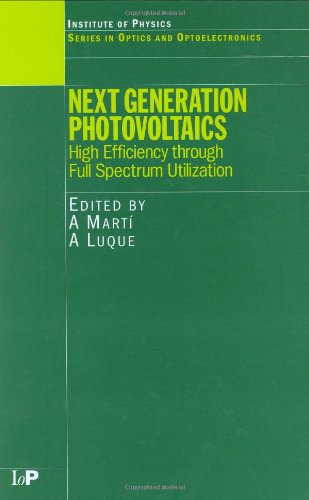
Next generation photovoltaics high efficiency through full spectrum utilization 1st Edition by Martí, Luque ISBN 0750309059 978-0750309059


Original price was: $50.00.$35.00Current price is: $35.00.
Next generation photovoltaics high efficiency through full spectrum utilization 1st Edition by A. Martí, A. Luque- Ebook PDF Instant Download/Delivery: 0750309059, 978-0750309059
Full download Next generation photovoltaics high efficiency through full spectrum utilization 1st Edition after payment
Product details:
ISBN 10: 0750309059
ISBN 13: 978-0750309059
Author: A. Martí, A. Luque
Although photovoltaics are regarded by many as the most likely candidate for long term sustainable energy production, their implementation has been restricted by the high costs involved. Nevertheless, the theoretical limit on photovoltaic energy conversion efficiency-above 85%-suggests that there is room for substantial improvement of current commercially available solar cells, both silicon and thin-film based. Current research efforts are focused on implementing novel concepts to produce a new generation of low-cost, high-performance photovoltaics that make improved use of the solar spectrum. Featuring contributions from pioneers of next generation photovoltaic research, Next Generation Photovoltaics: High Efficiency through Full Spectrum Utilization presents a comprehensive account of the current state-of-the-art in all aspects of the field. The book first discusses topics, such as multi-junction solar cells (the method closest to commercialization), quantum dot solar cells, hot carrier solar cells, multiple quantum well solar cells, and thermophotovoltaics. The final two chapters of the book consider the materials, fabrication methods, and concentrator optics used for advanced photovoltaic cells. This book will be an essential reference for graduate students and researchers working with solar cell technology.
Table of contents:
1 Non-conventional photovoltaic technology: a need to reach goals Antonio Luque and Antonio Martí
1.1 Introduction
1.2 On the motivation for solar energy
1.3 Penetration goals for PV electricity
1.4 Will PV electricity reach costs sufficiently low to permit a wide penetration?
1.5 The need for a technological breakthrough
1.6
Conclusions References
2 Trends in the development of solar photovoltaics
Zh I Alferov and V D Rumyantsev
2.1 Introduction
2.2 Starting period
2.3 Simple structures and simple technologies
2.4 Nanostructures and ‘high technologies’
2.5 Multi-junction solar cells
2.6 From the ‘sky’ to the Earth
2.7 Concentration of solar radiation
2.8 Concentrators in space
2.9 ‘Non-solar’ photovoltaics
2.10 Conclusions References
3 Thermodynamics of solar energy converters
Peter Dice
3.1 Introduction
3.2 Equilibria
3.2.1 Temperature equilibrium
3.2.2 Thermochemical equilibrium
3.3 Converting chemical energy into electrical energy: the basic requirements for a solar cell
3.4 Concepts for solar cells with ultra high efficiencies
3.4.1 Thermophotovoltaic conversion
3.4.2 Hot carrier cell
3.4.3 Tandem cells
3.4.4 Intermediate level cells
3.4.5 Photon up- and down-conversion
3.5 Conclusions
References
4 Tandem cells for very high concentration
A W Bett
4.1 Introduction
4.2 Tandem solar cells
4.2.1 Mechanically stacked tandem cells
4.2.2 Monolithic tandem cells
4.2.3 Combined approach: mechanical stacking of monolithic cells
4.3 Testing and application of monolithic dual-junction concentrator cells
4.3.1 Characterization of monolithic concentrator solar cells
4.3.2 Fabrication and characterization of a test module
4.3.3 FLATCON module
4.3.4 Concentrator system development
4.4 Summary and perspective Acknowledgments References
5 Quantum wells in photovoltaic cells C Rohr, P Abbott, I M Ballard, D B Bushnell, JP Connolly, NJ Ekins-Daukes and K W J Barnham
5.1 Introduction
5.2 Quantum well cells
5.3 Strain compensation
5.4 QWs in tandem cells
5.5 QWCs with light trapping
5.6 QWCs for thermophotovoltaics
5.7 Conclusions References
6 The importance of the very high concentration in third-generation solar cells
Carlos Algora
6.1 Introduction
6.2 Theory
6.2.1 How concentration works on solar cell performance
6.2.2 Series resistance
6.2.3 The effect of illuminating the cell with a wide-angle cone of light
6.2.4 Pending issues: modelling under real operation conditions
6.3 Present and future of concentrator third-generation solar cells
6.4 Economics
6.4.1 How concentration affects solar cell cost
6.4.2 Required concentration level
6.4.3 Cost analysis
6.5 Summary and conclusions
Note added in press
References
7 Intermediate-band solar cells
To Martí, L Cuadra and A Luque
7.1 Introduction
7.2 Preliminary concepts and definitions
7.3 Intermediate-band solar cell: model
7.4 The quantum-dot intermediate-band solar cell
7.5 Considerations for the practical implementation of the QD-IBSC
7.6 Summary
Acknowledgments
References
8 Multi-interface novel devices: model with a continuous substructure
ZT Kuznicki
8.1 Introduction
8.2 Novelties in Si optoelectronics and photovoltaics
8.2.1 Enhanced absorbance
8.2.2 Enhanced conversion
8.3 Active substructure and active interfaces
8.4 Active substructure by ion implantation
8.4.1 Hetero-interface energy band offset
8.4.2 Built-in electric field
8.4.3 Built-in strain field
8.4.4 Defects
8.5 Model of multi-interface solar cells
8.5.1 Collection efficiency and internal quantum efficiency
8.5.2 Generation rate
8.5.3 Carrier collection limit
8.5.4 Surface reservoir
8.5.5 Collection zones
8.5.6 Impurity band doping profile
8.5.7 Uni- and bipolar electronic transport in a multi-interface emitter
8.5.8 Absorbance in presence of a dead zone
8.5.9 Self-consistent calculation
8.6 An experimental test device
8.6.1 Enhanced internal quantum efficiency
8.6.2 Sample without any carrier collection limit (CCL)
8.7 Concluding remarks and perspectives
Acknowledgments
References
9 Quantum dot solar cells
A J Fine
9.1 Introduction
9.2 Relaxation dynamics of hot electrons
9.2.1 Quantum wells and superlattices
9.2.2 Relaxation dynamics of hot electrons in quantum dots
9.3 Quantum dot solar cell configuration
9.3.1 Photoelectrodes composed of quantum dot arrays
9.3.2 Quantum dot-sensitized nanocrystalline TiO2 solar cells
9.3.3 Quantum dots dispersed in organic semiconductor polymer matrices
9.4 Conclusion
Acknowledgments
References
10 Progress in thermophotovoltaic converters
Bernd Bitnar, Wilhelm Durisch, Fritz von Roth, Günther Palfinger, Hans Sigg, Detlev Grützmacher, Jens Gobrecht, Eva-Maria Meyer, Ulrich Vogt, Andreas Meyer and Adolf Heeb
10.1 Introduction
10.2 TPV based on III/V low-bandgap photocells
10.3 TPV in residential heating systems
10.4 Progress in TPV with silicon photocells
10.4.1 Design of the system and a description of the components
10.4.2 Small prototype and demonstration TPV system
10.4.3 Prototype heating furnace
10.4.4 Foam ceramic emitters
10.5 Design of a novel thin-film TPV system
10.5.1 TPV with nanostructured SiGe photocells
10.6 Conclusion
Acknowledgments
References
11 Solar cells for TPV converters
VM Andreev
11.1 Introduction
11.2 Predicted efficiency of TPV cells
11.3 Germanium-based TPV cells
11.4 Silicon-based solar PV cells for TPV applications
11.5 GaSb TPV cells
11.6 TPV cells based on InAs- and GaSb-related materials
11.6.1 InGaAsSb/GaSb TPV cells
11.6.2 Sub-bandgap photon reflection in InGaAsSb/GaSb TPV cells
11.6.3 Tandem GaSb/InGaAsSb TPV cells
11.6.4 TPV cells based on low-bandgap In AsSbP/InAs
11.7 TPV cells based on InGaAs/InP heterostructures
11.8 Summary
Acknowledgments References
12 Wafer-bonding and film transfer for advanced PV cells C Jaussaud, E Jalaguier and D Mencaraglia
12.1 Introduction
12.2 Wafer-bonding and transfer application to SOI structures
12.3 Other transfer processes
12.4 Application of film transfer to III-V structures and PV cells
12.4.1 HEMT InAlAs/InGaAs transistors on films transferred onto Si
12.4.2 Multi-junction photovoltaic cells with wafer bonding using metals
12.4.3 Germanium layer transfer for photovoltaic applications
12.5 Conclusion References
13 Concentrator optics for the next-generation photovoltaics P Benítez and J C Miñano
13.1 Introduction
13.1.1 Desired characteristics of PV concentrators
13.1.2 Concentration and acceptance angle
13.1.3 Definitions of geometrical concentration and optical efficiency
13.1.4 The effective acceptance angle
13.1.5 Non-uniform irradiance on the solar cell: How critical is it?
13.1.6 The PV design challenge
13.1.7 Non-imaging optics: the best framework for concentrator design
13.2 Concentrator optics overview
13.2.1 Classical concentrators
13.2.2 The SMS PV concentrators
13.3 Advanced research in non-imaging optics
13.4 Summary
People also search for:
next generation photovoltaics
next generation materials for solar photovoltaics 2024
quantum dots for next generation photovoltaics
next generation materials for solar photovoltaics 2025
next generation of solar panels
Tags: Martí, Luque, Next generation, photovoltaics high, through full