
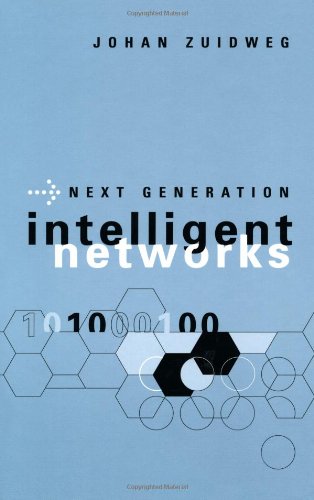
Next Generation Intelligent Networks 1st Edition by Johan Zuidweg ISBN 1580532632 978-1580532631


Original price was: $50.00.$35.00Current price is: $35.00.
Next Generation Intelligent Networks 1st Edition by Johan Zuidweg – Ebook PDF Instant Download/Delivery:1580532632, 978-1580532631
Full download Next Generation Intelligent Networks 1st Edition after payment
Product details:
ISBN 10: 1580532632
ISBN 13: 978-1580532631
Author: Johan Zuidweg
This volume sets out to provide professionals with a comprehensive survey of current and emerging intelligent telecommunications networks, including underlying software, implementation, deployment and standards. It assesses the influence of mobile networks and IP technology on the directions that IN is taking now, and discusses the role of IN in tomorrow’s network. It also focuses on emerging software architectures for programming and deploying value-added services, and proposes a vision of value-added services in the network of the future. It presents cutting-edge technologies that help practitioners to effectively handle the new challenges brought on by the rapid growth of cellular mobile networks and the internet.
Table of contents:
1 Introduction
1.1 The telephone network
1.1.1 The telephone exchange
1.1.2 Electronic and digital exchanges
1.1.3 Signaling
1.1.4 Intelligence in the network
1.2 Computer communications
1.2.1 Computer networks
1.2.2 Internetworking
1.2.3 Internet versus telephony
1.3 Mobile networks
1.3.1 Cellular networks
1.3.2 Issues in mobile networking
1.3.3 Integrating mobile telephony and data
1.4 Text purpose and overview
1.5 Possible reading tracks
2 Intelligent networks
2.1 SS7
2.2 IN standards
2.2.1 Standardization bodies
2.2.2 Standardization cycles
3
2.2.3 IN conceptual model
2.3 Service plane
2.4 Global functional plane
2.4.1 SIBs
2.4.2 Basic call process
2.5 Distributed functional plane
2.5.1 Functional entities
2.5.2 Half call
2.5.3 Detection points
2.5.4 Trigger processing
2.6 Physical plane
2.6.1 Physical entities
2.6.2 IN application protocol
2.7 CS-2
2.7.1 CS-2 service plane
2.7.2 CS-2 global functional plane
2.7.3 CS-2 distributed functional plane
2.7.4 Implementing CS-2
2.8 CS-3 and CS-4
2.8.1 CS-3 features
2.8.2 ETSI improvements in CS-2 and CS-3
2.8.3 New additions in CS-4
2.8.4 Beyond CS-4
2.9 Implementing IN
2.9.1
Alcatel IN
2.9.2 Multivendor IN products
3 IN and the Internet
3.1 IP, the Internet, and the Web: Defining terms
3.1.1 IP
3.1.2 Routers and gateways
3.1.3 Creation of IP standards
3.1.4 Connecting to the Internet
3.2 Intelligence on the Internet
3.2.1 Voice, video, and multimedia over the Internet
3.2.2
H.323
3.2.3 H.323 and IN
3.2.4
SIP
3.2.5 SIP clients and servers
3.2.6 H.323 versus SIP
3.2.7 Media Gateway Control Protocol
3.2.8 Soft switching
3.3 Interaction between the Internet and IN
3.3.1 PINT
3.3.2 SPIRITS
3.3.3 Web-IN
3.4 Managing services via the Internet
3.4.1 Service management and configuration over the Internet
3.4.2 Unified messaging
4 The mobile dimension
4.1 Cellular networks
4.2 GSM
4.2.1 GSM architecture
4.2.2 Mobility management and handover
4.2.3 Security
4.2.4 GSM connection services
4.3 GPRS
4.3.1 GPRS radio interface
4.3.2 GPRS architecture
4.3.3 Mobility management in GPRS
4.3.4 GPRS connection model
4.4 CAMEL
4.4.1 CAMEL architecture
4.4.2 Setting triggers in the visited network
4.4.3 CAMEL service example: Prepaid subscription with roaming
4.4.4 CAMEL standardization
4.4.5 CAMEL phase 3
4.5 Internet in the mobile environment
4.5.1 WAP
4.5.2 iMode
4.5.3 MEXE
4.5.4 SIM Application Toolkit
4.6 Mobile-specific services
4.6.1
SMS
4.6.2 Location services
4.6.3 Mobile payment services
4.7 3G mobile networks
4.7.1
3GPP
4.7.2
UMTS
4.7.3
VHE
4.7.4 Open service access
References
5 Distributing intelligence
5.1 Parlay
5.1.1 Parlay concept
5.1.2 Parlay business model
5.1.3 From Parlay to OSA
5.2
OSA
5.2.1 OSA interfaces
5.2.2 General interface structure
5.2.3 OSA call-control interface
5.3 Using OSA
5.3.1 Authentication
5.3.2 Service selection and service agreement
5.3.3 Application-initiated call setup
5.4 Implementing OSA
5.4.1 Languages and middleware
5.4.2 OSA configurations
5.4.3 Mapping from OSA to CAMEL
5.4.4 OSA products
5.5 OSA applications
References
6 Telecommunications middleware
6.1 Telecommunications information-networking architecture
6.1.1 TINA-C
6.1.2 TINA business model
6.1.3 From business model to architecture
6.1.4
Session model
6.2 TINA service architecture
6.2.1 Computational objects
6.2.2 Access session
6.2.3 Service session
6.3 TINA network-resource architecture
6.3.1 Computational objects
6.3.2 Connection establishment
6.3.3 Federation
6.4 The future of TINA
6.4.1 Auxiliary projects
6.4.2 The decline
6.4.3 The future
6.5 OMG
6.5.1 CORBA
6.5.2 IDL
6.6 TDTF
6.6.1 Control and management of audio and video streams
6.6.2 TCAP-CORBA gateway
6.6.3 Telecommunications service access and subscription
6.6.4 Open-service marketplace
6.6.5 Wireless access and mobility
6.6.6 UML for telecommunications
7 Service creation
7.1 From SIBs to objects
7.1.1 Linear service logic
7.1.2 Limitations of the IN model
7.1.3 Object-oriented programming
7.1.4 Object-oriented service logic
7.2 Java in telecommunications
7.2.1 Java beans
7.2.2 EJBs
7.2.3 EJB tool environments
7.3 JAIN
7.3.1 JAIN architecture
7.3.2 JAIN protocol APIs
7.3.3 JAIN call control
7.3.4 JAIN example: Call forwarding
7.3.5 JAIN applications
7.3.6 Specification, products, and conformance
7.3.7 JAIN and Parlay
7.4 CPL
7.4.1 CPL structure
7.4.2 Example CPL script
7.4.3 Deploying CPL
7.4.4 IN and CPL
7.5 Feature interactions
7.5.1 Solving feature interactions
7.5.2 Detection
7.5.3 Heuristic methods
7.5.4 Resolution
7.5.5 Complexity of the feature-interaction problem
References
8 Evolution scenarios
8.1 Next generation networks
8.2 Convergence or divergence?
8.2.1 Changes in standardization
8.2.2 A new role for standardization
8.3 IN evolution
8.4 If it ain’t broke, why fix it?
People also search for:
next generation intelligent networks
international conference on intelligent computing and next generation networks
next generation technologies list
next generation internet
next generation intelligent network