
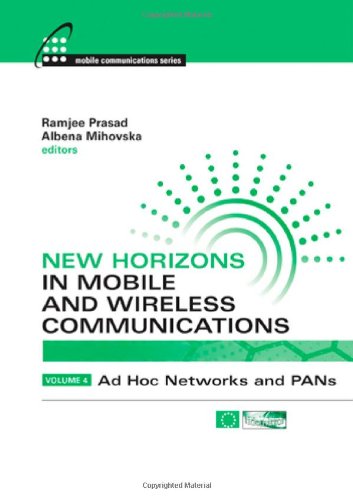
New Horizons in Mobile and Wireless Communications Vol 4 Mobile Communications 1st Edition by Ramjee Prasad ISBN 978-1607839736 1607839736


Original price was: $50.00.$35.00Current price is: $35.00.
New Horizons in Mobile and Wireless Communications Vol 4 Mobile Communications 1st Edition by Ramjee Prasad- Ebook PDF Instant Download/Delivery: 978-1607839736, 1607839736
Full download New Horizons in Mobile and Wireless Communications Vol 4 Mobile Communications 1st Edition after payment
Product details:
ISBN 10: 1607839736
ISBN 13: 978-1607839736
Author: Ramjee Prasad
Based on cutting-edge research projects in the field, this comprehensive 4-volume book series provides the latest details and covers the most impactful aspects of mobile, wireless, and broadband communications development. These books present key systems and enabling technologies in a clear and accessible manner, offering you a detailed roadmap the future evolution of next generation communications. Drawing upon the insights of leading experts in the field, each of the four volumes is dedicated to an area of critical importance, including Radio Interfaces; Networks, Services and Applications; Reconfigurability; and Ad Hoc Networks.
Table of contents:
CHAPTER 1
Introduction
1.1 Wireless Ad Hoc Networks
1.1.1 Mobile Ad Hoc Networks (MANETS)
1.1.2 Wireless Sensor Networks (WSNs)
1.2 Wireless Mesh Networks
1.2.1 Wireless Mesh Backhaul Design
1.2.2 Multihop Concepts in Next Generation Wide Area Systems
1.2.3 Classification for Ad Hoc Networks
1.3 Pervasive Communications and Systems
1.4 Preview of the Book
References
CHAPTER 2
Protocols and Algorithms for Ad Hoc Networks
2.1 Introduction
2.2 Routing
2.2.1 Models and Algorithms for Routing and Forwarding in MANETS
2.2.2 Multicast Routing Protocols
2.2.3 Routing/Forwarding in Infrastructure-Based Multihop Networks
2.3 Protocols and Algorithms for Self-Organizing and Opportunistic Networks
2.3.1 Protocols and Algorithms for Sensor Networks
2.3.2 Self-Organisation and Topology Control
2.4 Conclusions
References
CHAPTER 3
Technologies for Capacity Enhancement
3.1 Introduction
3.1.1 Channel Network Capacity
3.1.2 Diversity
3.1.3 Scheduling, Resource Allocation, and Power Control
3.1.4 Cross-Layer Techniques
3.2 Enhancing the Performance of Relay Systems
3.2.1 Distributed Coding Strategies
3.2.2 Coded Bidirectional Relaying
3.2.3 Cooperative Cyclic Diversity
3.2.4 Fixed Relay Assisted User Cooperation
3.2.5 Joint Routing and Resource Partionining
3.3 Performance Enhancements for Wireless Mesh Networks
3.3.1 Scheduling Algorithms for Wireless Backhaul Networks
3.3.2 Cross-Layer Framework for Wireless Mesh Networks
3.4 Capacity Enhacements in WPANS
3.4.1 Parent-Child Communication Model and Its Limitations
3.4.2 Parent-Child Scheduling Solution
3.4.3 Capacity Analysis
3.5 Conclusions References
CHAPTER 4
Context Aware and Secure Personalized Communications
4.1 Introduction
4.1.1 Personalisation and Individualisation of Devices and Services
4.1.2 Requirements for Ad Hoc Network and Service Architectures
4.2 Context-Aware Service Discovery
4.2.1 Context-Awareness for PNs
4.2.2 Distributed Service Discovery for WSNs
4.3 Data Aggregation and Fusion
4.3.1 Resource Management Through Network Traffic Management
4.3.2 Distributed Data Aggregation
4.4 Adaptive Security Framework
4.4.1 Requirements for Security, Privacy, and Trust
4.4.2 Analysis and Evaluation
4.5 Conclusions References
CHAPTER 5
Network and Enabling Architectures
5.1 Introduction
5.1.1 Seamless Integration of Broadcast
5.1.2 Mobility Support
5.1.3 QoS Support
5.1.4 Security, Privacy, and Trust
5.1.5 Device Architectures
5.2 Networking and Enabling Architectures for Personal Networks
5.2.1 PN Networking Functionalities
5.2.2 PN Link Layer Functionality
5.2.3 PN Service Layer Functionality
5.2.4 PN Context Management Functionality
5.2.5 Networking Aspects of the PN-F
5.2.6 PN Interactions with External Service Frameworks
5.3 Architectures for WSN
5.3.1 Hybrid Hierarchical Architecture
5.3.2 Design of Middleware
5.4 Protocol Architecture for Opportunistic Networks
5.5 Device Architecture for Enhanced User Experience
5.6 Testbed Architectures
5.6.1 Body Sensor Networks
5.6.2 Integration of Remote WSN Testbeds
5.7 Conclusions
References
CHAPTER 6
Feasibility Studies for Novel Network Concepts
6.1 Introduction
6.1.1 Business Feasibility Analysis
6.1.2 Feasibility Conditions Specific for Ambient Networks
6.2 Cost Analysis for Relay Deployment
6.2.1 Relating the Uplink to the Downlink in the Cost Methodology
6.2.2 Simulations in Real Dense-Urban Scenarios
6.3 Business Models for WSN Technologies and Applications
6.3.1 The Value Network
6.3.2 WSNs and the User
6.4 Feasability of WPANs
6.4.1 Use Case: Service Portfolio of a Journalist
6.5 Conclusions
References
CHAPTER 7
Conclusion and Future Vision
People also search for:
new horizons in mobile and wireless
new horizons mobile.com
new horizons mobile home park
new horizons mobile crisis
a new horizon inc