
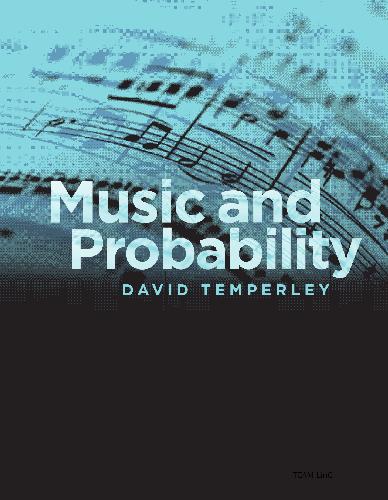
Music and Probability 1st edition by David Temperley ISBN 0262515199 978-0262515191
Original price was: $50.00.$35.00Current price is: $35.00.
Music and Probability 1st EDition by David Temperley – Ebook PDF Instant Download/Delivery: 0262515199, 978-0262515191
Full download Music and Probability 1st edition after payment
Product details:
ISBN 10: 0262515199
ISBN 13: 978-0262515191
Author: David Temperley
Exploring the application of Bayesian probabilistic modeling techniques to musical issues, including the perception of key and meter.
In Music and Probability, David Temperley explores issues in music perception and cognition from a probabilistic perspective. The application of probabilistic ideas to music has been pursued only sporadically over the past four decades, but the time is ripe, Temperley argues, for a reconsideration of how probabilities shape music perception and even music itself. Recent advances in the application of probability theory to other domains of cognitive modeling, coupled with new evidence and theoretical insights about the working of the musical mind, have laid the groundwork for more fruitful investigations. Temperley proposes computational models for two basic cognitive processes, the perception of key and the perception of meter, using techniques of Bayesian probabilistic modeling. Drawing on his own research and surveying recent work by others, Temperley explores a range of further issues in music and probability, including transcription, phrase perception, pattern perception, harmony, improvisation, and musical styles.
Music and Probability—the first full-length book to explore the application of probabilistic techniques to musical issues—includes a concise survey of probability theory, with simple examples and a discussion of its application in other domains. Temperley relies most heavily on a Bayesian approach, which not only allows him to model the perception of meter and tonality but also sheds light on such perceptual processes as error detection, expectation, and pitch identification. Bayesian techniques also provide insights into such subtle and advanced issues as musical ambiguity, tension, and “grammaticality,” and lead to interesting and novel predictions about compositional practice and differences between musical styles.
Table of contents:
1 Introduction
2 Probabilistic Foundations and Background
Elementary Probability
Conditional Probability and Bayes’ Rule
Other Probabilistic Concepts
Early Work on Music and Probability
3 Melody I: The Rhythm Model
Rhythm and Meter
Previous Models of Meter Perception
A Probabilistic Rhythm Model
The Generative Process
The Meter-Finding Process
Testing the Model on Meter-Finding
Problems and Possible Improvements
4 Melody II: The Pitch Model
Previous Models of Key-Finding
The Pitch Model
Testing the Model on Key-Finding
5 Further Issues
Error Detection
Further Issues
6 A Polyphonic Key-Finding Model
A Pitch-Class-Set Approach to Key-Finding
The Generative Process
The Key-Finding Process
Comparing Distributional Models of Key-Finding
Further Issues in Key-Finding
7 Applications of the Polyphonic Key-Finding Model
Key Relations
Tonalness
Tonal Ambiguity and Clarity
Another Look at Major and Minor
Ambiguous Pitch-Collections in Common-Practice Music
Explaining Common Strategies of Tonal Harmony
8 Bayesian Models of Other Aspects of Music
Probabilistic Transcription Models
Bod: The Perception of Phrase Structure
Raphael and Stoddard: Harmonic Analysis
Mavromatis: Modeling Greek Chant Improvisation
Saffran et al.: Statistical Learning of Melodic Patterns
9 Style and Composition
Some Simple Cross-Entropy Experiments
Modeling Stylistic Differences
Testing Schenkerian Theory
10 Communicative Pressure
Communicative Pressure in Rules of Voice-Leading
The Syncopation-Rubato Trade-Off
Other Examples of Communicative Pressure in Rhythm
“Trading Relationships”
Low-Probability Events in Constrained Contexts
People also search for:
david williams probability
dave benson music a mathematical offering
david b music
david b musique
david c music
Tags:
David Temperley,Music and Probability