
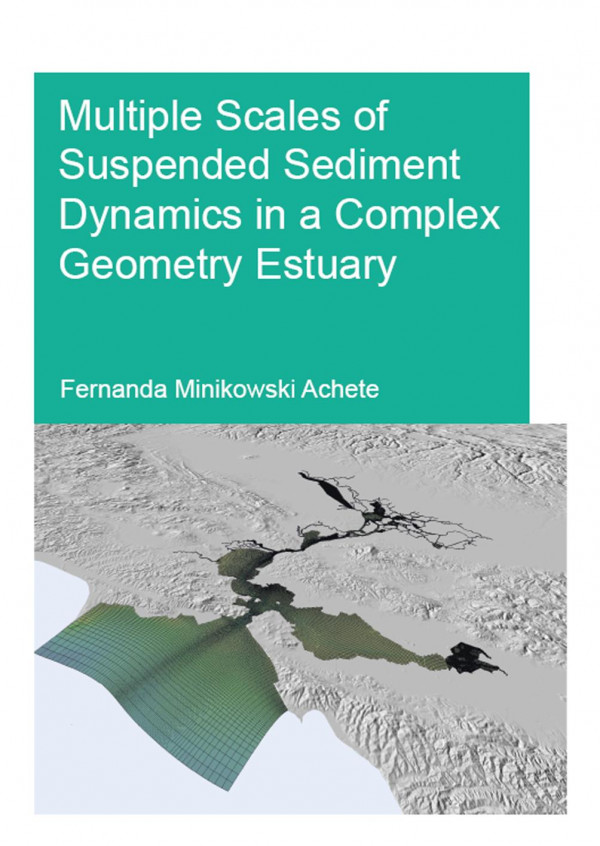
Multiple Scales of Suspended Sediment Dynamics in a Complex Geometry Estuary 1st Edition by Fernanda Minikowski Achete ISBN 978-1138029767 1138029769


Original price was: $50.00.$35.00Current price is: $35.00.
Multiple Scales of Suspended Sediment Dynamics in a Complex Geometry Estuary 1st Edition by Fernanda Minikowski Achete – Ebook PDF Instant Download/Delivery: 978-1138029767, 1138029769
Full download Multiple Scales of Suspended Sediment Dynamics in a Complex Geometry Estuary 1st Edition after payment
Product details:
ISBN 10: 1138029769
ISBN 13: 978-1138029767
Author: Fernanda Minikowski Achete
Many estuaries are located in urbanized, highly engineered environments. Cohesive sediment plays an important role due to its link with estuarine health and ecology. An important ecological parameter is the suspended sediment concentration (SSC) translated into turbidity levels and sediment budget.
This study contributes to investigate and forecast turbidity levels and sediment budget variability at San Francisco Bay-Delta system at a variety of spatial and temporal scales applying a flexible mesh process-based model (Delft3D FM). It is possible to have a robust sediment model, which reproduces 90% of the yearly data derived sediment budget, with simple model settings, like applying one mud fraction and a simple bottom sediment distribution. This finding opens the horizon for modeling less monitored estuaries.
Comparing two case studies, i.e. the Sacramento-San Joaquin Delta and Alviso Slough, a classification for estuaries regarding the main sediment dynamic forcing is proposed: event-driven estuary (Delta) and tide-driven estuary (Alviso Slough). In the event-driven estuaries, the rivers are the main sediment source and the tides have minor impact in the net sediment transport. In the tide-driven estuaries, the main sediment source is the bottom sediment and the tide asymmetry defines the net sediment transport.
This research also makes advances in connecting different scientific fields and developing a managerial tool to support decision making. It provides the basis to a chain of models, which goes from the hydrodynamics, to suspended sediment, to phytoplankton, to fish, clams and marshes.
Table of contents:
1 General introduction
1.1 Background
1.1.1 Hydrodynamics
1.1.2 Sediment dynamics
1.1.3 Sediment and ecology
1.1.4 Spatial‐temporal scale
1.1.5 Modeling framework
1.2 Motivation: the CASCaDE II project and BDCP
1.2.1 CASCaDE II project
1.2.2 BDCP
1.3 Research objectives
1.4 Outline of the thesis
2 A 2D Process-Based Model for Suspended Sediment Dynamics: a first Step towards Ecological Modeling
2.1 Introduction
2.2 Study area and model
2.2.1 Model description
2.2.2 Initial and boundary conditions
2.3 Results
2.3.1 Calibration
2.3.2 Suspended Sediment Dynamics (water year 2011)
2.3.3 Sensitivity analysis
2.4 Discussion
2.4.1 Spatial sediment distribution
2.4.2 Sediment budget
2.4.3 Sediment flux analysis
2.4.4 Sediment deposition pattern
2.4.5 Turbidity
2.4.6 Data input discussion
2.5 Conclusions
Appendix 2‐A: Hydrodynamic Calibration
Appendix 2-B: SSC Calibration
3 Suspended Sediment Dynamics in a tidal channel network under Peak River Flow
3.1 Introduction
3.2 Study Area
3.3 Methodology
3.3.1 Model description
3.3.2 Initial and boundary conditions
3.3.3 Calculation of sediment discharge and bed level change
3.3.4 Model calibration and dynamics
3.4 Results
3.4.1 Mass storage between Sacramento River stations
3.4.2 Hydrodynamics
3.4.3 Suspended sediment discharge
3.5 Discussion
3.5.1 Hydrodynamics
3.5.2 Suspended sediment discharge
3.5.3 Deposition pattern
3.5.4 Tidal influence
3.5.5 Simulating the second discharge peak
3.5.6 Recommendations
3.6 Conclusions
4 Impact of a sudden tidal prism increase in estuarine sediment flux: implications to remobilization of Hg-contaminated sediment
4.1 Introduction
4.2 Study area
4.2.1 Model description
4.2.2 Initial and boundary conditions
4.3 Results and discussion
4.3.1 Hydrodynamic model
4.3.2 Sediment Calibration
4.3.3 Sediment dynamics
4.3.4 Tidal prism step increase
4.3.5 High river discharge events implications
4.3.6 Sensitivity in sediment flux
4.3.7 Morphological updating
4.3.8 Tracking mercury‐contaminated sediment
4.4 Conclusions
5 How important are climate change and foreseen engineering measures on the sediment dynamics in the San Francisco Bay-Delta system?
5.1 Introduction
5.2 Study Area
5.2.1 Bay history
5.3 Methodology
5.3.1 Model description
5.3.2 Scenarios
5.4 Results
5.4.1 Base‐Case scenario (BCS)
5.4.2 Scenarios comparison
5.4.3 Pumping Scenario ‐ SacraP
5.4.4 Flooded Island Scenario ‐ F‐isl
5.4.5 Sea Level Rise scenario at 2100 ‐ SLRS
5.4.6 Sea Level Rise scenario at 2100 and decrease of SSC‐ SLRS, 38%SSC
5.4.7 Sea Level Rise scenario at 2100 and Pumping at Sacramento River ‐ SLR+SacraP
5.4.8 Sea Level Rise scenario at 2100, Pumping at Sacramento River and Flooded Island ‐SLRS+SacraP+Fisl
5.5 Discussion
5.5.1 Process‐based model approach
5.5.2 Scenarios sediment budget uncertainties
5.5.3 Internal Impacts ‐ Pumping Scenario
5.5.4 External Impacts ‐ SLR and SLR with decrease of SSC input
5.5.5 Non predictable Impacts ‐ Levee Failure
5.5.6 Yearly variability
5.5.7 Ecological Impact
Recommendations
5.6 Conclusions
6 Conclusions
6.1 General
6.2 Recommendations for future research
7 References
People also search for:
multiple scales of suspended sediment
suspended sediments
sediment scale definition
scale sediment
how to measure suspended sediment in water
Tags: Fernanda Minikowski Achete, Multiple Scales, Sediment Dynamics, Complex Geometry