
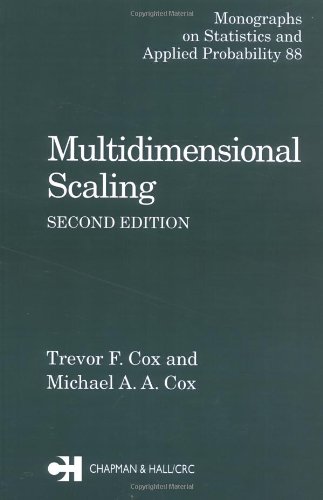
Multidimensional scaling 2nd Edition by Trevor Cox, Cox ISBN 978-1584880943 1584880945


Original price was: $50.00.$35.00Current price is: $35.00.
Multidimensional scaling 2nd Edition by Trevor F. Cox, M.A.A. Cox – Ebook PDF Instant Download/Delivery: 978-1584880943, 1584880945
Full download Multidimensional scaling 2nd Edition after payment
Product details:
ISBN 10: 1584880945
ISBN 13: 978-1584880943
Author: Trevor F. Cox, M.A.A. Cox
Multidimensional scaling covers a variety of statistical techniques in the area of multivariate data analysis. Geared toward dimensional reduction and graphical representation of data, it arose within the field of the behavioral sciences, but now holds techniques widely used in many disciplines. Multidimensional Scaling, Second Edition extends the popular first edition and brings it up to date. It concisely but comprehensively covers the area, summarizing the mathematical ideas behind the various techniques and illustrating the techniques with real-life examples. A computer disk containing programs and data sets accompanies the book.
Table of contents:
1 Introduction
1.1 Introduction
1.2 A look at data and models
1.2.1 Types of data
1.2.2 Multidimensional scaling models
1.3 Proximities
1.3.1 for mixed data Similarity/dissimilarity coefficients
1.3.2 Distribution of proximity coefficients
1.3.3 Similarity of species populations
1.3.4 Transforming from similarities to dissimilarities
1.3.5 The metric nature of dissimilarities
1.3.6 Dissimilarity of variables
1.3.7 Similarity measures on fuzzy sets
1.4 Matrix results
1.4.1 The spectral decomposition
1.4.2 The singular value decomposition
1.4.3 The Moore-Penrose inverse
2 Metric multidimensional scaling
2.1 Introduction
2.2 Classical scaling
2.2.1 Recovery of coordinates
Dissimilarities as Euclidean distances
2.2.3 Classical scaling in practice
2.2.4 How many dimensions?
2.2.5 A practical algorithm for classical scaling
2.2.6 A grave example
2.2.7 Classical scaling and principal components
2.2.8 The additive constant problem
2.3 Robustness
2.4 Metric least squares scaling
2.5 Critchley’s intermediate method
2.6 Unidimensional scaling
2.6.1 A classic example
2.7 Grouped dissimilarities
2.8 Inverse scaling
3 Nonmetric multidimensional scaling
3.1 Introduction
3.1.1 RP space and the Minkowski metric
3.2 Kruskal’s approach
3.2.1 Minimising S with respect to the dispariti
3.2.2 A configuration with minimum stress
3.2.3 Kruskal’s iterative technique
3.2.4 Nonmetric scaling of breakfast cereals
3.2.5 STRESS1/2, monotonicity, ties and missing data
3.3 The Guttman approach
3.4 A further look at stress
3.4.1 Interpretation of stress
3.5 How many dimensions?
3.6 Starting configurations
3.7 Interesting axes in the configuration
4 Further aspects of multidimensional scaling
4.1 Other formulations of MDS
4.2 MDS Diagnostics
4.3 Robust MDS
4.4 Interactive MDS
4.5 Dynamic MDS
4.6 Constrained MDS
4.6.1 Spherical MDS
4.7 Statistical inference for MDS
4.8 Asymmetric dissimilarities
5 Procrustes analysis
5.1 Introduction
5.2 Procrustes analysis
5.2.1 Procrustes analysis in practice
5.2.2 The projection case
5.3 Historic maps
5.4 Some generalizations
5.4.1 Weighted Procrustes rotation
5.4.2 Generalized Procrustes analysis
5.4.3 The coefficient of congruence
5.4.4 Oblique Procrustes problem
5.4.5 Perturbation analysis
6 Monkeys, whisky and other applications
6.1 Introduction
6.2 Monkeys
6.3 Whisky
6.4 Aeroplanes
6.5 Yogurt
6.6 Bees
7 Biplot
7.1 Introduction
7.2 The classic biplot
7.2.1 An example
7.2.2 Principal component biplots
7.3 Another approach
7.4 Categorical variables
8 Unfolding
8.1 Introduction
8.2 Nonmetric unidimensional unfolding
8.3 Nonmetric multidimensional unfolding
8.4 Metric multidimensional unfolding
8.4.1 The rating of nations
9 Correspondence analysis
9.1 Introduction
9.2 Analysis of two-way contingency tables
9.2.1 Distance between rows (columns) in a contingency table
9.3 The theory of correspondence analysis
9.3.1 The cancer example
9.3.2 Inertia
9.4 Reciprocal averaging
9.4.1 Algorithm for solution
9.4.2 Two-way weighted dissimilarity coefficients
9.4.3 An example: the Münsingen data
9.4.4 The whisky data
9.4.5 The correspondence analysis connection
9.5 Multiple correspondence analysis
9.5.1 A three-way example
10 Individual differences models
10.1 Introduction
10.2 The Tucker-Messick model
10.3 INDSCAL
10.3.1 The algorithm for solution
10.3.2 Identifying groundwater populations
10.3.3 Extended INDSCAL models
10.4 IDIOSCAL
10.5 PINDIS
11 ALSCAL, SMACOF and Gifi
11.1 ALSCAL
11.1.1 The theory
11.1.2 Minimising SSTRESS
11.2 SMACOF
11.2.1 The majorization algorithm
11.2.2 The majorizing method for
nonmetric MDS
11.2.3 Tunnelling for a global minimum
11.3 Gifi
11.3.1 Homogeneity
12 Further m-mode, n-way models
12.1 CANDECOMP, PARAFAC and CANDELINC
12.2 DEDICOM and GIPSCAL
12.3 The Tucker models
12.3.1 Relationship to other models
12.4 One-mode, n-way models
12.5 Two-mode, three-way asymmetric scaling
12.6 Three-way unfolding
People also search for:
multidimensional scaling
non metric multidimensional scaling
non metric multidimensional scaling nmds
classical multidimensional scaling
metric multidimensional scaling
Tags: Trevor Cox, Cox, Multidimensional scaling