
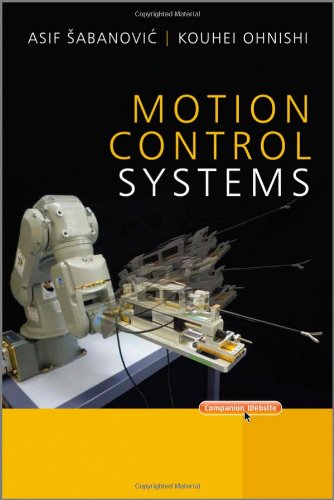
Motion Control Systems 1st Edition by Asif Šabanović, Kouhei Ohnishi ISBN 978-0470825730 0470825730

Original price was: $50.00.$35.00Current price is: $35.00.
Motion Control Systems 1st Edition by Asif Šabanović, Kouhei Ohnishi – Ebook PDF Instant Download/Delivery: 978-0470825730, 0470825730
Full download Motion Control Systems 1st Edition after payment
Product details:
ISBN 10: 0470825730
ISBN 13: 978-0470825730
Author: Asif Šabanović, Kouhei Ohnishi
Motion Control Systems is concerned with design methods that support the never-ending requirements for faster and more accurate control of mechanical motion. The book presents material that is fundamental, yet at the same time discusses the solution of complex problems in motion control systems. Methods presented in the book are based on the authors’ original research results. Mathematical complexities are kept to a required minimum so that practicing engineers as well as students with a limited background in control may use the book. It is unique in presenting know-how accumulated through work on very diverse problems into a comprehensive unified approach suitable for application in high demanding, high-tech products. Major issues covered include motion control ranging from simple trajectory tracking and force control, to topics related to haptics, bilateral control with and without delay in measurement and control channels, as well as control of nonredundant and redundant multibody systems.
Provides a consistent unified theoretical framework for motion control design
Offers graduated increase in complexity and reinforcement throughout the book
Gives detailed explanation of underlying similarities and specifics in motion control
Unified treatment of single degree-of-freedom and multibody systems
Explains the fundamentals through implementation examples
Based on classroom-tested materials and the authors’ original research work
Written by the leading researchers in sliding mode control (SMC) and disturbance observer (DOB)
Accompanying lecture notes for instructors
Simulink and MATLAB® codes available for readers to download
Motion Control Systemsis an ideal textbook for a course on motion control or as a reference for post-graduates and researchers in robotics and mechatronics. Researchers and practicing engineers will also find the techniques helpful in designing mechanical motion systems.
Table of contents:
PART ONE-BASICS OF DYNAMICS AND CONTROL
1 Dynamics of Electromechanical Systems
1.1 Basic Quantities
1.1.1 Elements and Basic Quantities in Mechanical Systems
1.1.2 Elements and Basic Quantities in Electric Systems
1.2 Fundamental Concepts of Mechanical Systems
1.2.1 The Principle of Least Action
1.2.2 Dynamics
1.2.3 Nonpotential and Dissipative Forces
1.2.4 Equations of Motion
1.2.5 Properties of Equations of Motion
1.2.6 Operational Space Dynamics
1.3 Electric and Electromechanical Systems
1.3.1 Electrical Systems
1.3.2 Electromechanical Systems
1.3.3 Electrical Machines
References
Further Reading
2 Control System Design
2.1 Basic Concepts
2.1.1 Basic Forms in Control Systems
2.1.2 Basic Relations
2.1.3 Stability
2.1.4 Sensitivity Function
2.1.5 External Inputs
2.2 State Space Representation
2.2.1 State Feedback
2.2.2 Stability
2.2.3 Observers
2.2.4 Systems with Observers
2.2.5 Disturbance Estimation
2.3 Dynamic Systems with Finite Time Convergence
2.3.1 Equivalent Control and Equations of Motion
2.3.2 Existence and Stability
2.3.3 Design
2.3.4 Control in Linear Systems
2.3.5 Sliding Mode Based Observers
References
Further Reading
PART TWO – ISSUES IN MOTION CONTROL
3 Acceleration Control
3.1 Plant
3.2 Acceleration Control
3.2.1 Formulation of Control Tasks
3.2.2 Equivalent Acceleration and Equivalent Force
3.3 Enforcing Convergence and Stability
3.3.1 Convergence for Bounded Control Input
3.3.2 Systems with Finite-Time Convergence
3.3.3 Equations of Motion
3.3.4 General Structure of Acceleration Control
3.4 Trajectory Tracking
References
Further Reading
4 Disturbance Observers
4.1 Disturbance Model Based Observers
4.1.1 Velocity Based Disturbance Observer
4.1.2 Position Based Disturbance Observer
4.2 Closed Loop Disturbance Observers
4.2.1 Internal and External Forces Observers
4.3 Observer for Plant with Actuator
4.3.1 Plant with Neglected Dynamics of Current Control Loop
4.3.2 Plant with Dynamics in Current Control Loop
4.4 Estimation of Equivalent Force and Equivalent Acceleration
4.5 Functional Observers
4.6 Dynamics of Plant with Disturbance Observer
4.6.1 Disturbance Estimation Error
4.6.2 Dynamics of Plant With Disturbance Observer
4.7 Properties of Measurement Noise Rejection
4.8 Control of Compensated Plant
4.8.1 Application of Estimated and q
References
Further Reading
5 Interactions and Constraints
5.1 Interaction Force Control
5.1.1 Proportional Controller and Velocity Feedback
5.1.2 Environment with Losses
5.1.3 Lossless Environment
5.1.4 Control of Push Pull Force
5.2 Constrained Motion Control
5.2.1 Modification of Reference
5.2.2 Modification by Acting on Equivalent Acceleration
5.2.3 Motion Modification while Keeping Desired Force Profile
5.2.4 Impedance Control
5.2.5 Force Driven Systems
5.2.6 Position and Force Control in Acceleration Dimension
5.3 Interactions in Functionally Related Systems
5.3.1 Grasp Force Control
5.3.2 Functionally Related Systems
References
Further Reading
6 Bilateral Control Systems
6.1 Bilateral Control without Scaling
6.1.1 Bilateral Control Design
6.1.2 Control in Systems with Scaling in Position and Force
6.2 Bilateral Control Systems in Acceleration Dimension
6.3 Bilateral Systems with Communication Delay
6.3.1 Delay in Measurement Channel
6.3.2 Delay in Measurement and Control Channels
6.3.3 Closed Loop Behavior of System with Observer
6.3.4 Bilateral Control in Systems with Communication Delay
References
Further Reading
PART THREE – MULTIBODY SYSTEMS
7 Configuration Space Control
7.1 Independent Joint Control
7.2 Vector Control in Configuration Space
7.2.1 Selection of Desired Acceleration
7.3 Constraints in Configuration Space
7.3.1 Enforcement of Constraints by Part of Configuration Variables
7.4 Hard Constraints in Configuration Space
References
Further Reading
8 Operational Space Dynamics and Control
8.1 Operational Space Dynamics
8.1.1 Dynamics of Nonredundant Tasks
8.1.2 Dynamics of Redundant Tasks
8.2 Operational Space Control
8.2.1 Nonredundant Task Control
8.2.2 Redundant Task Control
References
Further Reading
9 Interactions in Operational Space
9.1 Task-Constraint Relationship
9.2 Force Control
9.3 Impedance Control
9.4 Hierarchy of Tasks
9.4.1 Constraints in Operational Space
9.4.2 Enforcing the Hierarchy of Tasks
9.4.3 Selection of Configuration Space Desired Acceleration
References
Further Reading
People also search for:
step by step design of motion control systems
types of motion control systems
digital motion control systems arrived with
flir motion control systems
robot motion control systems
Tags: Asif Šabanović, Kouhei Ohnishi, Motion Control Systems